Having read about vapor barriers when insulating, for example, an attic, I understand why it should be there but not exactly how "moisture works."
You don’t have a completely closed vapor barrier, so what happens, for example, at the transition to the floor or wall where the foil ends?
If you plan to renovate an old house and intend to put foil on the ceiling, inside the insulation towards the cold attic but not in the walls... Is it then okay to just stop with the plastic foil where the exterior walls begin?
I assume that the moisture in the air only becomes a problem when the air travels through the wall/ceiling and condenses due to lower temperatures, so by putting foil on the ceiling and not the walls, you at least prevent some of the air from condensing... or??? Have I understood correctly??
If you cannot wrap a house completely airtight, it is better not to wrap it at all. If you only wrap the ceiling, you will move the moisture problems to the walls instead, causing bigger problems there.
Is that really an established truth, Matti? If the plastic in the ceiling is the only change you make in the house, then it's reasonable that the same amount of moisture exits the house. However, if you simultaneously review your ventilation with intake and exhaust in bathrooms, etc. (i.e., improve the natural draft system), then it's reasonable that overall, you improve the moisture situation in the house and, additionally, with plastic in the ceiling, give the attic some breathing space. That's where the problems are the greatest.
Is that really an accepted truth, Matti? If plastic in the ceiling is the only change you make in the house, it's reasonable that the total amount of moisture leaving the house remains the same, but if you simultaneously improve your ventilation with inflow and outflow in the bathroom, etc. (i.e., improve the natural draft system), it's reasonable to say that you overall improve the moisture situation in the house, and with plastic in the ceiling, give the attic some breathing room. That's where the problems are biggest anyway.
Yes, the problem is biggest in the attic since there is no plastic there. If you put plastic there, you move the problem from there to the walls. Then, if you read about the air's ability to carry moisture at different temperatures, you'll understand it better. Moisture always seeks to balance between the inside and outside of the construction. In winter, when outdoor air can't carry much moisture, the moisture moves outward, and with plastic in the ceiling, it only has the opportunity to be pushed out into the walls.
Yes, the problem is biggest in the attic as there is no plastic there. If you add plastic, the problem moves to the walls. Then, if you read about the air's ability to carry moisture at different temperatures, you'll understand the whole thing better. Moisture always seeks to balance between the inside and outside of the construction. In winter, when the outdoor air can't carry much moisture, the moisture moves outward, and with plastic in the ceiling, it can only be pushed out into the walls.
That's not true. Possibly if there's overpressure in the house, but hardly even then. The larger the surface that moisture can be transported on, the more moisture can penetrate. As a thought experiment, you can take a bag of water and poke a few holes in it and compare it to poking a lot of holes. It leaks more water the more holes you make. It doesn't leak much more water from the holes that remain if you seal some of them.
If you mean something different, you'll need to explain better.
Yes, the problem is greatest in the attic as there is no plastic there. If you put plastic there, you move the problem from there to the walls.
If you model the problem as there being a certain amount of moisture inside the building that needs to go out through walls and roof, it makes sense to think that there will be more moisture through a smaller cross-section if you block certain parts.
But in reality, we have some ventilation (which should be there at least, otherwise the air will soon become very bad and eventually people in the house will suffocate).
And the proportion of moisture going out through ventilation probably increases if you decrease the amount going through the roof or walls.
If you also enhance ventilation at the same time, it might even result in less moisture load on the walls...
Finally, most tend to have more problems in the attic than in the walls, so it seems like you're generally closer to the point where problems arise in the attic rather than in the walls, so it could mean that the walls can actually handle a little increased moisture load.
However, it's unfortunately difficult to check if it went well in the walls without tearing them apart.
I'm not saying you're wrong, but I just want to point out that perhaps you might be, at least a little bit...
Apart from your theoretical explanations of the moisture issue, which are unremarkable, there is (at least) one more aspect:
The material in the walls and ceiling surface layers.
If the walls, for example, are covered with gypsum boards, mounted according to all the rules, i.e. intact without cutouts and screwed against studs all around, there is not much air leakage through the wall.
Moisture migration through the gypsum board can probably be disregarded. Especially if the gypsum is also covered with fabric and painted in a couple of layers. Or wallpapered with a plastic-coated wallpaper.
And if, for example, the ceiling is covered with paneling, like beadboard for instance, a lot of air can leak out that way through all the gaps and joints.
I find it hard to see that it would be a disadvantage to plastic wrap the ceiling to reduce air leakage that way.
Why would the air flow through the walls increase if you stop the flow through the ceiling?
Surely there is no force pressing a constant amount of air into the house that must exit somewhere?
You can probably ignore the moisture migration through the gypsum board. Especially if the gypsum is also covered with fabric and painted in a few layers. Or wallpapered with a plastic-coated wallpaper.
Well, gypsum board is actually quite highly diffusion-open. I seem to remember that, for example, wood has higher vapor resistance.
Certainly, with some surface treatment, it can become more vapor-tight, but without specifying what, it's hard to generalize like that.
Both convection (airflow) and diffusion address the issue of moisture migration. You seem to focus more on convection. Indeed, convection can in unfortunate cases transport much larger amounts of moisture than diffusion does.
But the thread is about the plastic; to stop convection, you can use other materials, wind barrier fabric, hydration paper, board materials, etc.
Mikael_L has good insight. Perhaps an analogy with electricity can be useful. The driving force (voltage) for diffusion is the partial pressure difference for water vapor between the inside of the wall/ceiling and the outside of the wall/ceiling. The amount of water vapor transported (current) is limited by the diffusion resistance the entire wall provides (resistance).
Since the wall has many layers, these can be seen as series-connected resistors where a certain partial pressure (potential) prevails before and after each layer (resistor). What is crucial for condensation to occur is if this partial pressure (potential) somewhere in the wall exceeds the partial pressure of water vapor that the air can hold at a certain temperature (=> relative humidity = 100%). Since relative humidity cannot exceed 100%, liquid condenses if the potential tends to go over the saturation pressure. This happens with a greater amount per hour the higher the driving potential is.
Therefore, it is not only important how diffusion-tight/open a material is but also where in the wall's cross-section you place the diffusion-open and diffusion-tight materials. In general, diffusion openness should increase from the inside to the outside of the cross-section. That is why the plastic is on the inside and not on the outside. Putting an OSB board on the outside of a diffusion-open stud wall is therefore also a "cardinal sin." Furthermore, these relationships limit how thick internal insulation (installation layer) can/should be used inside a PE film; the temperature must not be too low directly on the inside of the plastic.
Placing plastic on the ceiling only results in increased diffusion of moisture through the walls if the partial pressure on the inside near the wall increases. As Mikael_L has shown, this does not necessarily have to occur; the local relative humidity on the inside can be regulated through manual or controlled ventilation.
Well, gypsum board is actually quite diffusion-open. I seem to recall that, for example, wood has a higher vapor resistance. Sure, with some surface treatment it can become more vapor-tight, but without specifying what, it's hard to generalize like that...
You are of course right, in theory at least
I find it hard to imagine that moisture movement through a gypsum board would cause problems unless what is on the outside of the gypsum is much denser so that the moisture cannot be transported further out.
The problems usually arise where there are air leaks because the surface is not airtight, or through gaps in the vapor barrier or at attic hatches, etc., where warm moist air condenses on cold surfaces.
The vapor resistance of gypsum seems to be 3–20 x 10^3 s/m (applies to exterior gypsum that is 9 mm). But I can't find any figures for wood.
A little quote: "Density tests show that it doesn't matter much which sealing layer is used, i.e., gypsum board, plastic film, or 'wind-tight'. When comparing different materials in the same joint construction, the measurements show that the joints are essentially equally tight regardless of the material used. There are some differences, but these may be due to small variations in workmanship. The windbreaker has the greatest air leakage through the joints. This may be because it is a bit stiffer than the other materials and therefore seals less well at an overlap. The measurements also show that when the sealing layers are joined with overlap and where the overlap is clamped with a sparse panel or glued with a sealing tape, the joint becomes completely tight. A simple gypsum board, joined over a stud, is worse than any of the tested sealing layers, joined with overlap. However, if the joint on the gypsum board is puttied, the tightness is as good as for the other sealing layers. Double gypsum boards with staggered joints provide good tightness. By comparing measurements on the joint constructions with the corresponding details in large elements, it appears that they behave in roughly the same way. It is possible to achieve the same good air tightness with 'wind-tight' and gypsum boards as with plastic film."
But this pertains to air tightness, not moisture tightness.
Not quite sure if I've become wiser... I'm thinking like this:
If we have an isolated room entirely without a vapor barrier with a certain amount of moisture floating around, moisture will form somewhere through the insulation when the temperature drops. The moisture comes from the warm indoor air. So the moisture in the indoor air must be replenished continuously, which comes from ourselves, wet clothes, etc., right?
If you now put foil on the ceiling of the room, you ensure that nothing migrates out from there, which should mean that (without ventilation), the humidity in the room would rise, and more moisture would end up in the walls.
BUT if you make sure to have ventilation that maintains the same humidity in the room all the time, there can hardly be more moisture in the walls. The amount of moisture in the walls should only depend on the amount of moisture in the air in the room.
The alternative is to not have any vapor barrier at all, but then I'll likely get "guaranteed" problems in the attic, right?
"The moisture aspects can be summarized as follows. From a diffusion perspective, it is usually (residential buildings, schools, kindergartens, and offices with functioning ventilation) not important whether plastic foil or other vapor-tight materials are used or not. From a convection point of view, it is essential that the constructions are airtight. This is usually ensured with plastic foil, but other sealing materials are also possible. If the construction is not airtight, you must ensure, as mentioned above, that convection cannot occur, for example by creating a negative pressure inside." http://www.sp.se/sv/index/services/moist/general/Sidor/default.aspx
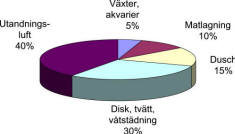
Indoor moisture typically comes from exhaled air, during showers/washing/dishes and drying clothes and other things, during cooking, and moisture brought in with wet clothes. And obviously other similar sources. Errors or damage in the house's construction can also introduce moisture, such as a broken roof, a foundation on waterlogged undrained ground, etc. Finally, moisture can also enter through unfavorable conditions of various kinds: Underpressure in the house can draw in more humid outdoor air during certain periods and times in the summer, and diffusion can also occur under these circumstances. This doesn't usually happen in the house, but crawl spaces tend to be subject to these problems.
Moisture leaves the house mainly in two ways: through ventilation (which I believe should be the main transport route out) and through diffusion in different parts of the building's envelope. Moisture can also exit during airing and when doors are opened, as well as potentially through gaps (drafts). Could this also be called ventilation? Then there are somewhat more esoteric ways of removing moisture, the AC system often directs moisture out through a hose directly to the drain or outside the house. Other dehumidifiers, condensation dryers, etc. can do the same job.
All this creates a moisture balance in the house that, together with temperature, forms an indoor vapor pressure (vapor pressure = loosely used, it's actually called water vapor's partial pressure, but that's cumbersome to write!). Outdoor there is a different vapor pressure, and the differences between these drive the water vapor in a certain direction. How quickly and how much water vapor is transported depends on the vapor pressure difference and the vapor transport resistance which the materials in-between provide. On this page, you can find a decent vapor pressure table: http://www.lfs-web.se/fukt.htm What it shows is vapor pressure at saturation, i.e., 100% RH. If it’s, for example, 50% RH, the vapor pressure will also be half, at the same temperature. If you maintain the same amount of moisture (as grams/m3) and increase the temperature, the RH decreases, so it’s important to be precise when considering how everything is connected.
A change in the house's climate envelope by adding some diffusion-tight plastic on certain surfaces is unlikely to change the outdoor vapor pressure. However, diffusion is reduced to nearly zero on those surfaces, so it is reasonable to assume that RH will increase inside the house, and thus also the vapor pressure. But if ventilation accounts for the vast majority of moisture removal, RH and vapor pressure will not increase significantly; on the other hand, if ventilation is very poor, it will make a difference.
Did you know that a person exhales about 1kg of water vapor per day? A family of four can "produce" up to 10 kg of water vapor that must be either ventilated out or exit through walls and ceiling via diffusion. Personally, I would prefer that this entire bucket of water, every day, does not need to be transported through my walls. http://www-v2.sp.se/energy/ffi/boende_fukt.asp
Click here to reply
Vi vill skicka notiser för ämnen du bevakar och händelser som berör dig.