
11,701 views ·
28 replies
12k views
28 replies
Do I dare remove the door frame in the basement or could it be load-bearing?
That the frame goes up against the wall plate might not be surprising, but the frame is probably attached to a stud behind it that is load-bearing upwards; assuming that the frame itself alone would be load-bearing is probably stretching it.
maybe tips that hul uses. google for answersS skutten11 said:The thing about it being scary is up to you and not knowing, googling might not be worth much, it's clear that you put in load-bearing frames since you're so sure, it's supported over a frame, but maybe you don't do that, in connection with doors next to each other a stud is put up to relieve or large windows, but the actual frame of the door or window frame is not load-bearing. I don't even believe that in the good old days it was said that frames were load-bearing, however, the wall could warp so the door didn't fit the opening properly.
There are variations where frames extend beyond and are considered load-bearing. However, it is more common for them to be load-bearing in exterior walls. There are also windows that are load-bearing. In basements, frames can be long to secure a high attachment as they anticipated that the timber would rot.S skutten11 said:
yep exactly often they tend to be door frames and windows next to each other load-bearingI irihenke said:there are variants where frames go past and are an. and can be seen as load-bearing.
however, it is more common for them to be load-bearing in exterior walls. where there are also windows that are load-bearing.
in basements, frames can be long to get a high anchor as they were prepared for the wood to rot
surely the frame is both plastered and cast inPer Eskilsson said:


Thank you all for the answers. I will investigate tomorrow whether the upper frame part is embedded in the brick walls on the sides or if the frame is independent. If it's independent, which I hope for, it should be easier to remedy the intervention after removing it. I would like to get rid of the frame, partly to avoid hitting my head but also because the wood is an organic material that absorbs moisture.
My better half thinks I'm taking on too much work, that it's unnecessary to lower the door frames. But on the other hand, she is 7 cm shorter than me, so she doesn’t quite understand my problem as she has never hit her head in the basement. To be continued...
To be continued...you are more in the room than in the doorway
When we tried to knock out the gray frame, we discovered that the frame is nailed together with some wooden pieces that have been inserted between the bricks. The nail holes in the frame aren't visible; they seem to be heavily painted over. I haven't decided how to proceed. Either I remove both the frame and the wooden pieces since I want as little organic material in the basement as possible, but then I have to fill the holes with some mortar.
Or I just try to remove the frame and leave the wooden pieces.
Or I leave both the wooden pieces and the frame. Right now, it feels like we have more important tasks than this.
We also discovered that there is an iron beam above/next to the frame that provides support.
Or I just try to remove the frame and leave the wooden pieces.
Or I leave both the wooden pieces and the frame. Right now, it feels like we have more important tasks than this.
We also discovered that there is an iron beam above/next to the frame that provides support.

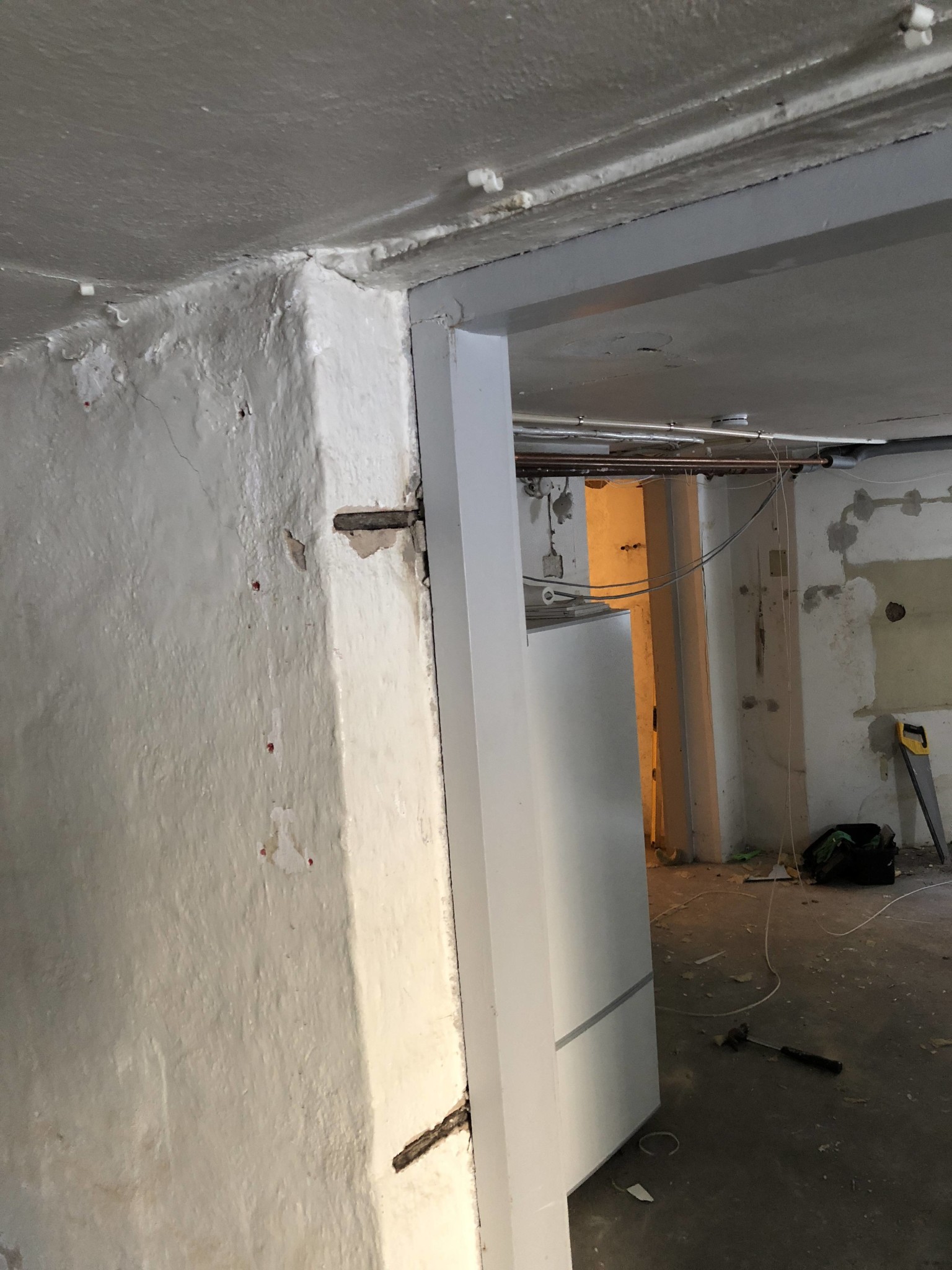
I would have just removed the wedges around the nails and then cut them with the reciprocating saw. You're already at the point where you have to do some patching up, so you might as well finish the job. I've never seen the version with a piece of plank inserted into the joint, but you can just remove it. The beam is holding up the wall.

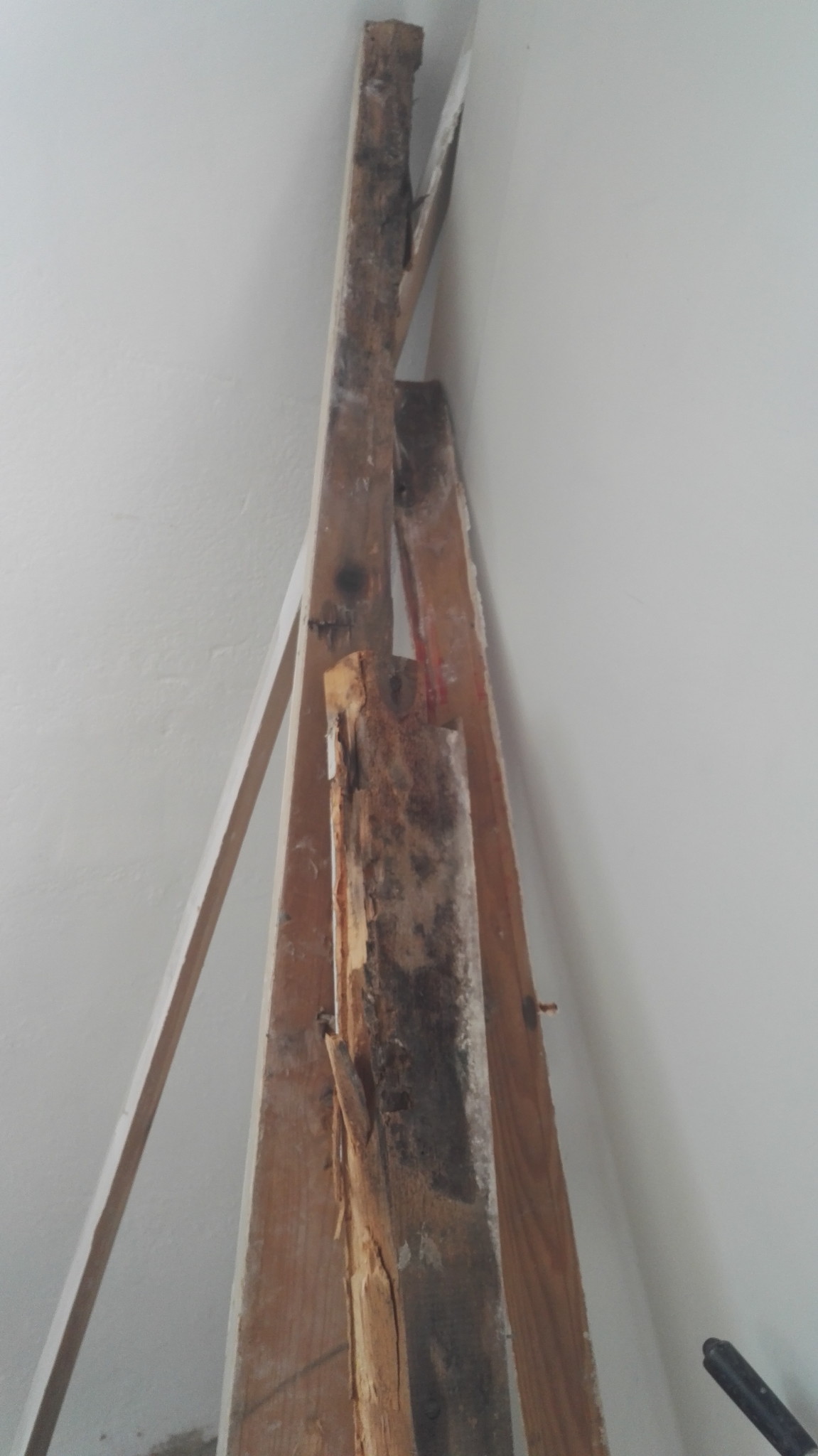


The nail heads may be clipped, and the frame was installed as the wall was built up.
Our door frame, which was installed in the outer wall between the basement and the garage, was attached in such a way, with small embedded wooden pieces in the wall that the door frame was nailed into with double-pointed nails.
At this stage, I had removed all the plaster that sits right next to the frame. Then sawed off the nails that go between the frame & wall. Subsequently, I sawed off the frame, one/two places on each side piece. Removed the frame.
Once the door frame is gone, it is possible to drill out the wood in the wall.
Our door frame, which was installed in the outer wall between the basement and the garage, was attached in such a way, with small embedded wooden pieces in the wall that the door frame was nailed into with double-pointed nails.
At this stage, I had removed all the plaster that sits right next to the frame. Then sawed off the nails that go between the frame & wall. Subsequently, I sawed off the frame, one/two places on each side piece. Removed the frame.
Once the door frame is gone, it is possible to drill out the wood in the wall.
Click here to reply