
41,401 views ·
62 replies
41k views
62 replies
Discovered a large hole next to the neighbor, what to do?
Before throwing in such a wildcard, one should perhaps consider the regulations that were in place when the house was built or obtained an approved building permit.Tosse said:
For example, if we take fire class EI15 today, it requires a 45 mm frame and a 9 mm wood/particle board on both sides or alternatively 14 mm particle board on one side (no insulation in between). I just want to show that even today's fire protection regulations have simple constructions, so I therefore don't believe it is an argument that the wall is incorrect from a fire protection point of view and especially wasn't incorrect at the end of the 1800s when they had just started considering fire protection and thereby created the so-called Landshövdinghusen in which TS lives.
What does the year the association was formed have to do with whether the house is built according to current regulations?? The house's construction or its building technical requirements do not change just because a BRF is formed in the house.Tosse said:
And if you can't imagine living in houses or apartments that are built according to the rules that applied when the house was built, there is only one option, which is to move into a newly built house. But the problem is, you then have to rebuild every time the rules change in order to always live in a house that meets the latest regulations.
Member
· Västernorrland
· 12 077 posts
The housing cooperative will most certainly patch up the hole......(if you don't do it yourself as I already mentioned). Even if one would want to build fire-rated there, it wouldn't be enough to build fire-rated sporadically. The entire apartment would need to be made into a fire compartment according to today's regulations. And they probably won't start doing that for this reason.



We shouldn't delve too much into the legalities, but since it is already clear in the thread that the board is responsible for addressing this maintenance (or if they want to apply for a building permit/file a building notification for a new wall construction):
The Building Statute of 1874 applies to a house from the 1920s. It can be found here:
http://www.boverket.se/sv/lag--ratt...bocker/aldre-lagar-om-planering-och-byggande/
Fire-separating walls in the house are not discussed at today's level of detail except that wood and other flammable materials should be separated from fireplaces and chimneys (what mattered was craftsmanship and not standards at that time) but the building permit process with drawings did exist. Then the house may have been remodeled over the years so that other regulations apply. The board's problem.
The Building Statute of 1874 applies to a house from the 1920s. It can be found here:
http://www.boverket.se/sv/lag--ratt...bocker/aldre-lagar-om-planering-och-byggande/
Fire-separating walls in the house are not discussed at today's level of detail except that wood and other flammable materials should be separated from fireplaces and chimneys (what mattered was craftsmanship and not standards at that time) but the building permit process with drawings did exist. Then the house may have been remodeled over the years so that other regulations apply. The board's problem.
The board/association has, as previously mentioned, an obligation to repair the framework that lies under the association's responsibility. And I believe they should repair the wall according to the original construction, meaning replacing rotten wood unless someone before you has altered the wall and it is not made according to the house rules or according to the building permit given, for example, when splitting a large apartment into two smaller ones, which occasionally happens.
But this likely means replacing damaged wood with fresh wood and simultaneously investigating the source of any potential water leakage to ensure it has been addressed earlier.
In your situation, I would have personally added one or even two 12 mm gypsum boards to the entire wall to minimize noise between the apartments and also achieve a better and more secure wall. However, that is entirely your concern or, rather, at your expense, as the board is only responsible for restoring it to its original condition.
But this likely means replacing damaged wood with fresh wood and simultaneously investigating the source of any potential water leakage to ensure it has been addressed earlier.
In your situation, I would have personally added one or even two 12 mm gypsum boards to the entire wall to minimize noise between the apartments and also achieve a better and more secure wall. However, that is entirely your concern or, rather, at your expense, as the board is only responsible for restoring it to its original condition.

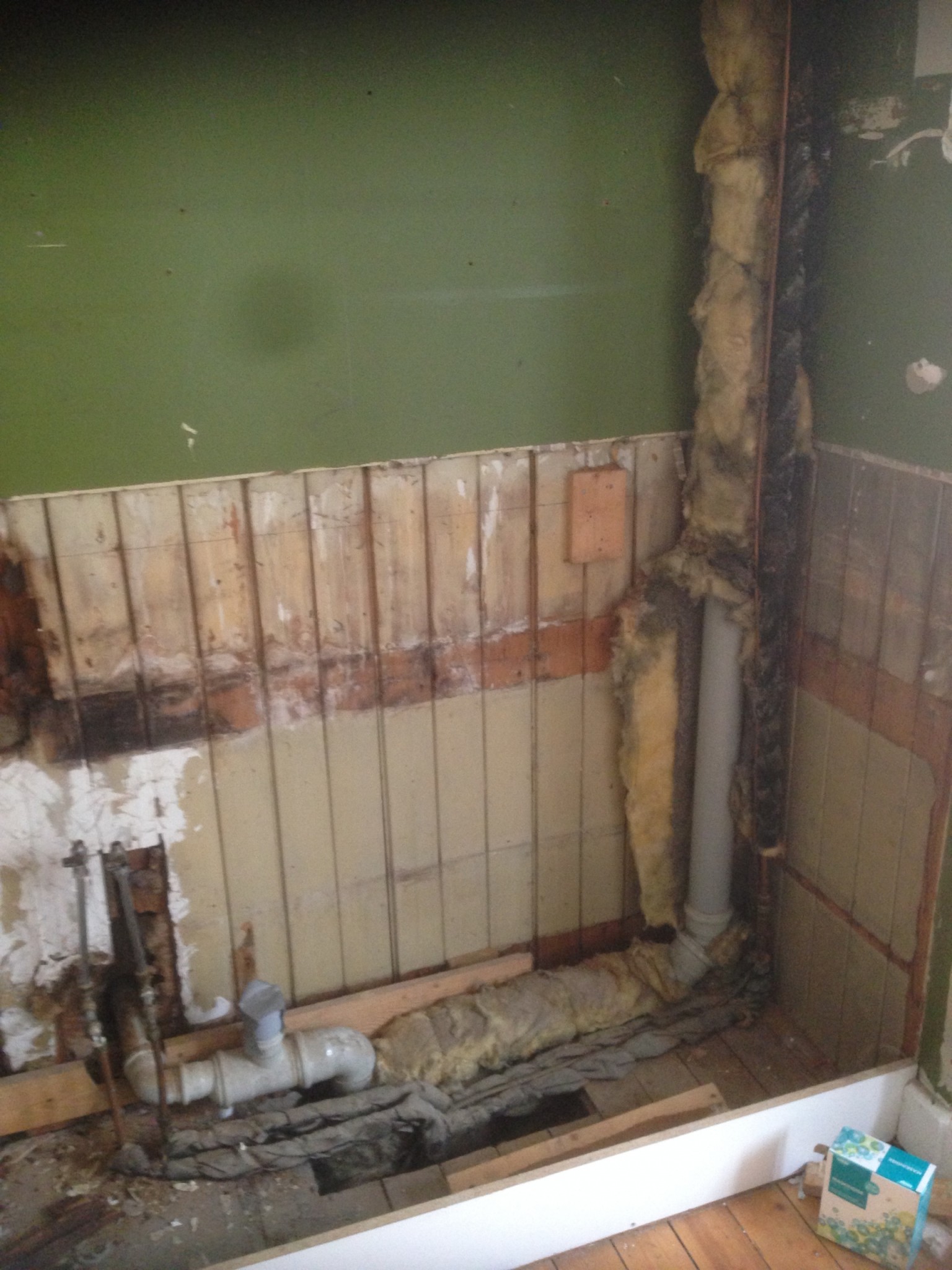
At the risk of not being completely updated, there are no rules, only recommendations regarding fire-rated surfaces in non-newly constructed multi-family buildings. The old rules, when I was most active, stated that if the individual properties' doors did not meet the correct fire rating, a new comprehensive review of all surfaces was conducted. These too were only rules one "should" comply with and not legally required to be addressed.
It can be a dilemma in many cases regarding what should be done and what is actually done, with significant differences when there is no law mandating action. I believe it is not the housing association's duty to fix the hole, read that as I believe and do not know one hundred percent for sure, in other words, it largely falls to the apartment owner to fix the surface and overlook what won't be visible. It's an unfortunate situation, and I hope for your sake that I'm wrong.
As mentioned, the older rules, which were only guidelines, applied only to fire-rated doors and nothing else.
Kind regards, P-A
It can be a dilemma in many cases regarding what should be done and what is actually done, with significant differences when there is no law mandating action. I believe it is not the housing association's duty to fix the hole, read that as I believe and do not know one hundred percent for sure, in other words, it largely falls to the apartment owner to fix the surface and overlook what won't be visible. It's an unfortunate situation, and I hope for your sake that I'm wrong.
As mentioned, the older rules, which were only guidelines, applied only to fire-rated doors and nothing else.
Kind regards, P-A
Last edited:

I largely agree with oceanis. IF the damage is as limited as it appears in the picture, with no signs of ongoing moisture and no major damage to the load-bearing beams, and considering that it is a small association.
Then I would probably just carve out the rotten parts, fill in a bit with similar construction, and then apply gypsum board, or preferably two layers of gypsum. If you want to be extra cautious, you can brush Boracol (kills mold) on the damaged wood surfaces.
Repairing the damage costs a few hundred kronor in materials, and even as an amateur, you should be able to fix it in a couple of hours.
Then I would probably just carve out the rotten parts, fill in a bit with similar construction, and then apply gypsum board, or preferably two layers of gypsum. If you want to be extra cautious, you can brush Boracol (kills mold) on the damaged wood surfaces.
Repairing the damage costs a few hundred kronor in materials, and even as an amateur, you should be able to fix it in a couple of hours.
What I mean is that if there was a renovation when it was converted into an apartment building, it might be the requirements from that year that apply. Because I assume it wasn't originally built as an apartment building.
If you renovate a 1920s villa into 4 apartments today, you can't build according to 1920s regulations.
If I were TS, I would talk to the board first. If the board doesn't want to bring in a carpenter to fix it in an acceptable way, I would be willing to fix it myself - but then I would want written confirmation that the board has approved the construction and the work as a whole.
If you renovate a 1920s villa into 4 apartments today, you can't build according to 1920s regulations.
If I were TS, I would talk to the board first. If the board doesn't want to bring in a carpenter to fix it in an acceptable way, I would be willing to fix it myself - but then I would want written confirmation that the board has approved the construction and the work as a whole.
Well, then I agree with you. I didn't know about the history. Regardless, it is the condo association's responsibility to fix this damage in a satisfactory manner. I personally don't know what the rules are when repairing an old wall. But you seem sure of your opinion that ancient techniques suffice. The same goes if you have to replace a water pipe? - okay with built-in joints and so on. That would really make all renovations easier! I mean, when you move into a house, you have to accept the standards that applied when it was built! 