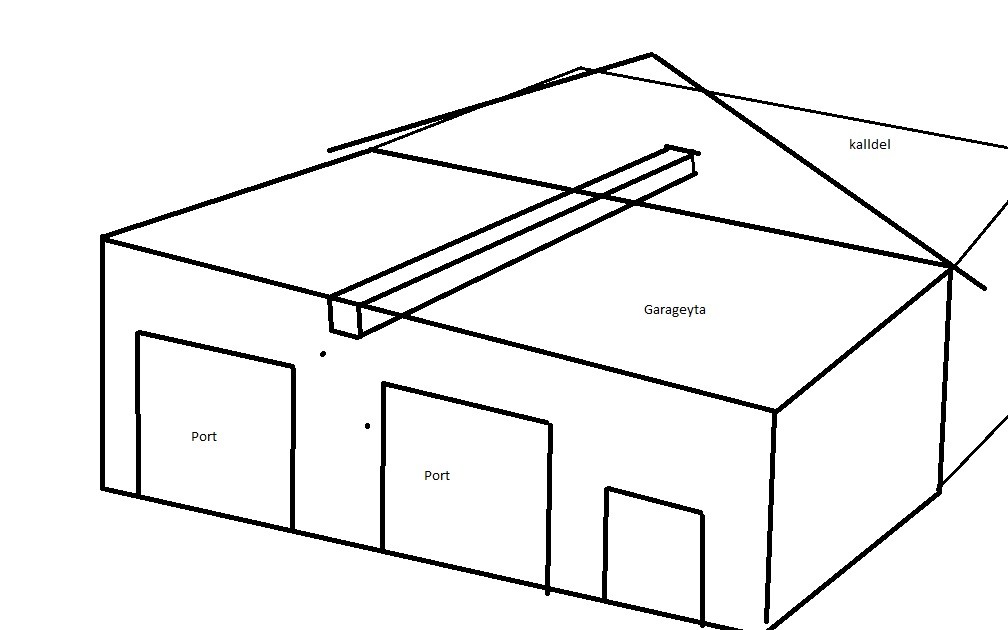
Anyone here who can help quickly with the measurements for a steel beam I’m thinking of installing in my garage? I'm planning to use it partly for support for the rafters and to have a rolling hoist on it, so I can lift some things, like a snowmobile, engines etc., no huge loads. I thought of placing it between the doors; it won’t be centered under the rafters, but that shouldn't matter, right?? The floor area is 7.2m, so the beam's length must be floor area + wall thicknesses? Say 8-10m (it doesn't matter if it sticks out in the cold area by a meter, they are sold in 10 or 12m lengths or something similar?). I assume it will be some form of I-beam, or is an H-beam sufficient? The width is 8.9m (floor area). Attached is a quick sketch so you can see what I’m thinking...
What type of trusses do you have? If the trusses are self-supporting, they should not load the beam.
For example, an IPE160 bends down just under 3cm if you load it with a point load of 500kg in the middle between the supports.
I have a beam with an 8m span in my garage, and in that beam, I hang a 500 kg hoist. My beam consists of two IPE160 placed side by side, so I get just under 15mm deflection if I max out the hoist in the middle of the beam.
The advantage of using double beams is that you also get significantly greater safety against buckling. In your case, you could also attach the beam to the trusses to avoid the risk of buckling.
I-profile is optimal when considering the ability to carry load relative to the beam's own weight.
H-profile is optimal when considering the ability to carry load relative to the construction height of the beam.
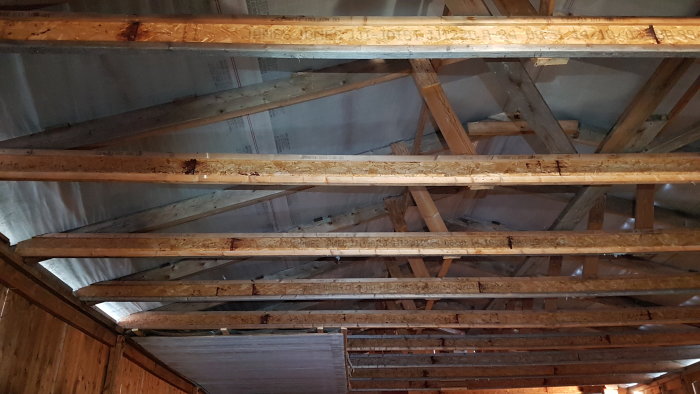
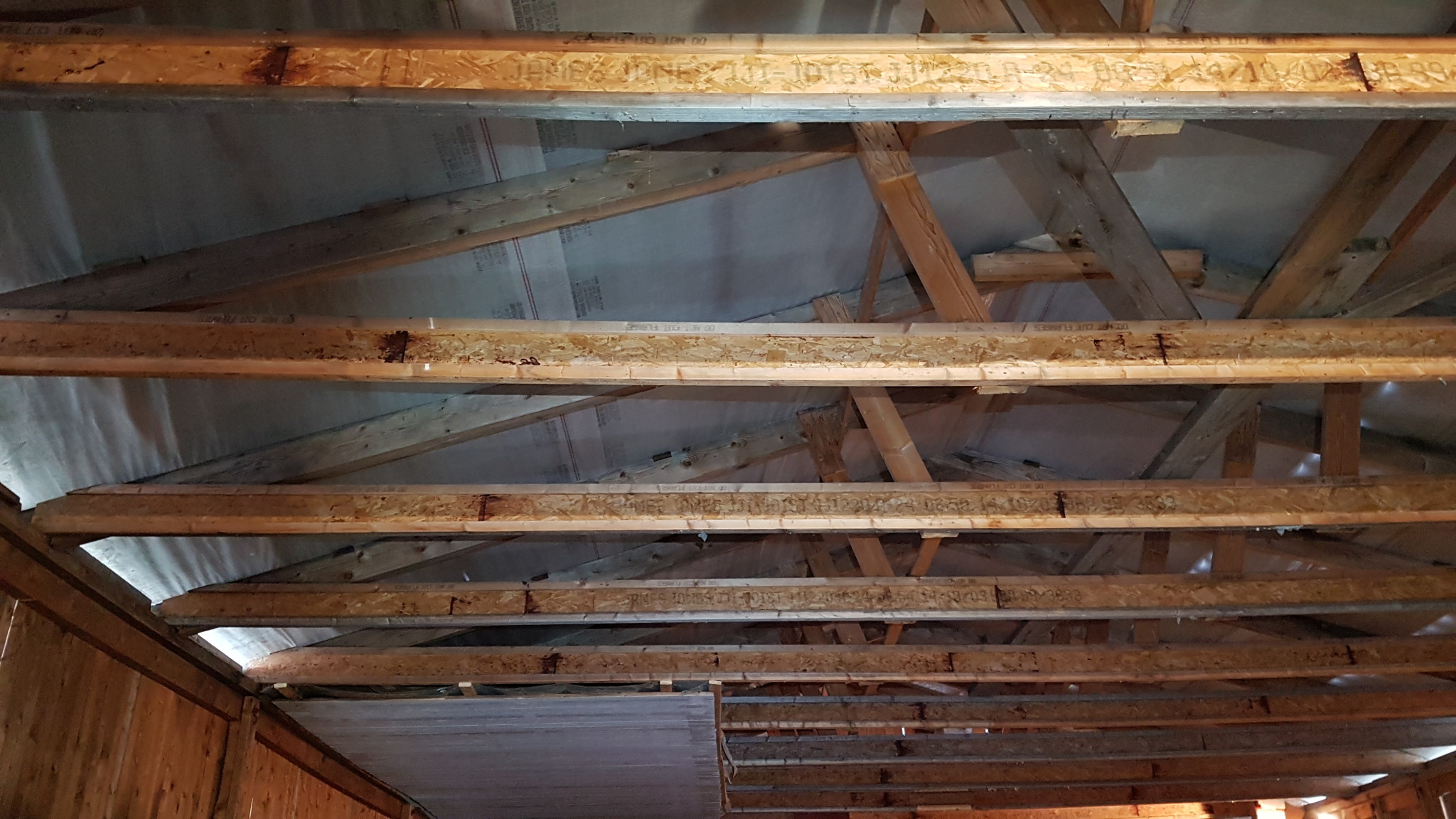
They are trusses (is that what they call them?), but slightly custom. Two 45x45s with plywood in between, never seen anything like that before. It's an old military warehouse, so maybe they are reinforced?? In a few places, the finger joints have slid apart (due to snow load, I assume), so I've had to reinforce there.
Wondering if I need to reinforce the entire horizontal beams/joists or whatever they're called in some way? Planks that bind the 45s together? The previous owner had started nailing up planks (with age-resistant plastic above), but I tore it down because I wanted to inspect the trusses and am going to put new plastic anyway, frame out, and then sheet the ceiling. Thoughts and tips?
Sending a picture so you can see
Should I frame across or along? Sheet along the trusses, or "across"? How do carpenters do it?
What you have in the lower chord of the truss is so-called light beams or masonite beams... nothing custom there. A deliberate choice, more likely. Such beams, among other things, make the thermal bridge smaller if you had insulation against a sub-roof, but you don't
Question;
Are you going to hang the steel beam from the lower chord of the truss? Or should the steel beam stand on its own columns at the ends? Judging by your sketch, I would have guessed option 1. But, I don't think that's the best option.
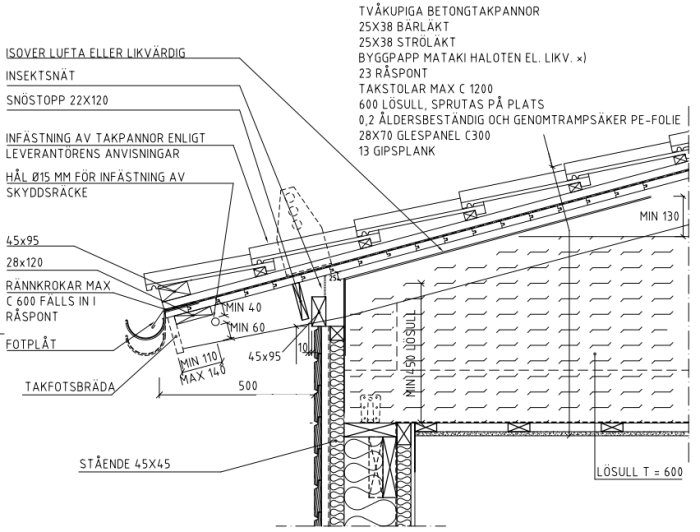
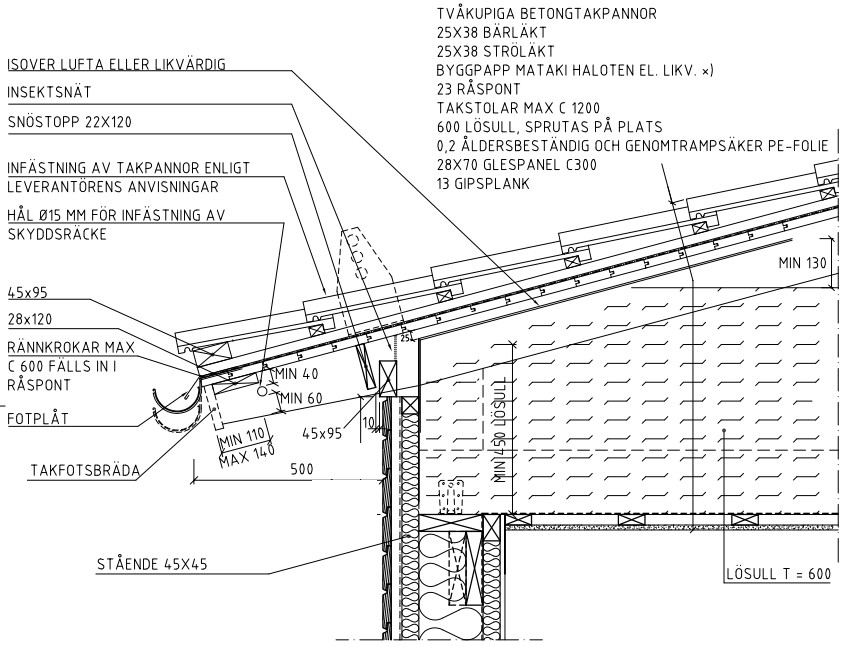
Ah ok, good then with such lightweight beams. I'm going to insulate walls and loose fill insulate the roof to make a heated section. Is there a good site that shows how to do the insulation at the eaves? There should be a small air gap between the vapor barrier and the thin plywood or whatever it's called, right? The beam will stand on its own pillars, it was just a simple sketch for just the beam's position, so I didn't think about that
Regarding the eaves: this is how I did it on my house. Isover lufta or equivalent is stapled to the sides of the rafter's upper frame. Isover lufta is a cardboard sheet with some polystyrene spacers on it (surprisingly expensive despite this), so it doesn't have to be anything special that forms this air gap. The sheet forms an air gap and prevents the loose-fill insulation from clogging it since it sits on the wall at the bottom and then continues up between the rafters.
Thanks for the picture, perkylainen
When photographing ceilings indoors, is there anything I should keep in mind? Do you lay furring strips cc300 across the rafters and sheet metal along them? I wanted to lay tp20 sheet metal along the rafters since it's not perfectly straight between the undersides of the rafters (can differ a few cm here and there..) and it's easier when the sheets flex with the profiling, if you understand what I mean.. Is that okay?
Click here to reply
Vi vill skicka notiser för ämnen du bevakar och händelser som berör dig.