
I am going to build a wardrobe with sliding doors.
I do not want to hang the doors directly from the ceiling, i.e., I do not want the weight of the wardrobe doors to burden the ceiling beams.
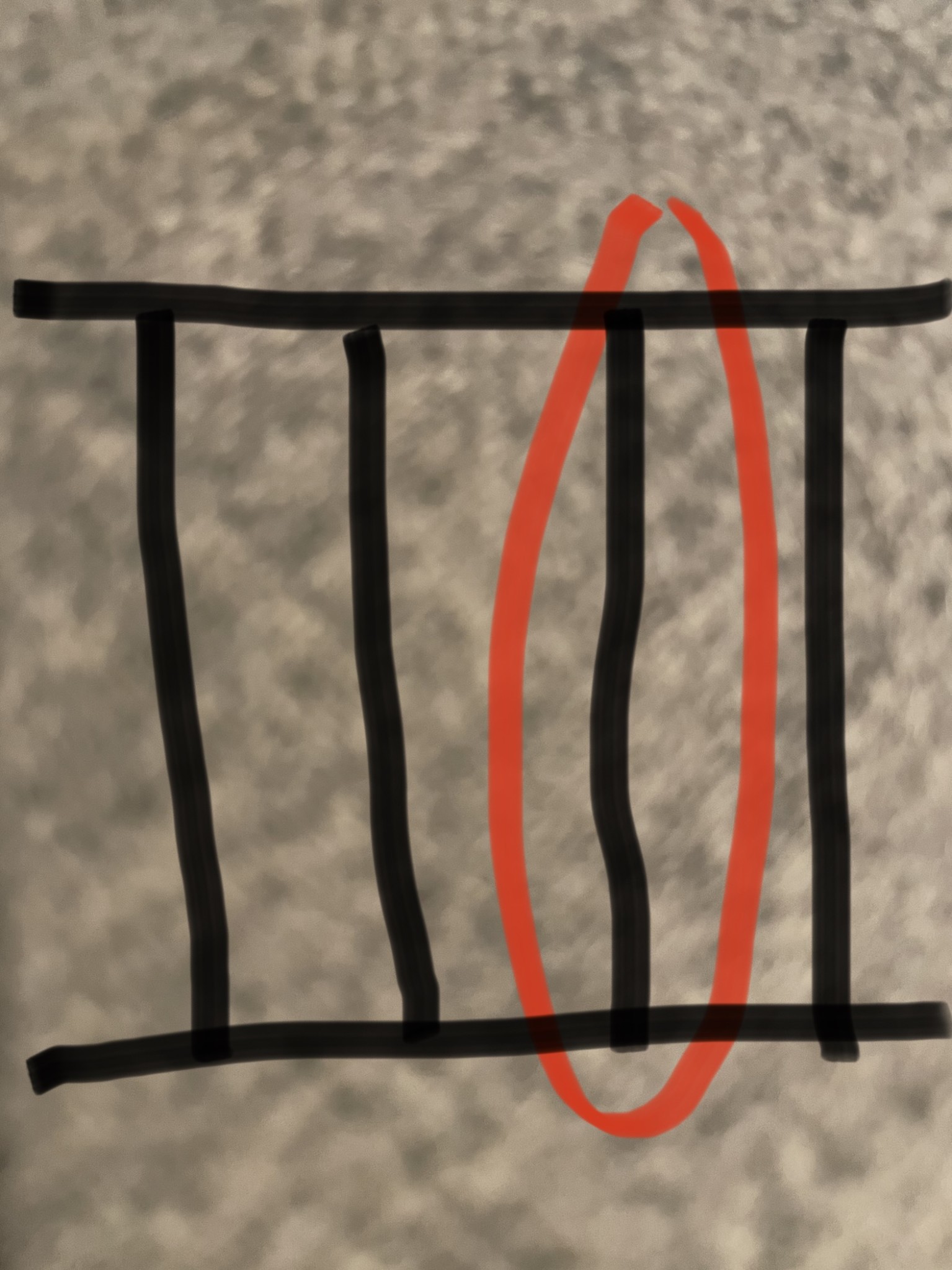
Therefore, my plan is to build an inverted U. For the top beam, I plan to use a glulam beam 70x70 or 90x90. The sides will be regular 45 studs.
What will the deflection be with a 70 or 90 beam?
The span is 260 cm and the doors may weigh 40 kg each. There are three doors.
I do not want to hang the doors directly from the ceiling, i.e., I do not want the weight of the wardrobe doors to burden the ceiling beams.
Therefore, my plan is to build an inverted U. For the top beam, I plan to use a glulam beam 70x70 or 90x90. The sides will be regular 45 studs.
What will the deflection be with a 70 or 90 beam?
The span is 260 cm and the doors may weigh 40 kg each. There are three doors.

It will be 90x90, which gives approximately 5 mm deflection. Position the glulam column so that the laminations are on edge.
Nothing wrong with that idea, but I wonder if regular stud wood turned with the 'back' upwards provides less deflection.D Derbyboy said:I am going to build a wardrobe with sliding doors.
I do not want to hang the doors directly from the ceiling, that is, I do not want the weight of the wardrobe doors to burden the ceiling joists.
Therefore, my plan is to build an upside-down U. For the overhead beam, I was thinking of using a glulam post 70x70 or 90x90. The sides will be regular 45 studs.
What will be the deflection with a 70 or 90 post?
The span is 260 cm, and the doors might weigh 40 kg each. There are three doors.
Actually, it probably won't cause any deflection since glulam beams will be screwed at an angle into the ceiling (roofing boards and Huntonit) at the front edge (facing the room). At the back of the beam, I can use brackets since they are not visible from outside the wardrobe.
Can 5 mm in my case be converted to kg?
What I want to reduce is the load on the floor joist, and I can sacrifice a little of the wardrobe's height for that.
Another option or perhaps an additional measure could be attaching a post at the back in the middle of the span on a 90x90 glulam.
So, the two tracks are 42 mm, which means I could place a post "behind" the tracks of 90-42=48mm.
Can 5 mm in my case be converted to kg?
What I want to reduce is the load on the floor joist, and I can sacrifice a little of the wardrobe's height for that.
Another option or perhaps an additional measure could be attaching a post at the back in the middle of the span on a 90x90 glulam.
So, the two tracks are 42 mm, which means I could place a post "behind" the tracks of 90-42=48mm.
45x120 C 24 also gives 5 mm. To get under 5 mm, 45x145 is needed, which TS probably doesn't have room for.F fribygg said:
Can you explain a bit further?D Derbyboy said:
Thank you Justus
5mm becomes so abstract for me, and since I will attach the pillar to the ceiling, I will never get a deflection. Or the actual deflection will be something other than 5mm since the pillar interacts with the entire ceiling.
The doors weigh a total of 3x40 kg=120 kg. If I skipped my horizontal pillar, the ceiling beams would then be loaded with 120 kg. How many kilos are the ceiling beams loaded with if I hang the doors on the pillar? This way I can relate the action to the benefit.
I hope you understand, I might be confusing myself (as usual).
5mm becomes so abstract for me, and since I will attach the pillar to the ceiling, I will never get a deflection. Or the actual deflection will be something other than 5mm since the pillar interacts with the entire ceiling.
The doors weigh a total of 3x40 kg=120 kg. If I skipped my horizontal pillar, the ceiling beams would then be loaded with 120 kg. How many kilos are the ceiling beams loaded with if I hang the doors on the pillar? This way I can relate the action to the benefit.
I hope you understand, I might be confusing myself (as usual).
If the horizontal glulam post plus the three doors are only fastened to the ceiling beams and the whole is centered over three beams, the load on the middle beam will be 65 kg and on the surrounding beams 32.5 kg each. Assume the post weighs 10 kg. These are quite negligible loads.
If your beams are part of a floor structure also used for residential purposes on the upper side, they will have a distributed load of about 180 kg per meter (at c/c 600). Increasing by 50 kg over part of the span is not dramatic, it depends on the span and beam dimensions.
It is a single-story house (flat roof) with custom-made roof beams (type kerto) with a span of 6m.
Every kg counts, therefore. I get nervous just thinking about adding more load to the beams. Hence, I think my solution will be good, i.e., to place a glulam column.
Every kg counts, therefore. I get nervous just thinking about adding more load to the beams. Hence, I think my solution will be good, i.e., to place a glulam column.
Yes, if you don't want to burden the roof beams, it's better to place the construction on the "floor".
I've looked into such a solution as well. However, I can't find any suitable brackets that I find appropriate.
I do think it shouldn't be many kilos that load if I:
1) use 90x90 horizontal pillars
2) relieve the span with two pillars 65 cm from each outer edge/pillar The pillars will admittedly only be able to support 48mm of the horizontal pillar.
Outer pillar (65 cm) pillar (130 cm) pillar (65 cm) outer pillar.
I don't think the above solution would result in many kilos on the roof beam.
I do think it shouldn't be many kilos that load if I:
1) use 90x90 horizontal pillars
2) relieve the span with two pillars 65 cm from each outer edge/pillar The pillars will admittedly only be able to support 48mm of the horizontal pillar.
Outer pillar (65 cm) pillar (130 cm) pillar (65 cm) outer pillar.
I don't think the above solution would result in many kilos on the roof beam.
Unfortunately, I have difficulty following your reasoning. Which solution do you prefer?
Click here to reply