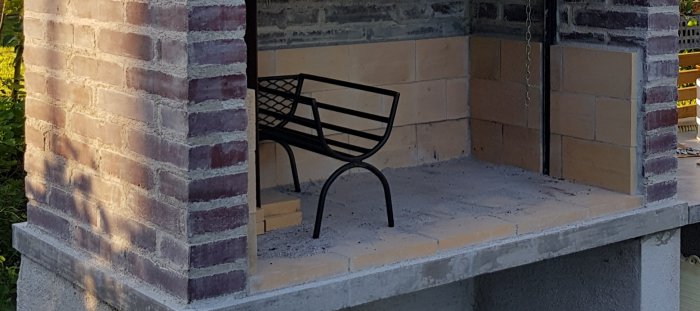
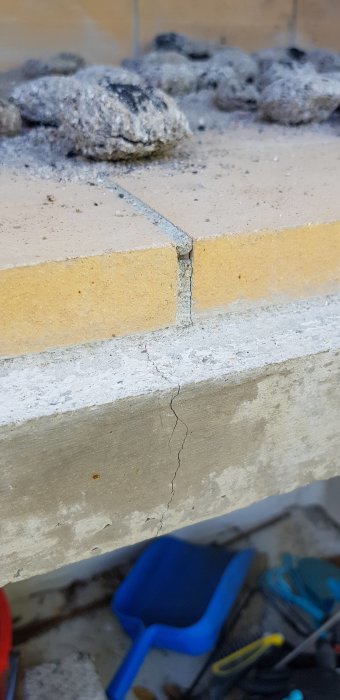
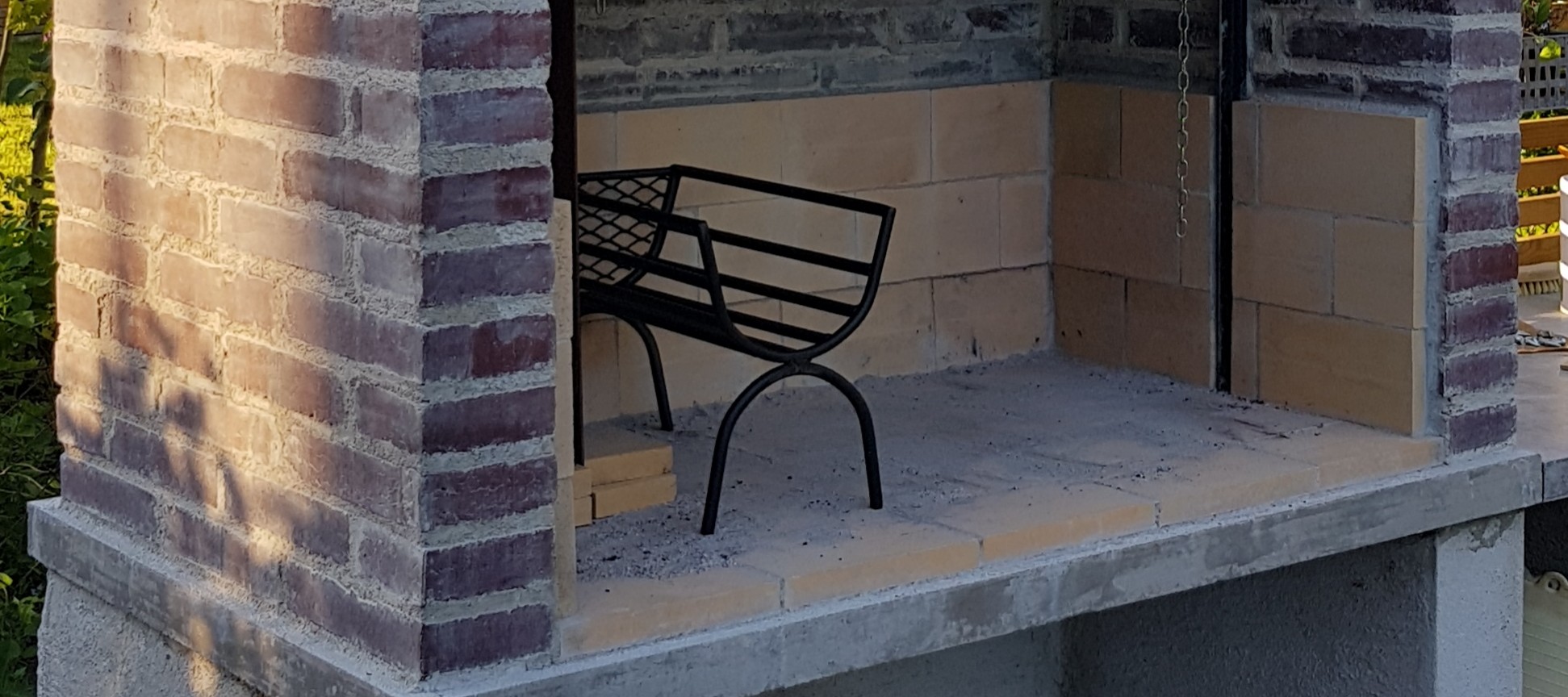
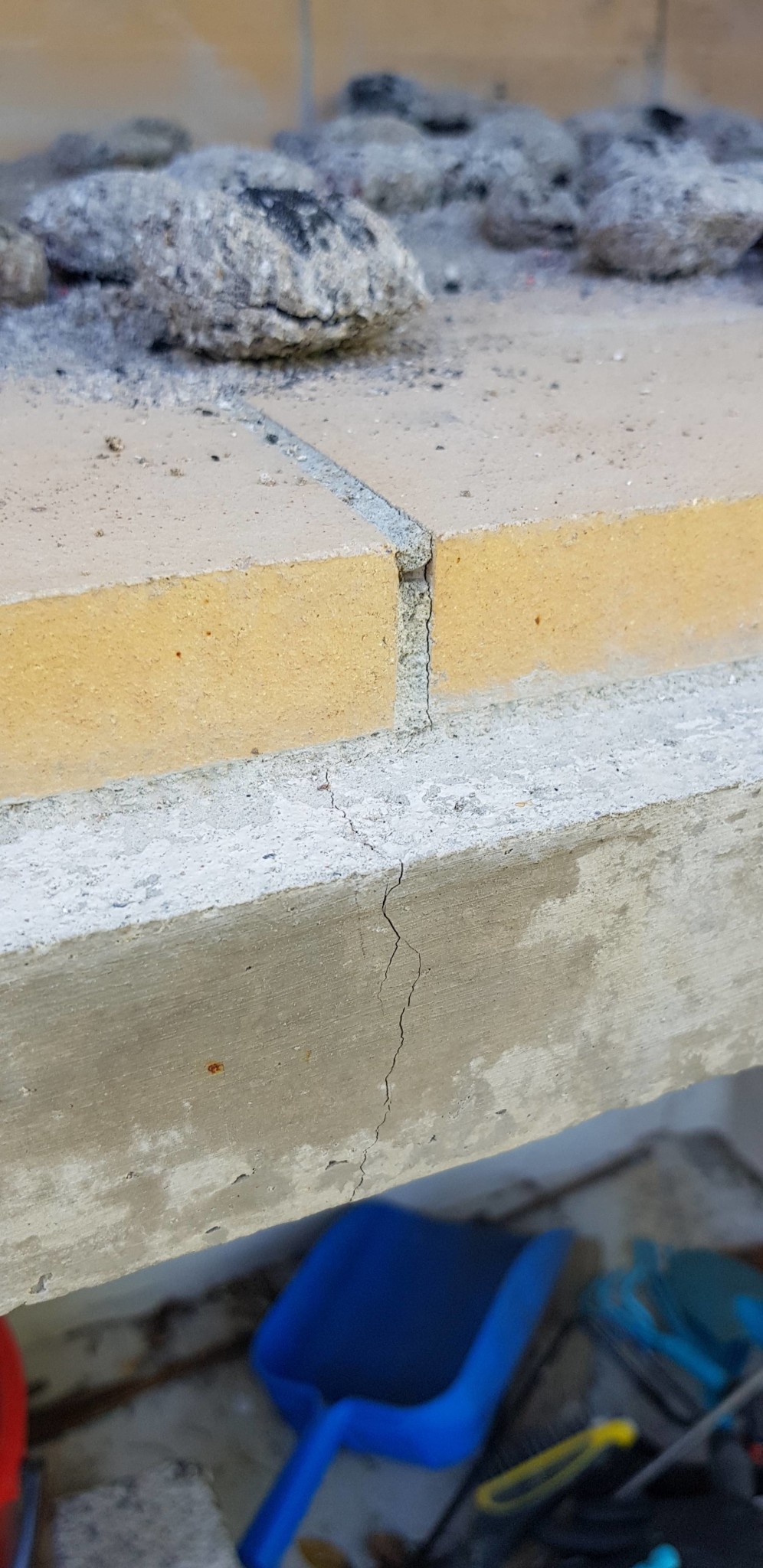
I put two bags of glowing briquettes in my brick grill yesterday to cure the paint on the chimney. It got really hot, and two thin cracks appeared on the front of the reinforced concrete slab. It is 56 mm thick and has fire-resistant bricks on top, mortared with refractory mortar. The cracks only appeared on the front and go just a few cm on the underside. I thought of fixing it with a radius fillet b-mortar at the front in the "corner" fire-resistant stone/concrete edge, so no water can seep in. Maybe a bit of leftover anchor compound first.
Now I understand it gets really hot, but I've seen a lot of examples of this construction, so I was still a bit surprised that the cracks appeared. Since I want my grill to withstand many BBQ evenings in the future, I thought I'd play it safe and place the embers on a steel plate instead of directly on the fire-resistant stone. I'll place that plate on 30mm standing flat iron, so there's an air gap underneath, with openings all around.
Do you think the air gap is enough to reduce the heat to the concrete sufficiently? One could have a layer of vermiculite/perlite under the plate, but then it starts to feel like overkill.
It's no news that concrete cracks when it gets really hot, you do have reinforcement in the slab, iron from side to side and a mesh on top of that, then it will last for years without anything happening.
The fact that concrete cracks when it gets really hot is no news, you do have reinforcement in the slab, iron from side to side and a mesh on it, then it will last for years without anything happening.
Absolutely, had both mesh and iron (8mm I believe) on the long sides and a couple in the middle. So I feel pretty secure with the reinforcement.
Then the crack is mostly just an annoying part. Just go with the flow . Then you can have a sheet as you say, there's a loooot of air in a grill that cools down, and the hottest part is under the embers, so do what you feel like.
Then it's mostly an annoying part, that crack. Just accept it . You could put a sheet as you say, there's a lot of air in a grill that cools down, and the hottest part is under the coals, so do what you feel like.
Yes, the crack won't be visible once I've skimmed some mortar over it.
But you mean air under the sheet? The coals on the sheet, which I'll have to replace every few seasons, and then air underneath, 3cm. Surely the air should cool quite a bit? Then there's the brick too, but it's not exactly insulating, though.
With air under the plate, it doesn't get as hot (more like radiation). Most likely, the firebricks will almost glow unless there is ash on the bricks (it insulates very well against the glowing heat). So not completely removing the ash but leaving some can be good. Just a thought, when you've finished grilling, there's probably a lot of coal left. Have you considered how you can extinguish the coals and grill again with the same batch? A scoop, similar to an upside-down dustpan with high edges, placed over the embers is good. You won't be favored by those who make charcoal; it will use about 50% less coal.
Yep with air under the sheet, it doesn't get that hot, (more like radiation) probably the firebrick will almost be on the verge of glowing unless there's ash on the brick (it insulates really well against the ember heat). So not removing the ash completely and leaving some might be good. Just a thought, when you're done grilling, there's probably a lot of coal left, have you thought about how you can extinguish the coals and grill again with the same batch? A scoop like an upside-down dustpan with high edges to put over the embers is good. You won't be liked by those who make charcoal, you'll use about 50% less charcoal-
Thanks, good idea to make the next fire on the ash for a bit more insulation. I always reused old gray briquettes on my Weber, which I extinguished with a lid after grilling just to save the coal for next time
It is often said that the key is to keep the air still for better insulation, and that this is the very function of the insulating material.
In that case, I shouldn't just have an empty air gap underneath with openings on the sides for better air circulation (risk of higher heat?). Should one perhaps manufacture a 30mm high steel frame, pour vermiculite/perlite into it, and then place a board on which the embers can be laid? Hmm.
The idea of placing a metal plate as the base for the hearth can be good. A 3 cm air gap underneath seems reasonable and don't forget to have support in the middle, the plate will bend and you'll have to turn it over as well. A 10 mm plate is probably what you should aim for as it can withstand a bit. A 10 mm plate can support itself, so it only needs 3 supports on the sides and middle, allowing some air to circulate underneath.
Click here to reply
Vi vill skicka notiser för ämnen du bevakar och händelser som berör dig.