I live in a wooden house with a basement from the 1930s. In the garage, there are quite large cracks in the ceiling. Above is the kitchen. I've been able to lift a floorboard and seen that there's a wooden joist structure. But underneath it seems to be concrete. Was that a common way to build? Does the concrete serve any load-bearing function or was it just to get a "nice" ceiling in the basement? What I'm really wondering is if I should address the ceiling? I do want to tidy up what's cracked, but should I also support it with a beam or something? It's hanging down a bit around the cracks.
I live in a wooden house with a basement from the 1930s. In the garage, there are quite large cracks in the ceiling. The kitchen is above. There, I've been able to lift a floorboard and see that it's a wooden beam structure. But underneath it, there seems to be concrete. Was this a common way to build? Does the concrete serve a structural function or was it just to get a "nice" ceiling in the basement? What I'm really wondering is if I should fix the ceiling. I want to at least tidy up the cracked areas, but should I also support it with some beam or something? It sags a bit around the cracks.
Sincerely
If you're saying you have a wooden beam structure, I'm pretty sure it's plaster you have in the ceiling below. You don't cast a concrete slab and install wooden beams on top, so it's surely plaster you have.
If the cracks are larger, you might be able to fill in with very fine plaster without too large sand grains/gravel. Otherwise, it's probably some sort of sealant you need. The whole thing might be reinforced with something like chicken wire.
You don't need to support it with a beam if it's just plaster, which it probably is, but you might want to make sure it's secure so that it doesn't end up falling on someone's head eventually. It's likely to come loose in large chunks due to the presumed chicken wire reinforcement, so you should be able to fasten it with some screws if you can hit the right spot in some good substrate. Then you repair the cracks.
Otherwise, if the ceiling is in too bad a shape, just take it all down and nail up a wooden ceiling, or screw in gypsum board or something.
What you write sounds completely reasonable.
It seems to be perhaps a 5cm thick layer. I'll probably try to clean out a crack a bit so you can see what's there to possibly attach to. A plaster ceiling sounded tempting but I think it's a boring job... I also believe it's full of sawdust and other things in the joist space.
What you write sounds entirely reasonable.
It seems to be perhaps a 5cm thick layer. I might try to clean out a crack a bit so one can see what’s there to potentially attach to. A gypsum ceiling sounds tempting but I think it’s a boring job... I also believe it's full of sawdust and other things in the joist system.
If that is a basement joist system, I guess it might even be built with a trossbotten. So then you'd have the sawdust in the joist system not only in a "paper tray" but also the "paper tray" resting on subfloor boards.
If nothing else, the sawdust should be in a "paper tray." I write "paper tray," because they typically nailed something like roofing felt in these compartments, especially against colder spaces, and then filled it with sawdust.
If nothing else, it should at least be untreated regular thick paper.
But yes, you do sometimes. I have cast vaults x 3 and on the living plan it is done exactly like that. First 10-12 cm concrete, then floor joists and subfloor of raw plank. I have pulled up a floor in the house and could note an interesting "cheat". The floor joists were only of dimension 50x75 (45x70 but not planed). Instead, everything was propped up with wooden blocks, masonite pieces, and whatever they had found. Level floor circa 1951. Probably because the concrete vault was uneven.
BTW, a light concrete house so that might explain the solution.
Ok.. feels like they did as they pleased in the past
I guess I'll have to try to see somewhere how thick it is then.
If it turns out to be 10cm thick. Then it's concrete.. and does it have a load-bearing function? Or can we assume that the floor joists also extend over the basement walls and provide support?
The real question is whether I need to brace it or just fill in the cracks. It hangs down probably 5cm
Actually, yes, sometimes you do. I have cast vaults x 3 and on the living plan, it is done exactly like that. First 10-12 cm of concrete, then floor joists and a subfloor of rough planking. I've lifted a floor in the house and noted an interesting "cheat." The floor joists were only of dimension 50x75 (45x70 but not planed). Instead, they had shimmed everything up with pieces of wood, Masonite pieces, and whatever else they could find. Level floor from 1951. Probably because the concrete vault was uneven.
By the way, it’s a light concrete house so that might explain the solution.
/LOB
There's a difference between leveling a floor on an existing beam system and having two separate beam systems. In your example, it's pretty obvious that the purpose was to facilitate floor laying, but they are too flimsy to carry a load-bearing function.
To TS then - you might get better help if you upload some pictures. Do you still have the possibility to access from above and assess or even measure the floor joists’ dimensions? An image from underneath might be enough to determine if it's concrete, light concrete, or plaster.
The floor has been re-laid for a long time, so I can't check again now, but I took a picture while I was at it.. seems to be double joists.. But I don't remember how deep.
Well, yes, sometimes you do that. I have cast vaults x 3, and on the living floor, it is done precisely so. First 10-12 cm of concrete, then floor joists and a subfloor of rough flooring boards.
But then you don't have a beam system on top of the cast vault, right? Rather, you have a framed floor, which is not the same as a beam system. There is, so to speak, no reason to cast a vault at 10-12 cm and then also install a beam system on top of it.
Llob said:
I opened up a floor in the house and noted an interesting "shortcut." The floor joists were only 50x75 in dimension (45x70 not planed). Instead, everything had been shimmed with bits of wood, pieces of masonite, and whatever else was available. Level flooring circa 1951. Probably because the concrete vault was uneven.
Yes, and here you have the answer. It was simply framed on top of the concrete vault. It is the concrete vault that supports the whole structure, not the "floor joists," as you mention, with the dimension 50x75. Those matchsticks don't support anything
[image] [image]
The floor has been closed up for a long time so I can't check again now, but I took a picture while I was working.. seems to be double joists.. But I don't remember how deep they are.
That clearly looks like a real wooden framework.
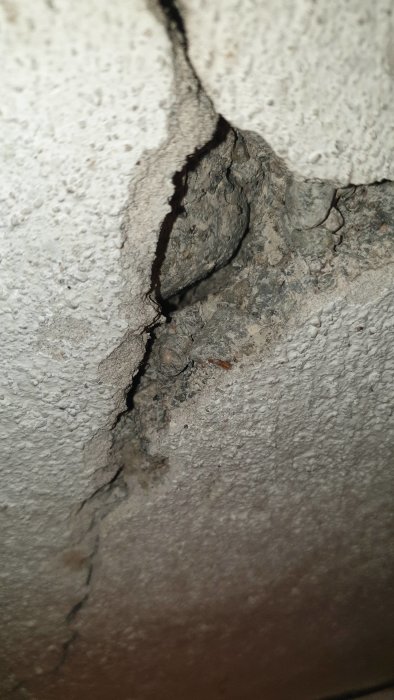
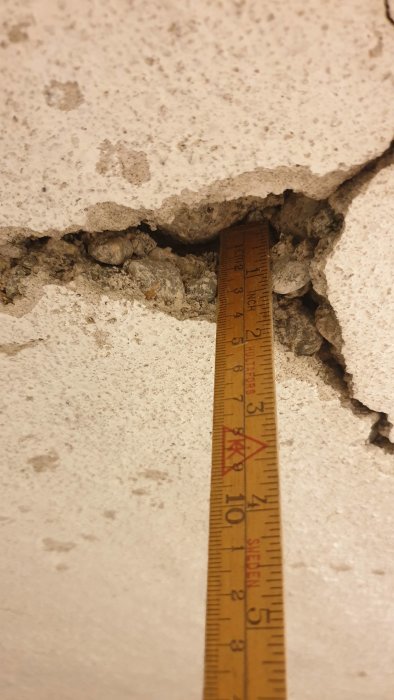
However, the ceiling in the first image is a bit suspicious. It looks quite thick to only be a little plaster. Can you take a picture closer to the larger hole, right into the crack, possibly with a tape measure or ruler right in so you can see the depth in some way?
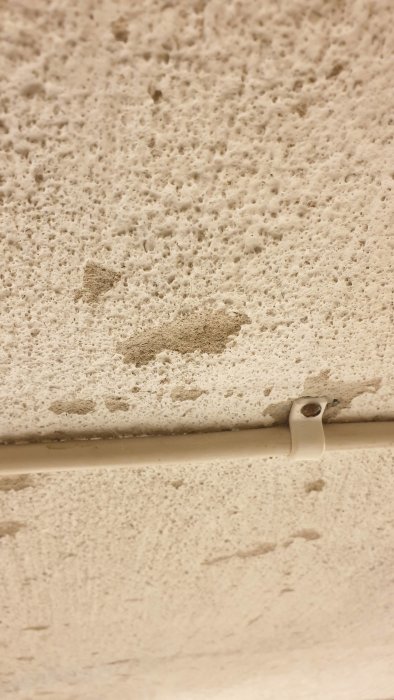
Taken a couple of pictures. On the outer layer, it's probably plaster because it crumbles when you touch it. But further in, you can see stones. Unfortunately, can't reach to look up any further . Might need to drill a peephole.
It was a strange story to be indoors. Fairly large stones...
It's some old casting, that's for sure. It's not plaster all the way through, that's clear enough.
What on earth is holding up this layer, really? I don't see any reinforcement in the form of chicken wire or similar.
Then it almost has to be a thicker slab of concrete so it's self-supporting? With rebar?
Do you think you can measure the thickness of the floor structure? The best place is by the stairs down to the basement, because there you should be able to determine the distance between the basement ceiling and the ground floor.
But to return to the original question. If the ceiling is stable and doesn't move when you press it, and you feel that it is well fastened/anchored so it's not a danger to remain in place, then it's best to just plaster over the cracks and holes.
Since the surface is already plastered, it won't make much difference to the surface if you do it neatly.
However, if the ceiling is loose, and you feel that the whole thing wobbles like a big cake, then forget about fixing it. In that case, it's better to take down the junk, but only after checking what is supporting the joists.
As it looks in the close-ups, it could resemble old cast entrance stairs underneath that are starting to crumble. But then it's a cast construction.
I haven't seen your floor plan, but it might very well be that this part belongs to an old outdoor area, i.e., that the garage roof was once a terrace. In that case, it's an old cast vault, and they might have decided to build an extension on top and therefore chose to build a joist framework on top because they realized the cast vault was about to give way. Or something like that.
Otherwise, it's very strange to have both a cast vault and wooden joists.
And in that case, you have to be careful because you don't want a cast vault falling on your head. That would be goodbye. That whole ceiling could weigh several tons in that case.
Click here to reply
Vi vill skicka notiser för ämnen du bevakar och händelser som berör dig.