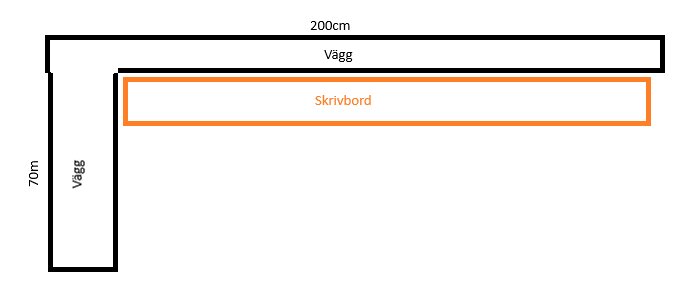
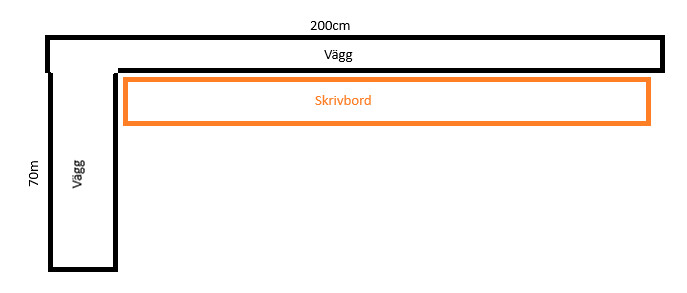
I want to set up a desk for my office in the house. My idea was to use a long countertop (200cm) and attach it to the studs, thereby avoiding the need for legs to give the impression that the top is floating.
My initial plan is to brace (45x45) along the short and long sides and then drill from underneath into the countertop. However, there is no wall to the right of the bench.
The walls are drywall but have a stud finder. I will try to anchor into the actual studs behind the drywall, but if not, I will use molly bolts.
The desk will be used as a regular desk, where I have a few computer monitors with accessories.
My questions:
1. How do I construct the right side of the desk where there is no wall to brace along the short side?
2. How many screws do I need to attach on the left short side versus the long side to ensure the structure can support the countertop?
I want to set up a desk for my office in the house. My idea was to use a long tabletop (200cm) and attach it to the studs to avoid using legs, giving the impression that the tabletop is floating.
My initial plan is to install studs (45x45) along the short and long sides and then screw from underneath into the tabletop. However, there is no wall to the right of the desk.
The walls are made of plasterboard but have stud finders. I'll try to anchor in the actual studs behind the plasterboard, but if not, I'll have to use molly expanders.
The desk will be used as a regular desk, with a few computer monitors and accessories.
My questions:
1. How do I construct the right part of the desk where there is no wall to attach along the short side?
2. How many screws do I need to secure the left short side and the long side to ensure the structure can support the tabletop?
[image]
That sounds nice, but since you don't have any support in the lower right corner, it won't be stable with such a long span. A shelf would be one thing, but a desk you might lean against will easily give way.
If you really want to try anyway, I would try placing several smaller brackets underneath all the way.
I want to set up a desk for my office in the house. My idea was to use a long countertop (200cm) and attach it to the studs to avoid having to use legs, giving the impression that the countertop is floating.
My initial plan is to attach studs (45x45) along the short and long sides and then drill upwards into the countertop. However, there is no wall to the right of the desk.
The walls are drywall but have stud finders. I will try to anchor into the studs behind the drywall, but if not possible, I will use molly bolts.
The desk will be used as a regular desk, where I have several computer monitors and accessories.
My questions:
1. How do I construct the right side of the desk where there is no wall to attach along the short side?
2. How many screws do I need to secure to the left short side and long side to ensure the construction can support the countertop?
[image]
It will work perfectly.
Just keep in mind that if you press down on the lower right corner where you have no support, the upper left corner will lift. Just make sure you dimension for forces in both directions.
If you do that, it will work perfectly; you hardly bend a 2-meter wide countertop if it’s of normal thickness.
Either way, I would place a bracket in the open corner, but it doesn't have to be something visible unless you amuse yourself by crawling on the floor.
I came up with an alternative solution and would like to hear if it is structurally feasible. Would it work to cut the countertop at 45° in the area where it can't be supported against the wall, and then let a vertical part of the countertop go all the way down to the floor and meet the end piece in a corresponding 45° cut? The idea is to then screw the parts together, so that the vertical part takes the load and provides support from the floor.
In practice, the right side would then become a "waterfall," where the countertop continues down to the floor and thus functions as a supporting structure.
I came up with an alternative solution and would like to hear if it's structurally feasible. Would it work to cut the countertop at a 45° angle in the part where it can't be braced against the wall, and then let a vertical part of the countertop extend all the way down to the floor and meet the end piece at a corresponding 45° cut? The idea is then to screw the parts together, so that the vertical piece takes the load and provides support from the floor.
In practice, the right side would then become a "waterfall," where the countertop continues down to the floor, thus acting as a supporting structure.
It gives nothing compared to a short bracket attached to the wall.
I want to set up a desk in my home office. My idea was to use a long countertop (200cm) and attach it to studs to avoid using legs, giving the impression that the countertop is floating.
My initial plan is to use studs (45x45) along the short and long sides and then drill from underneath into the countertop. However, there is no wall to the right of the desk.
The walls are drywall but have a stud finder. I will try to anchor into the studs behind the drywall; otherwise, I will use molly expanders.
The desk will be used as a regular desk, where I have a few computer monitors with accessories.
My questions:
1. How do I construct the right side of the desk where there is no wall to attach along the short side?
2. How many screws do I need to attach to the left short side and long side to ensure the construction supports the countertop?
[image]
I can't make sense of your drawing. Is the countertop supposed to be 200cm wide and 20 meters deep or what? You mentioned a countertop but in what dimension? The depth is crucial for the construction.
I came up with an alternative solution and would like to hear if it is structurally feasible. Would it work to cut the countertop at a 45° angle in the part where it cannot be fixed to the wall, and then let a vertical part of the countertop go all the way down to the floor and meet the end piece in a corresponding 45° cut? The idea is then to screw together the parts so that the vertical part takes the load and provides support from the floor.
In practice, the right side would then become a "waterfall," where the countertop continues down to the floor and thereby functions as a supporting structure.
It will be sturdy, as you will have solid support at both ends, and 200cm is not much of a span for a solid countertop.
1. I would place a brace from the right corner as low as possible on the wall, at least 45°. It will absorb a large part of the force.
2. 2-3 screws on the short side and 4-6 on the long side. Preferably a bead of glue as well. If you're worried, you can choose a slightly sturdier regel (45×70/90) and longer screw.
The thickness and depth of the board are of great importance, but I assume you want at least 60cm depth to accommodate a computer screen, etc. I have an 18mm plyfa board as a desk (albeit with a slightly shorter span and better support) but it doesn't noticeably sag when I put weight on it.
In practice, the right side would then become a "waterfall," where the countertop continues down to the floor and thus functions as a supporting structure.
If you reinforce the joint with a beam or angle iron on the inside, that will suffice.
Honestly, I can't make sense of your drawing. Should the board be 200cm wide and 20 meters deep or what? You mentioned countertop but in what dimensions? The depth is crucial for the construction.
I forgot to mention that part. I was thinking of a countertop that is 60-70cm deep.
Vi vill skicka notiser för ämnen du bevakar och händelser som berör dig.