
4,109 views ·
30 replies
4k views
30 replies
Condensation in outer corner
Probably not as long as you don't have pure thermal bridges in the walls..H Harey said:
If you dry out the house with a dehumidifier while you're finishing it. Once you're done, the supply and exhaust air takes care of the house...
Not entirely easy to interpret what you see in the thermal camera. It can be difficult to determine what is one or several studs or if it is the absence of insulation.
Comparing the corners might be a way
Comparing the corners might be a way
Ok, but this is something that doesn't need to be considered at the moment then? Just put in a dehumidifier during construction, and then when the FVP is in place and the slab has dried there shouldn't be any problems?Karl-Ove Qvarfordt said:
But you mention the absence of insulation... could it be that there's a lack of internal insulation or do you mean external? If it's the external insulation in the framework that's meant, then this is a big problem and extensive intervention is needed... :/
The lack of insulation was mentioned by someone else earlier in the thread. I don't think that's the case.H Harey said:Ok, but this is something that doesn't need to be considered at this stage then? Just put in a dehumidifier during the construction phase, and then when the FVP is in place and the slab has dried, there should be no problems?
But you mention the lack of insulation... could it be that there is a lack of internal insulation or do you mean external? If it's the external in the frame, then this is a big problem and extensive work needs to be done... :/
Then the thermal camera was mentioned, I just pointed out the difficulty in interpreting what you see in it.
I think you can buy a hygrometer, it's not too expensive. Set it up in a few different places in the house you're building. Then put it up where you live now and compare the relative humidity. Then you'll have a good answer on whether you need a dehumidifier.
Which I think you do.
Which I think you do.
U
Utsliten och utdömd
Building conservationist
· 2 841 posts
Utsliten och utdömd
Building conservationist
- 2,841 posts
The moisture most likely comes from the material.
Nowadays, most skilled builders and designers are so aware of thermal bridges that it's probably not the problem. The same goes for the amount of insulation.
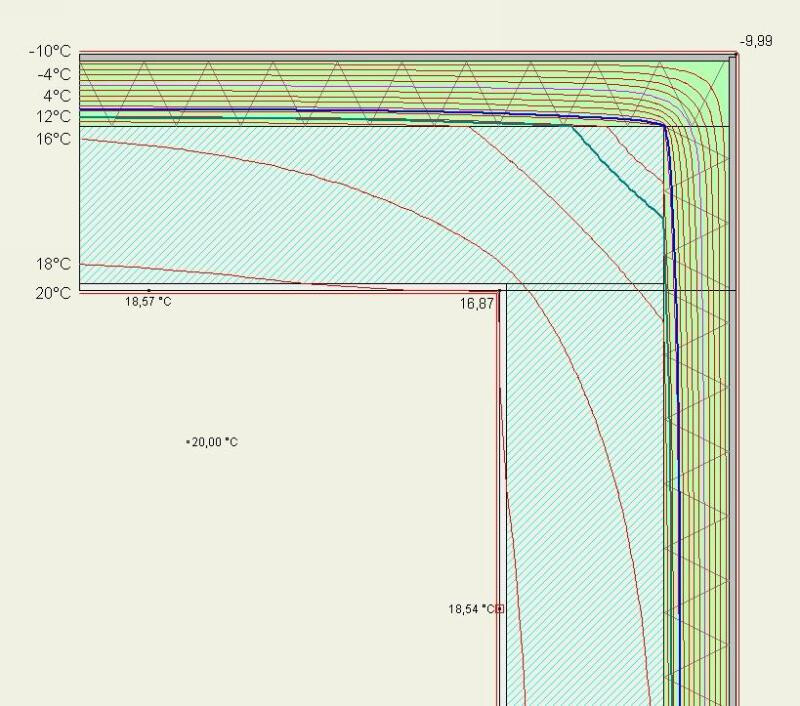
I think it's simply that air doesn't circulate as easily in the corners. This results in colder areas that aren't exposed to convection.
This won't be a problem at all once all the material has properly dried and you've adjusted the ventilation. I would avoid cladding the walls until the condensation stops, and if you want to continue working already, it goes much faster if you use a dehumidifier.
Nowadays, most skilled builders and designers are so aware of thermal bridges that it's probably not the problem. The same goes for the amount of insulation.
I think it's simply that air doesn't circulate as easily in the corners. This results in colder areas that aren't exposed to convection.
This won't be a problem at all once all the material has properly dried and you've adjusted the ventilation. I would avoid cladding the walls until the condensation stops, and if you want to continue working already, it goes much faster if you use a dehumidifier.