
5,833 views ·
10 replies
6k views
10 replies
Concrete subfloor - how does it work?

I have discovered that the trossbotten (i.e., the ceiling in the basement) in my house from '36 consists of 6-8 cm thick concrete with ~8-16 gravel as ballast. From the cracks in the basement ceiling that I have carefully chipped away, I have so far found 4 steel beams. The beams are 7 cm wide.
1. Any spontaneous comments regarding this trossbotten with beams? Seems quite strong for a house of about 65sqm!? The guy who built the house was a welder...
2. Where can I find information about the above construction so that I can better understand it, find out what else I might find in it, its strength, etc.?
FWIW;
I have previously seen that a non-load-bearing interior wall (standing timber 2"*7) rests directly on the trossbotten and was nailed at an angle to a 2"*6 board that was attached to the trossbotten.
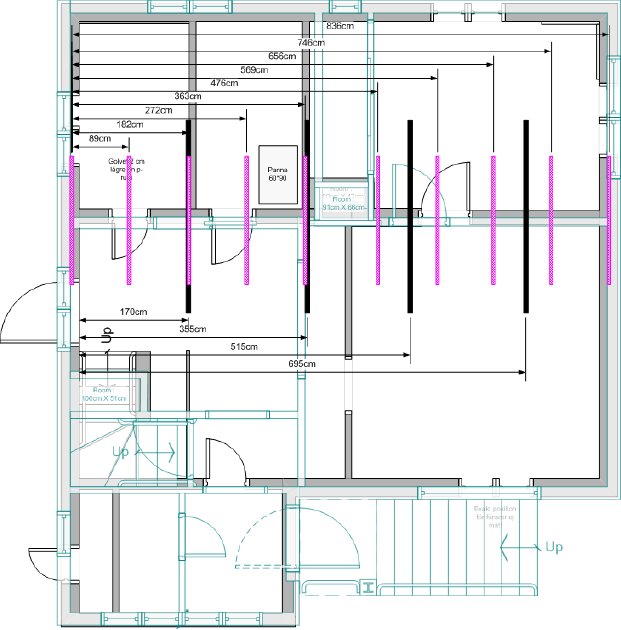
In the image below, the basement walls are dark gray, the living area is semi-transparent green, the roof trusses are pink, and the steel beams are black. Note that I have only confirmed the steel beams in the slightly wider basement rooms, the lower row in the image. Whether they extend across the entire width of the house, i.e., also into the slightly narrower rooms (top of the image), I do not know yet.
The outer walls of the basement are 28 cm thick including plaster, these as well as the central wall are made of concrete hollow blocks (I think that's what it's called). The interior walls are 9-10 cm of dark gray stone that crumbles when you look at them...
1. Any spontaneous comments regarding this trossbotten with beams? Seems quite strong for a house of about 65sqm!? The guy who built the house was a welder...
2. Where can I find information about the above construction so that I can better understand it, find out what else I might find in it, its strength, etc.?
FWIW;
I have previously seen that a non-load-bearing interior wall (standing timber 2"*7) rests directly on the trossbotten and was nailed at an angle to a 2"*6 board that was attached to the trossbotten.
In the image below, the basement walls are dark gray, the living area is semi-transparent green, the roof trusses are pink, and the steel beams are black. Note that I have only confirmed the steel beams in the slightly wider basement rooms, the lower row in the image. Whether they extend across the entire width of the house, i.e., also into the slightly narrower rooms (top of the image), I do not know yet.
The outer walls of the basement are 28 cm thick including plaster, these as well as the central wall are made of concrete hollow blocks (I think that's what it's called). The interior walls are 9-10 cm of dark gray stone that crumbles when you look at them...

Your house structurally resembles our own place a lot:
- 70 square meters of house area
- Built in 1939
- Concrete joist floor with embedded steel beams
- Basement walls made of concrete hollow blocks
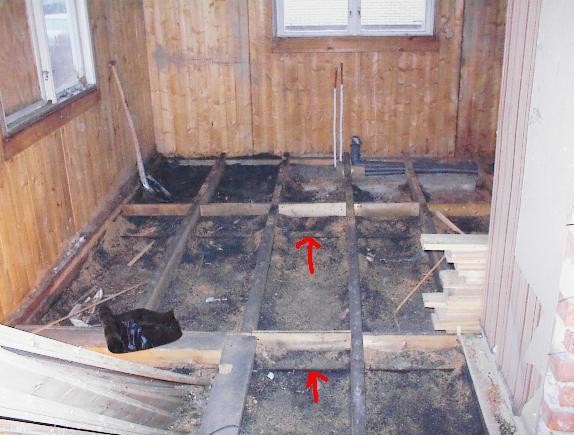
I have no idea what profession the people who built the house had, but for them also to be welders or just happened to have access to steel beams seems far-fetched, right? I think that was simply how they built our types of houses back then. Unfortunately, I don't have any info about the construction method but I do know that our steel beams run almost from outer wall to outer wall. The arrows on the picture mark the beams.
- 70 square meters of house area
- Built in 1939
- Concrete joist floor with embedded steel beams
- Basement walls made of concrete hollow blocks
I have no idea what profession the people who built the house had, but for them also to be welders or just happened to have access to steel beams seems far-fetched, right? I think that was simply how they built our types of houses back then. Unfortunately, I don't have any info about the construction method but I do know that our steel beams run almost from outer wall to outer wall. The arrows on the picture mark the beams.
I have the same construction in a 1930s house in Stockholm with a building area of 75 sqm. I think it's typical for the time. Concrete with beams, then wooden joists on top, tongue-and-groove boards, and possibly parquet. The gap is filled with potash. It seems extremely stable. One problem I encountered was when I needed to run new drainage and water pipes and go over/through a beam. I had to adjust the piping for the 110 mm pipe a bit, but I drilled through the beam in two places (50 mm pipe for the sink and two pipe-in-pipe for water). Then I cast the whole thing again.
That ash itches nicely in the eyes when it comes down 
Concrete and ash don't really insulate well. Sometimes very cold floors. I suspect Starfighter addresses that, but in my case, as I'm not planning to tear up the floors in the living area in that way...
What spacing do you have between the steel beams?
Is there any reinforcement across the beams supporting the concrete, or how does it really work?!
Have you had any hesitation about making "alterations" to walls other than the structural one in the basement and other floors?
Concrete and ash don't really insulate well. Sometimes very cold floors. I suspect Starfighter addresses that, but in my case, as I'm not planning to tear up the floors in the living area in that way...
What spacing do you have between the steel beams?
Is there any reinforcement across the beams supporting the concrete, or how does it really work?!
Have you had any hesitation about making "alterations" to walls other than the structural one in the basement and other floors?
That ash itches nicely in the eyes when it comes down [Answer yes! but I've only shoveled from above. Currently, I'm scooping out ash from a small 2 sqm hall, which will be re-cast with underfloor heating]
Concrete and ash don't insulate very well. Sometimes very cold floors. I suspect Starfighter addresses it, but in my case, I'm not planning to rip up the floors in the living area that way... [I'm going to furnish the basement and insulate the basement slab, so it'll probably be a bit warmer above. Today I only have emergency heating in the basement and thus cold floors above...]
What is the distance between the steel beams? [Don't know, I've just encountered one...]
Is there any reinforcement across the beams that holds up the concrete, or how does it really work!? [I've found reinforcement, about 6-8 mm, when I've drilled down pipes and such, so sure there is reinforcement, at least in my house]
Have you had any hesitation about making "interventions" on walls other than the heart wall in the basement and other floors? [I've cast a foundation for a fireplace. Sawed up parquet and subfloor, scooped out the ash, alternated a wooden beam, and cast in a reinforced slab with drilled rebar in the heart wall underneath). With such luck, I ended up with the foundation almost in the middle of the heart wall in the basement below. The heart wall is about 20-25 cm brick. Then it turned out that when I was connecting the fireplace to the chimney, there was a wooden wall to the chimney, standing grooved planks (the space between the wood and chimney was filled with sand). Neither I nor the chimney sweep liked the wood. Eventually, we agreed that I would saw off three standing grooved planks right where the smoke pipe was to connect in the stock. This way, the smoke pipe connection didn't come near wood. I filled the space after the sawed-off planks with masonry leca to come out flush with the plank wall. On the outside, I placed double masterboards. I was a bit nervous when I cut three standing planks, but it worked great. For safety, I had two props on a beam in the ceiling, which I removed after screwing in the masterboard panels that then held it all together. Otherwise, I won't (read: don't dare to) touch any other walls except that I'll widen a door in the basement by a decimeter or so. All my basement walls are brick. All the walls in the floors above are standing grooved planks in a dimension I've never seen before (sleeper-like). Additionally, there are horizontal grooved boards outside the planks. It's a bit impressive how they used to build in the old days when you take on these kinds of projects...]
Concrete and ash don't insulate very well. Sometimes very cold floors. I suspect Starfighter addresses it, but in my case, I'm not planning to rip up the floors in the living area that way... [I'm going to furnish the basement and insulate the basement slab, so it'll probably be a bit warmer above. Today I only have emergency heating in the basement and thus cold floors above...]
What is the distance between the steel beams? [Don't know, I've just encountered one...]
Is there any reinforcement across the beams that holds up the concrete, or how does it really work!? [I've found reinforcement, about 6-8 mm, when I've drilled down pipes and such, so sure there is reinforcement, at least in my house]
Have you had any hesitation about making "interventions" on walls other than the heart wall in the basement and other floors? [I've cast a foundation for a fireplace. Sawed up parquet and subfloor, scooped out the ash, alternated a wooden beam, and cast in a reinforced slab with drilled rebar in the heart wall underneath). With such luck, I ended up with the foundation almost in the middle of the heart wall in the basement below. The heart wall is about 20-25 cm brick. Then it turned out that when I was connecting the fireplace to the chimney, there was a wooden wall to the chimney, standing grooved planks (the space between the wood and chimney was filled with sand). Neither I nor the chimney sweep liked the wood. Eventually, we agreed that I would saw off three standing grooved planks right where the smoke pipe was to connect in the stock. This way, the smoke pipe connection didn't come near wood. I filled the space after the sawed-off planks with masonry leca to come out flush with the plank wall. On the outside, I placed double masterboards. I was a bit nervous when I cut three standing planks, but it worked great. For safety, I had two props on a beam in the ceiling, which I removed after screwing in the masterboard panels that then held it all together. Otherwise, I won't (read: don't dare to) touch any other walls except that I'll widen a door in the basement by a decimeter or so. All my basement walls are brick. All the walls in the floors above are standing grooved planks in a dimension I've never seen before (sleeper-like). Additionally, there are horizontal grooved boards outside the planks. It's a bit impressive how they used to build in the old days when you take on these kinds of projects...]
Above all, the ash itches in the lungs and nose. I can't remember how many bags we took to recycling. They do weigh quite a bit, and there was at least one bag that broke open at the bottom just as we were about to load it into the car...
I would guess that the distance between the beams is about 130 - 140 cm after checking some photos. If you want, I can do an actual measurement. (I'll try to remember it when I get home tonight)
I haven't encountered any other reinforcement, but I haven't made that many holes in the slab. From a construction standpoint, it must be reinforced to stay together, right?
Sure, I've hesitated when drilling holes in the load-bearing wall on both the upper and lower floors above each other, but everything has gone well, and the house is still standing. I didn't hesitate as much when I removed some walls here and there because they weren't load-bearing walls.
I would guess that the distance between the beams is about 130 - 140 cm after checking some photos. If you want, I can do an actual measurement. (I'll try to remember it when I get home tonight)
I haven't encountered any other reinforcement, but I haven't made that many holes in the slab. From a construction standpoint, it must be reinforced to stay together, right?
Sure, I've hesitated when drilling holes in the load-bearing wall on both the upper and lower floors above each other, but everything has gone well, and the house is still standing. I didn't hesitate as much when I removed some walls here and there because they weren't load-bearing walls.
Thank you both for your input! I'm starting to feel a bit more confident about what one can and cannot do. Starfighter, if it's easy for you to get the measurements, it would be appreciated, but it might not be that important...
I will probably try to keep searching to see if I can find any more written information about the construction method. It's always fun to know what you're doing
I will probably try to keep searching to see if I can find any more written information about the construction method. It's always fun to know what you're doing
I just (an hour ago) dug out ash from my hallway and found yet another steel beam that was positioned "differently" compared to the one I encountered before!!! In other words, it seems like they've laid a "grid" of beams in my house, going from long side to long side and from short side to the middle of the house I guess (the central wall). Fortunately, the beam I found now wasn't in the way of the waterborne underfloor heating that will be cast into the hallway. It was located right next to a wall.
It was not possible to get exact clarity on the measurements between the beams without drilling. Between the beam I can see in the basement ceiling and the crack at the next beam, I would guess about cc 120 - 125 cm, while on the ground floor from the photo above, I would estimate about cc 130 - 135 cm. Since these are different beams I compared, my guess is that they were laid out by eye and not been very precise with the measurements. I haven't encountered any beams in the other direction as was suggested, but mine run from long side to long side.
If you find any more information about the construction method, I would appreciate if you share it, it's always good to have!
If you find any more information about the construction method, I would appreciate if you share it, it's always good to have!
Pickup sticks with steel beams thus... Hmm, having beams crosswise is interesting. I haven't seen any such signs so far but will check carefully. Maybe one could try with a "rule detector"...
I'll keep you informed if I find anything. We can revive the thread when we come across something!
I'll keep you informed if I find anything. We can revive the thread when we come across something!
Ahem, a little embarrassing when I wrote the description myself.... The book "Småstugebygge genom eget arbete" is a goldmine
On the other hand, my version, steel beams, concrete, and coarse gravel, isn't exactly described :'( ;D
http://www.swehjo.com/diverse/bilder/bjalklag_01.jpg
http://www.swehjo.com/diverse/bilder/bjalklag_02.jpg
http://www.swehjo.com/diverse/bilder/bjalklag_03.jpg
http://www.swehjo.com/diverse/bilder/bjalklag_04.jpg
http://www.swehjo.com/diverse/bilder/bjalklag_05.jpg
http://www.swehjo.com/diverse/bilder/bjalklag_06.jpg
http://www.swehjo.com/diverse/bilder/bjalklag_07.jpg
http://www.swehjo.com/diverse/bilder/bjalklag_08.jpg
http://www.swehjo.com/diverse/bilder/bjalklag_09.jpg
http://www.swehjo.com/diverse/bilder/bjalklag_10.jpg
http://www.swehjo.com/diverse/bilder/bjalklag_11.jpg
http://www.swehjo.com/diverse/bilder/bjalklag_12.jpg
http://www.swehjo.com/diverse/bilder/bjalklag_13.jpg
The book "Småstugebygge genom eget arbete" is a goldmine On the other hand, my version, steel beams, concrete, and coarse gravel, isn't exactly described :'( ;D
http://www.swehjo.com/diverse/bilder/bjalklag_01.jpg
http://www.swehjo.com/diverse/bilder/bjalklag_02.jpg
http://www.swehjo.com/diverse/bilder/bjalklag_03.jpg
http://www.swehjo.com/diverse/bilder/bjalklag_04.jpg
http://www.swehjo.com/diverse/bilder/bjalklag_05.jpg
http://www.swehjo.com/diverse/bilder/bjalklag_06.jpg
http://www.swehjo.com/diverse/bilder/bjalklag_07.jpg
http://www.swehjo.com/diverse/bilder/bjalklag_08.jpg
http://www.swehjo.com/diverse/bilder/bjalklag_09.jpg
http://www.swehjo.com/diverse/bilder/bjalklag_10.jpg
http://www.swehjo.com/diverse/bilder/bjalklag_11.jpg
http://www.swehjo.com/diverse/bilder/bjalklag_12.jpg
http://www.swehjo.com/diverse/bilder/bjalklag_13.jpg
Click here to reply