
43,586 views ·
53 replies
44k views
53 replies
Coloring and stamping or patterning concrete
Built a dust collector using two standard angle grinder splash guards and a brush strip. They worked really well, but keep in mind that the lifespan of a cheap angle grinder when grinding with such a disc is between 30 seconds and 20 minutes. A really large filter is more important than a powerful vacuum cleaner. If it gets too tight at the brush and you have a too powerful machine, it will just stick. I have probably ground 25 square meters of plaster/paint from the basement wall and floor with that solution.

I have a Lidl angle grinder that is already a little broken but that I have managed to repair so it's good enough to work with. Plus a 10-year-old polishing machine that's been with me. With good dust collection, you should be able to extend the lifespan. We'll see how it goes.
What is recommended for filling the holes, self-leveling compound? Biltema's is the only self-leveling compound I've found that's recommended for outdoor use.
What is recommended for filling the holes, self-leveling compound? Biltema's is the only self-leveling compound I've found that's recommended for outdoor use.
It is possible to grind concrete with a steel cup brush otherwise, it removed the outer "skin" and left a rather nice and interesting surface. We'll see if there will be any leveling compound, a bit "rough" looks quite interesting....
Very FRUSTRATING! It feels like everything is going wrong...
I ordered a sink online thinking it was like the one we have in the kitchen, just make a hole for the sink itself and place the rest on top with the edges resting on the countertop. But no, it’s some design that's completely bizarre; you're supposed to make a really large hole for this design, not just for the sink itself but the whole thing, otherwise, it sits about a centimeter above the countertop...
Wondering what to do now... maybe a new sink, or is it possible to cast a sink in concrete after making the countertop? I've been under the impression they must be cast at the same time as the countertop.
EDIT: It strikes me that it might not be bizarre but probably normal, just me with little experience and making assumptions, sigh...
I ordered a sink online thinking it was like the one we have in the kitchen, just make a hole for the sink itself and place the rest on top with the edges resting on the countertop. But no, it’s some design that's completely bizarre; you're supposed to make a really large hole for this design, not just for the sink itself but the whole thing, otherwise, it sits about a centimeter above the countertop...
Wondering what to do now... maybe a new sink, or is it possible to cast a sink in concrete after making the countertop? I've been under the impression they must be cast at the same time as the countertop.
EDIT: It strikes me that it might not be bizarre but probably normal, just me with little experience and making assumptions, sigh...
Last edited:

Best with a picture:
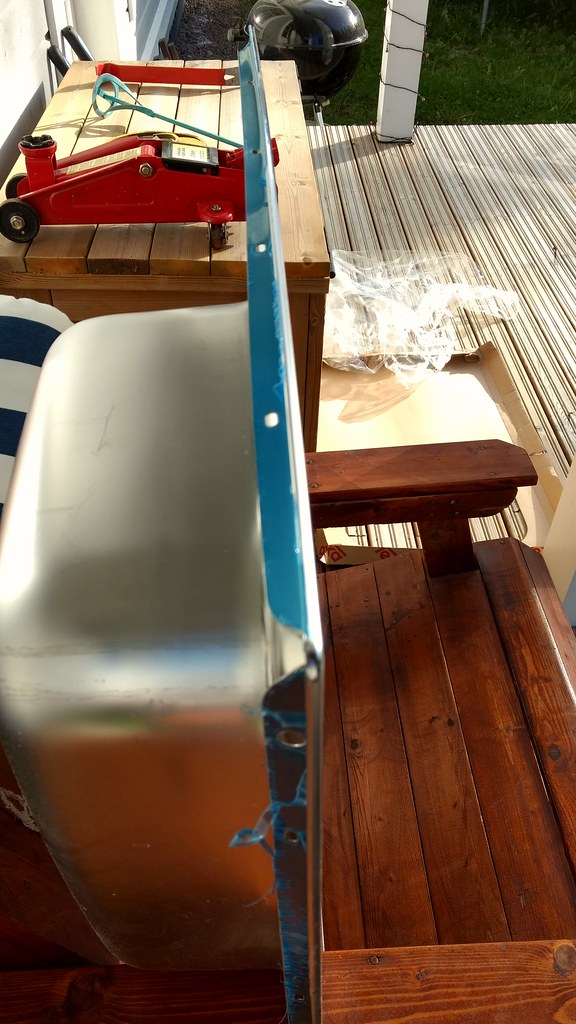
Considered removing the edges with an angle grinder first, but that wouldn't work either because further in parts of the sink are recessed, so it still wouldn't sit flush against the surface. You would need to cut a larger hole in the board in that case, which feels extreme and wasteful.
Considered removing the edges with an angle grinder first, but that wouldn't work either because further in parts of the sink are recessed, so it still wouldn't sit flush against the surface. You would need to cut a larger hole in the board in that case, which feels extreme and wasteful.
Can't you saw the hole? Should be possible to solve by putting a metal frame around it. The corners are tricky, I would have used a diamond disc on a dremel. Once it fits perfectly, I would have glued it from underneath. I cast a small concrete sink at the same time as the slab, probably works well to do it afterwards too. But I would probably try to use what I already had at home.
I've actually been thinking about that. A Dremel and diamond blade are on a smaller scale than I was considering, though. I think I can lay down the disc and mark it with a pen, then cut it out with a diamond blade, about a centimeter or so (I need to measure exactly how much it should be recessed), then take down the whole surface inside by the same amount so there’s a recess in the concrete.
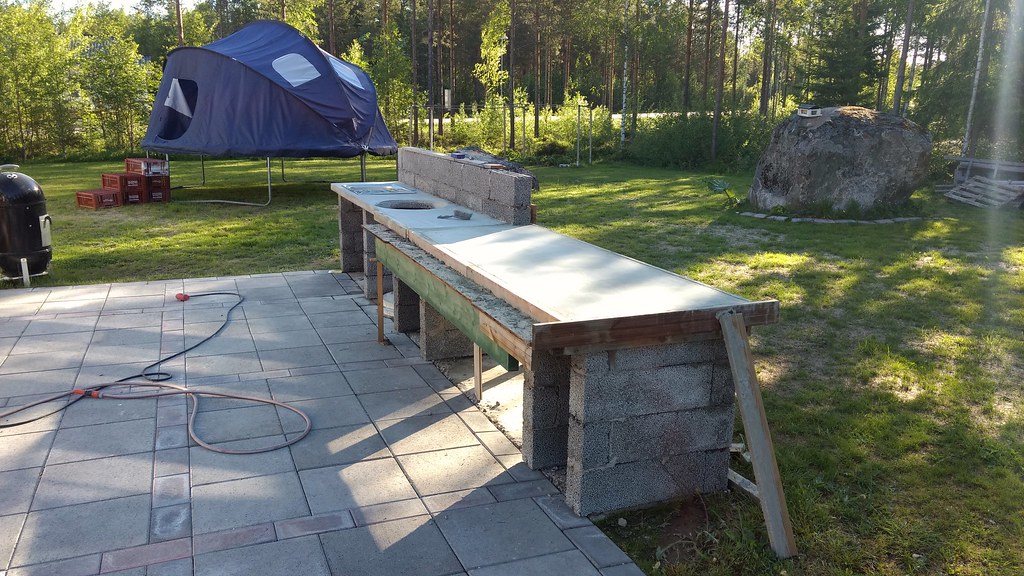
Yesterday, I cast the second part of the slab, and it went much better. I had access to the mold from both sides, so it was no problem to strip the form and get everything smooth. Then I ignored the recipe on the bag, it was entirely inappropriate and caused issues.
I mixed 10l of stone, 30l of sand with half a bag of cement, then added water until the right consistency.
Unfortunately, the cement mixer gave up just as I was finished as well... The bearing in the middle gave out somehow, so the container moves back and forth on the shaft. It slides too far back on the shaft, so it takes too much on the gear and makes a hell of a noise. So now I need to see if it's fixable...
Also sanded the surface I’ve already cast, but I think I'll have to use self-levelling compound anyway.
Yesterday, I cast the second part of the slab, and it went much better. I had access to the mold from both sides, so it was no problem to strip the form and get everything smooth. Then I ignored the recipe on the bag, it was entirely inappropriate and caused issues.
I mixed 10l of stone, 30l of sand with half a bag of cement, then added water until the right consistency.
Unfortunately, the cement mixer gave up just as I was finished as well... The bearing in the middle gave out somehow, so the container moves back and forth on the shaft. It slides too far back on the shaft, so it takes too much on the gear and makes a hell of a noise. So now I need to see if it's fixable...
Also sanded the surface I’ve already cast, but I think I'll have to use self-levelling compound anyway.
I found this link when I was looking for tips on surface treatments for concrete, linolja? Sounds interesting, I like the black look. But how does it hold up in the long run, I wonder? I wonder how it fares in combination with a polished surface and exposed aggregate....
http://lundagard.blogspot.fi/2010/10/hur-vi-har-behandlat-var-gjutna.html
Maybe I should test on a small area, like under the sink that I also started fitting yesterday, I have a little left but it almost fits now, should turn out well.... Such a shame about all the dust!
http://lundagard.blogspot.fi/2010/10/hur-vi-har-behandlat-var-gjutna.html
Maybe I should test on a small area, like under the sink that I also started fitting yesterday, I have a little left but it almost fits now, should turn out well.... Such a shame about all the dust!
I made the same discovery last year when I asked for treatment of a concrete slab in the paint store and got a can of "wood oil" in my hand...  It mostly contained linseed oil.
It worked well, the concrete darkened slightly and became a bit more yellow from just that oil. Now a year later, it seems to have disappeared, so I guess you have to repeat the treatment every year...
It mostly contained linseed oil.It worked well, the concrete darkened slightly and became a bit more yellow from just that oil. Now a year later, it seems to have disappeared, so I guess you have to repeat the treatment every year...

Sinuslinus:
There's just too much work with formwork and tearing down again and so on. I don't have the energy or motivation for it... I think it has started to look acceptable myself, the grinding I've been doing brought out a nice surface with exposed aggregate that I like. A bit more fine-tuning and it will probably be good. Right now, I'm thinking about the finish.
Mexibrick, I'm not too worried about it, there are food-safe products meant for concrete countertops, although I wonder if they work together. For example, I've looked at this before:
https://www.wsochcompany.se/ytbehan...l-betong-och-sten/topper-for-betong-och-golv/
There are so many products for this that it becomes confusing.
There's just too much work with formwork and tearing down again and so on. I don't have the energy or motivation for it... I think it has started to look acceptable myself, the grinding I've been doing brought out a nice surface with exposed aggregate that I like. A bit more fine-tuning and it will probably be good. Right now, I'm thinking about the finish.
Mexibrick, I'm not too worried about it, there are food-safe products meant for concrete countertops, although I wonder if they work together. For example, I've looked at this before:
https://www.wsochcompany.se/ytbehan...l-betong-och-sten/topper-for-betong-och-golv/
There are so many products for this that it becomes confusing.