Hello, I am in the planning stage of building a rather long fence and have been looking around to find the best method to attach the posts. Buy concrete bases?, cast your own bases or cast the post directly in the ground?. I've noticed that the last method seems to be very popular in many other countries than Sweden but why is that technique so unpopular here? As a layman, I would think that it should be very stable and that a treated post should last quite a long time before it would rot. Correct me
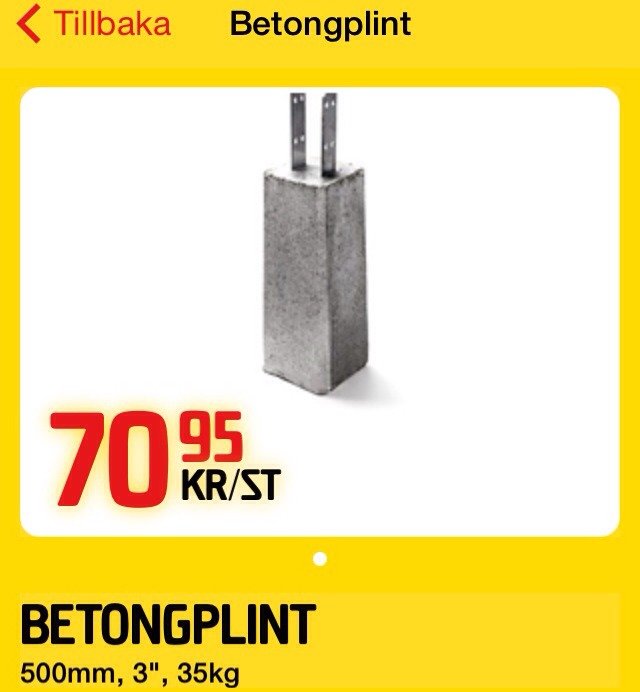
We installed a new fence 95 cm high for the residential association's playground and used ready-made footings from Byggmax with posts 70x70, fastened with two lag screws in each footing.
I had reservations about this method, I would have preferred to cast the footings instead, but I was wrong. It turned out surprisingly stable.
It would probably work to cast the posts directly, but it seems like a more questionable method, perhaps shorter lifespan for the posts and harder to replace.
The method as such is okay for putting up the fence. It is when it has served its purpose that problems arise for the responsible and environmentally conscious owner. When pressure-treated wood needs to be separated from concrete.
Use posts. Buy or follow the method above and cast directly in the ground, but insert post brackets, and don't skimp on the concrete. Otherwise, all posts will have to be dug up/replaced in about 25 years when the fence has served its time and needs to be replaced. It might not be your headache, but the person who owns the place then won't have any kind thoughts of you.
I have cast two fence posts (with post brackets) and installed one ready-made. The first was cast with one sack of pre-mixed concrete (20-25kg). It wasn't stable enough. The second was cast with two sacks, and it was okay. The one with the ready-made post feels the best, but of course, it could be because it's standing in slightly more stable ground. The two self-cast posts are in clay soil, and it almost turns into water with zero load-bearing capacity/stability during the winter months.
I have cast ground anchors and they turned out well and stable. I cut a bit off the length at the bottom and made them splay outwards, then I cast them in a dug hole. No problem to replace the pole if something happens. http://www.byggmax.se/spik-och-skruv/byggbeslag/jordankare-p238245
If I were to build a fence, I would look at two main methods.
Simple, cheap fence -> Ground auger and drive fence posts into the ground.
More expensive fence/plank -> Concrete base for the posts. Makes maintenance much easier.
Now, the thread starter is probably done, but I stumbled upon this method while watching YouTube
A 2-component polyurethane mixture that replaces concrete.
It looks very convenient, there are also videos where they compare the force required to pull the post out of the ground, the foam obviously beats the concrete.
A wooden post should fare better in the foam than in concrete, no moisture and it insulates well against cold.
Has anyone seen this in Sweden before? Is it available for purchase?
Sika has a product called "post fix," but it doesn't seem to be available here.
I built a small house for the trash bins in 2017.
Just 4 posts, but 2 and 1.8 high respectively.
Dug 4 holes about 60 cm deep.
Aligned the posts and filled around with regular joint foam from Biltema.
I built a small house for the trash bins in 2017. Only 4 posts, though 2 and 1.8 high. Dug 4 holes about 60 cm. Aligned the posts and filled around with regular joint foam from Biltema.
Topped with macadam.
Solid as a rock. More stable than ground anchors.
Very interesting.
How does it hold up today after winters and such?
Concrete preserves the embedded wood because it is alkaline. The post rots where it protrudes from the concrete plinth and not in the plinth itself. I have embedded NTR-A-classified posts in concrete in the garden for about 15 years and still no rot damage.
I wonder if it is the same with urethane foam? It is not alkaline like concrete.
Concrete preserves the embedded wood because it is alkaline. The post rots where it protrudes from the concrete slab and not in the slab itself. I have cast NTR-A-classified posts in concrete in the garden about 15 years ago and still no signs of rot.
I wonder if it's the same with urethane foam? It's not alkaline like concrete.
I don't know, but as you say, concrete preserves. Therefore, one can embed wood without major problems. Treated or not.
Foam doesn't preserve. But when the ground dries out (more or less), the post can recover... maybe.
I imagine that the day the wood rots, it probably doesn't matter much anyway.
I have cast down ground anchors and it turned out well and stable. I cut off a bit at the bottom and made them spread outwards, then I cast them in a dug hole. No problem changing the post if something happens. [link]
Old thread but I'll try How big a hole did you dig? And did you cast the entire post or drive it down a bit first?





Claes Sörmland said:
Concrete preserves the embedded wood because it is alkaline. The post rots where it protrudes from the concrete slab and not in the slab itself. I have cast NTR-A-classified posts in concrete in the garden about 15 years ago and still no signs of rot.