I'm about to build a hobby garage where I plan to have a recessed scissor lift (I chose the Jema JA601S), have received help with building permits and construction drawings, and this has been on hold for a while, but now I've received the go-ahead and am in the starting phase to begin. However, I've started to reconsider the choice of solution and just wanted to discuss here to get some input and perspective on the matter.
Some background info about the lift that's worth considering in the discussion:
The minimum installation depth is 115mm, the maximum lift height is 1800mm, and the specified concrete thickness is >270mm (-115mm), i.e., >155mm.
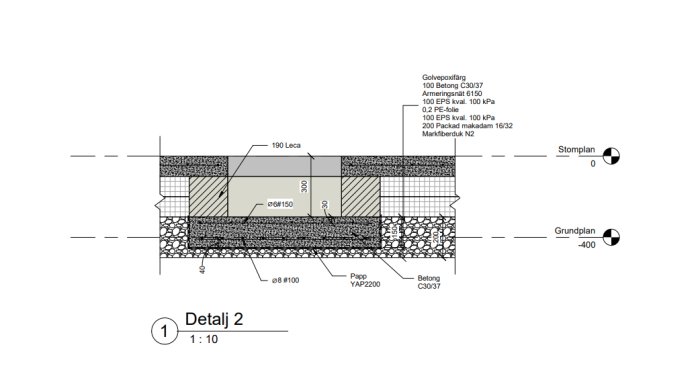
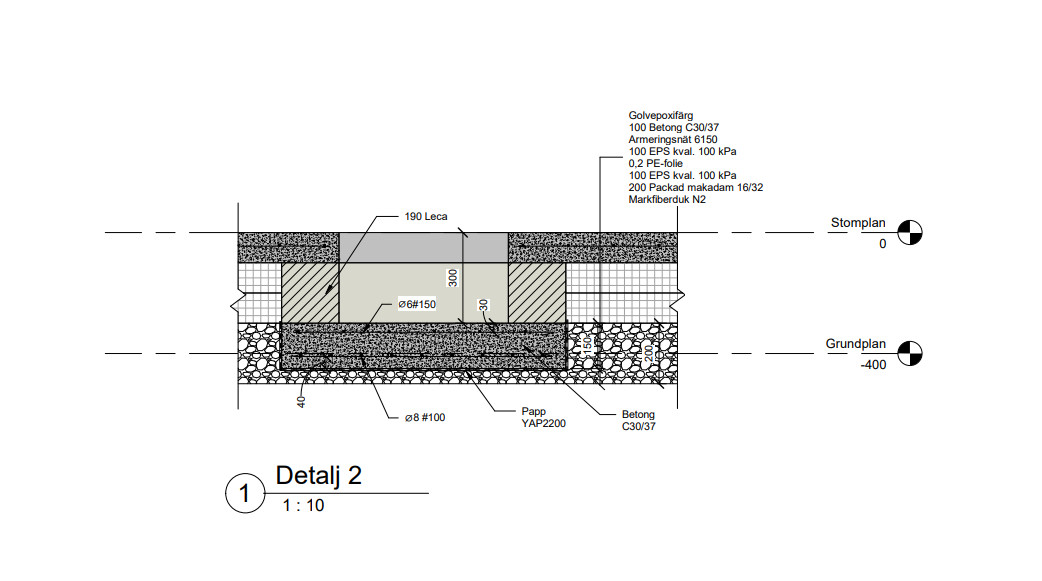
Let's start with the original construction:
I'm not an expert and can't provide exact details on why it's done the way it is, but I GUESS the idea of casting the recess in paper is to ensure moisture safety since that concrete is in the gravel and below the drainage depth. I ALSO GUESS that LECA blocks are partly chosen to create a "smooth transition" from uninsulated concrete to insulated concrete. Thoughts on this?
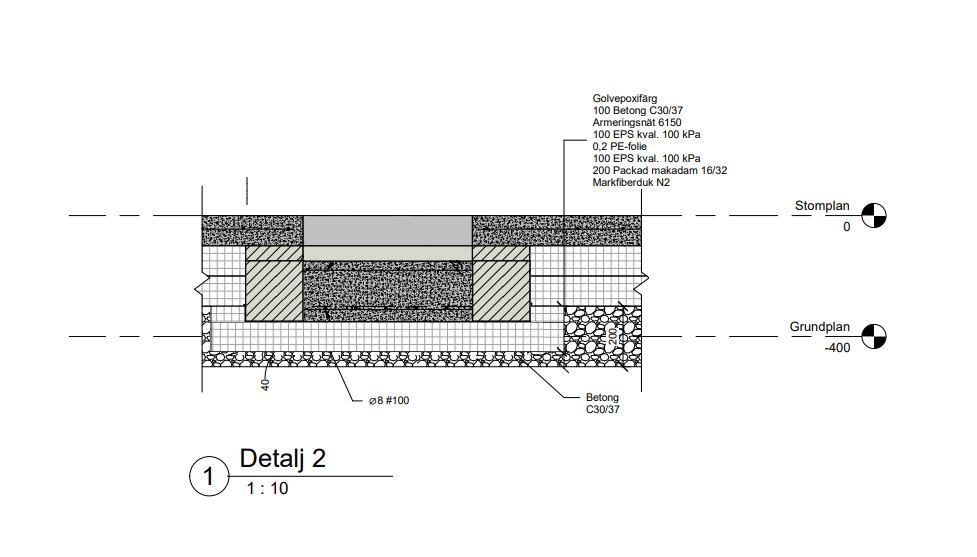
I've made some modified proposals that I consider could be more practical for my solution or might have some advantages in my case. However, I could be completely wrong, so constructive criticism is welcome!
Let's go through the different proposals.
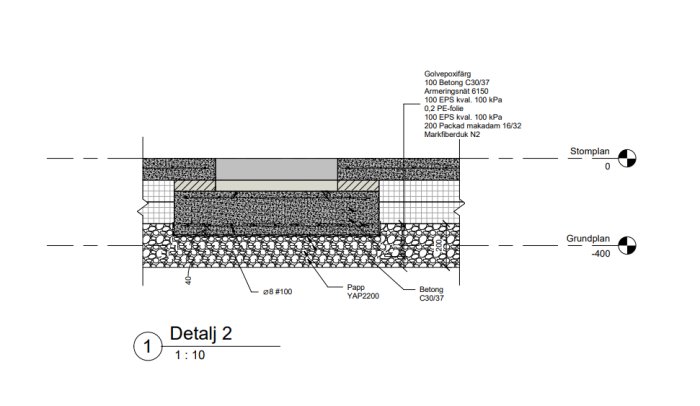
Rev 2:
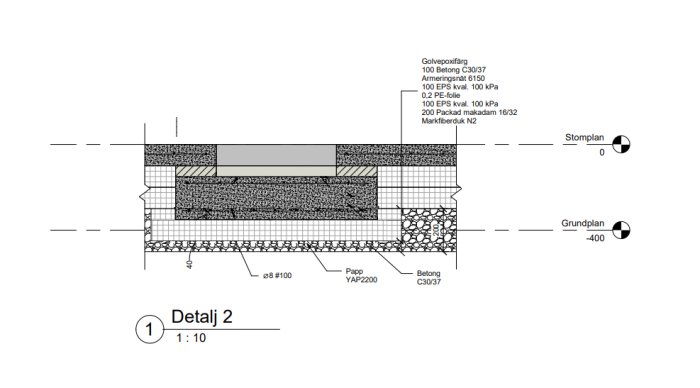
Rev 3:
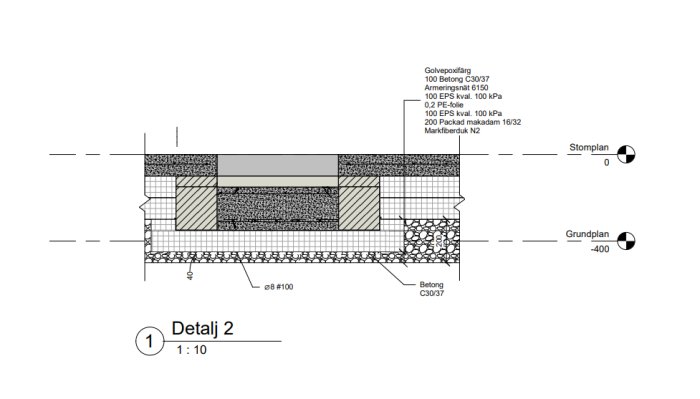
Rev 4:
What I primarily aimed for is to reduce the height of the recess to not affect the lift's maximum height. I'm 1.85 meters tall, and you can count on lifting at the thresholds with lift cushions in between, and you obviously want to be able to walk under the lift without risking hitting your head on protruding details like exhaust edges, etc.
On a friend's recommendation, I've played with the idea of insulating all the concrete, increasing the concrete thickness (his opinion is that you always place a lift on 200mm concrete), he also thinks you should cast everything as one piece, etc. I can't exactly determine the constructional impact of the different proposals, but I obviously don't want to create any issues with moisture, thermal bridges, possible future cracking, risk of the lift collapsing with me underneath, etc.
Some technical questions that arise are:
1. Should everything preferably be cast as one piece?
2. How should you approach gravel and drainage depth? Should it be adjusted a bit, or can you assume that a couple of relatively small recesses in the middle of the slab are negligible?
3. If you change the concrete from 150 to 200 mm, should you then change the bottom reinforcement? Thinking thicker concrete, greater leverage effect, more tensile force in the bottom reinforcement purely critically?
4. Roofing paper versus foam insulation in the gravel below drainage depth, pros and cons?
5. If you prefer to cast everything in one piece, how should the reinforcement be dimensioned?
6. Minimum height of gravel under the recess? At least 100mm should be appropriate, right?
7. Foam insulation under the recess? Belt and suspenders? EPS200? XPS200?
Am I overthinking it? Should I just pour concrete and go?