
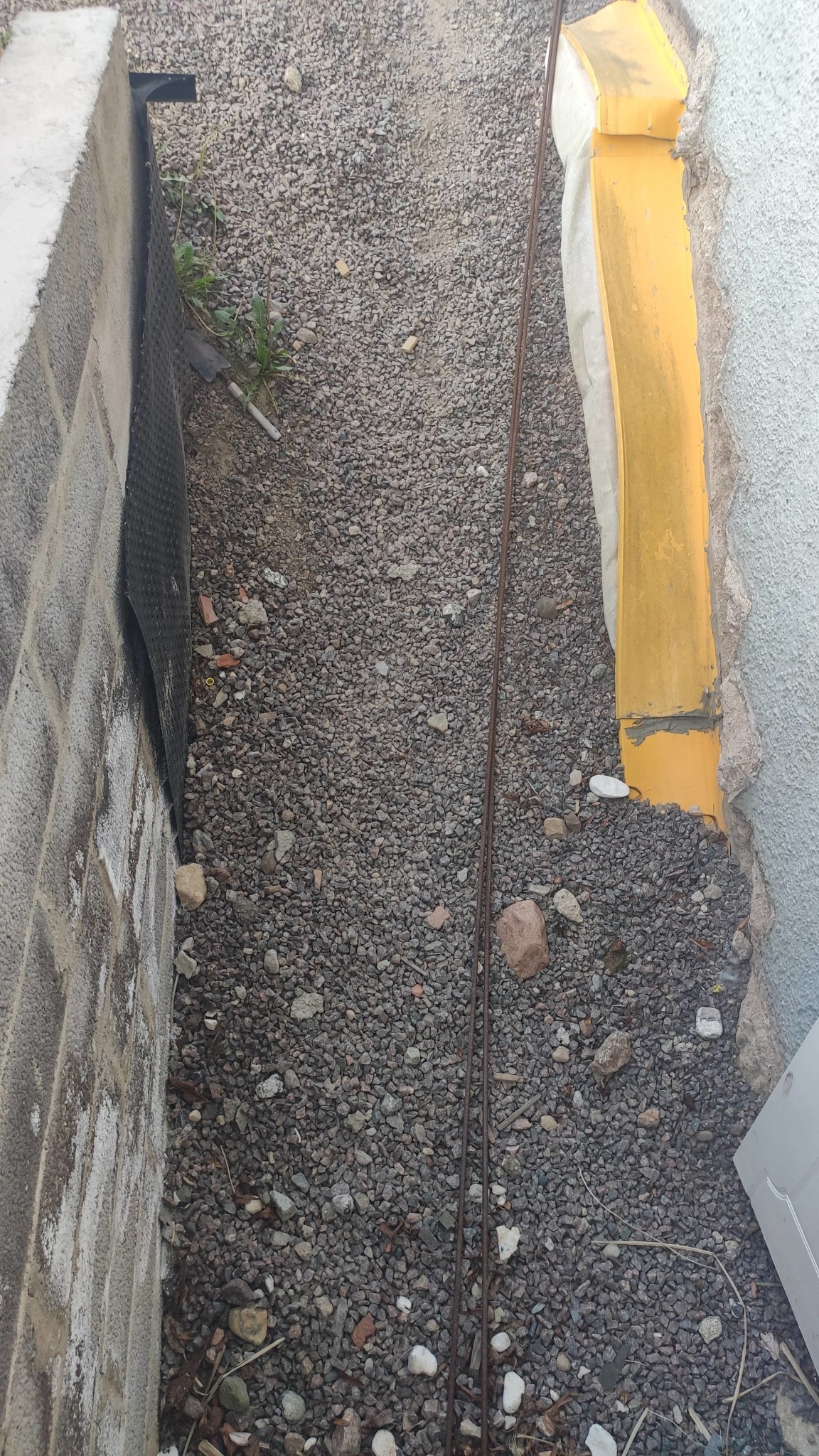
Drained a few years ago and at that time the cellar wall and cellar stairs were removed. The cellar wall has been rebuilt, and the drainage company prepared a gravel bed to cast the stairs. The drainage is against the house and is partially in the way of attaching the stairs to the house wall.
But regarding the actual casting, is it "just" a matter of building a staircase form and starting to cast directly onto the gravel bed? The cellar wall consists of only one short side and one long side. There is no wall where the stairs are supposed to end, it's just a slope with a lot of gravel currently.
My idea is to cast the stairs "freestanding" in the gravel bed if that works, without attaching it to either the wall or the house. Of course, it will be reinforced in the steps themselves, but I wasn’t planning to anchor the reinforcement to the wall or house wall. I'm thinking that the stairs will be heavy enough to stay in place anyway? ... And if the stairs were to move slightly, they wouldn’t take the rebuilt cellar wall made of leca blocks with them. Possibly reinforce the stairs at the bottom where I can attach them to both the house and the wall. Further up it becomes more difficult as the drainage is in the way.
But regarding the actual casting, is it "just" a matter of building a staircase form and starting to cast directly onto the gravel bed? The cellar wall consists of only one short side and one long side. There is no wall where the stairs are supposed to end, it's just a slope with a lot of gravel currently.
My idea is to cast the stairs "freestanding" in the gravel bed if that works, without attaching it to either the wall or the house. Of course, it will be reinforced in the steps themselves, but I wasn’t planning to anchor the reinforcement to the wall or house wall. I'm thinking that the stairs will be heavy enough to stay in place anyway? ... And if the stairs were to move slightly, they wouldn’t take the rebuilt cellar wall made of leca blocks with them. Possibly reinforce the stairs at the bottom where I can attach them to both the house and the wall. Further up it becomes more difficult as the drainage is in the way.
Last edited:
Construction veteran
· Norrland
· 342 posts
How big will the stairs be? It should work to make it entirely self-supporting, as you planned.
A picture probably says a bit more, I'm attaching one hereS Snickarkirre said:

In terms of dimensions, the stairs might be about 160cm "long" and about 110 high max. The width of the steps might be 80 cm, I think I will cast a simple "bike channel" on one side to make it easy to roll bikes up and down.
The gravel in the picture will be filled up a bit more. Under the gravel bed is clay that won't move. It's been like this for a few years now, so everything that needs to settle has likely done so.
The stairs are intended to start just after the door that can be glimpsed in the picture. At the very bottom, there's an opportunity to reinforce the first step against both the house wall and the cellar wall.
A floor will be cast at the bottom as well, which should provide the stairs with some support.
Construction veteran
· Norrland
· 342 posts
Okay, then it will be quite large anyway, and if I understood you correctly, it will be about 160 long, about 80 wide, and ish 110 high? I did a quick calculation, and it should hold approximately 700 liters, making the weight of the staircase 1610 kg. Have you done your own calculation? A cubic meter of concrete weighs about 2.3 tons. So that staircase won't move directly, and you can just cast it without reinforcing it to the house or anything.
Yes, approximate dimensions when I measured quickly. It might be slightly smaller dimensions, but roughly there.S Snickarkirre said:Okay, then it will be quite large anyway, and if I understood you correctly now, it will be about 160 long, about 80 wide, and roughly 110 high? Calculated quickly, it should approximately hold 700 liters, then the weight of the staircase would be 1610kg. Have you done any own calculation? A cubic meter of concrete weighs about 2.3 tons. So that staircase won't go anywhere directly, and you can just cast it without reinforcing it to the house or anything
Nope, haven't done any calculations yet..
I thought I'd check here first to see what's feasible before I start calculating too much or ordering material.
I've been back and forth about whether to cast a staircase or build a wooden one, which is significantly lighter. However, it brings certain challenges as I'm not quite sure how to fix it at the top and bottom and how I would keep the gravel in place, etc.
Therefore, casting came up again..
The amount of concrete, by the way, how many bags does this approximately equate to? I have a concrete mixer, so in that way it's fine, but I need to order roughly the right amount of concrete.
Construction veteran
· Norrland
· 342 posts
Okay, you can make it in wood too, but then you'll probably need to pour two foundations at the bottom or one the same width as the steps for the stringers to rest on and then bolt them down. At the top, it might be possible to pour two small foundations that you can secure the stringers into as well. It's probably easier than casting a staircase on the spot. Usually, concrete stairs are prefabbed up and down, then lifted into place later. But it might not be a bad idea to pour a small footing at the bottom that's recessed into the ground as support for the cast stairs. Or if the staircase casting itself goes into the ground. I thought a little more after I saw your picture, so it's probably good to secure it downward like that so it doesn't start sliding down over time. I think I was a bit mistaken at first. Is it the case that the ground slopes all the way down so the stairs will follow the slope? Then the stairs won't be as "thick" as I initially thought. So then my weight calculation doesn't hold.
Are you planning to mix with cement and then add gravel and sand yourself, or were you thinking of using coarse concrete bags? If you go with coarse concrete, you'll get about 13 liters of concrete per bag.
Are you planning to mix with cement and then add gravel and sand yourself, or were you thinking of using coarse concrete bags? If you go with coarse concrete, you'll get about 13 liters of concrete per bag.
Yes, the ground slopes all the way down, so essentially only the steps need to be cast and reinforced into each other if I cast in concrete. If I cast in concrete, I’ll buy ready-mixed bags and just mix with water. I can’t be bothered to mix everything myself; there has to be a limitS Snickarkirre said:Okay, well you could make it out of wood too, but then you'd probably need two foundations at the bottom or one that’s the same width as the staircase for the stringers to rest on, and then bolt them down. At the top, perhaps you could cast two small foundations to secure the stringers there too. It’s probably easier than casting a staircase on site. Usually, concrete staircases are prefabricated, and then you lift them into place later. But it might not be a bad idea to cast a small footing at the bottom that’s sunk into the ground as a counterhold for the cast staircase. Or if the staircase casting itself goes down into the ground. I thought a bit more after seeing your picture, and it’s probably good to secure it downwards that way so it doesn’t start sliding down over time. I think I was a bit mistaken initially. Is it the case that the ground slopes all the way down so the staircase will follow the slope? Then the staircase won’t be as "thick" as I initially thought. So my weight calculation isn’t accurate.
Are you planning to mix with cement and then add gravel and sand yourself, or were you thinking of using premixed concrete bags? If you're using premixed concrete, you’ll get about 13 liters of concrete per bag.
Even better would be to get a concrete truck here to fill the form, but I think I’ll go the middle way and mix coarse concrete myself.
But then there’s the idea of a wooden staircase I’ve been considering for a while too.. My thought there is to cast the first step at the bottom and cast holders for the stringers there, similarly at the top. But the question is how I should cast the foundation at the top so that it stays put and doesn’t move due to the slope. There’s nothing to hold against the side where the staircase is supposed to be. Unless the staircase itself acts as a counterhold? One idea was to cast against the short side of the basement wall and reinforce the foundation into the basement wall and possibly the house. Then I’d need to build a form above the drainage since I don’t want to disturb that. Against the house, the foundation would be quite thin but deeper just in front of the drainage again.. but the question is how deep you need to cast the foundation at the top, etc. I could dig down a bit and cast something lower down. But going all the way down to the beginning of the basement wall might be a bit difficult.
Yes, I’m not sure if this will work, but I haven’t found any very straightforward solutions for this as it’s built. Before the drainage, there was a wall on the short side where the staircase hung from that wall. Apparently, there was a void under the staircase. But that staircase fell apart quickly when they put the hammer against it..
If I can just find a good way to attach a wooden staircase, I’ll build one because it’s the easiest to handle and construct. With concrete, I’d still have to buy wood since I’d have to build a form
Last edited:
Construction veteran
· Norrland
· 342 posts
Sounds like a good idea to cast the first step down and secure it with something like beam shoes to the stringers. If you dig the foundation about a decimeter below the surface, it will hold the stairs in place if the gravel underneath is somewhat packed. If you can make it so that it sits even more below the ground, that would be even better. Then the stairs can't slide downward. Then at the top, it's enough with something like paving slabs or small foundations where you can bolt beam shoes into something like these https://www.byggmax.se/justerbar-st...0r52XYBCvI_Yi76EI_2-sUaAgktEALw_wcB#913=14408 Then the stairs get support from them when walking on them and at the same time they prevent the foundations/paving slabs from sliding down over time.
Great, thanks a lot for the tips!S Snickarkirre said:Sounds like a good idea to cast the first step below and fasten something like beam shoes to the stringers. If you dig the foundation about a decimeter below the ground, it will hold the stairs in place if the gravel down there is reasonably packed. If you can make it so it lies even more below the ground, that would be even better. Then the stairs cannot slide/shift downwards. Then at the top, just use something like ground plates or small foundations that you anchor beam shoes in, something like these [link] This way, the stairs are supported as you walk on them and at the same time prevent the foundations/ground plates from sliding down over time.
The gravel below is packed, or rather, below the gravel is clay soil so it's probably possible to dig down a bit more and cast a foundation. Then the floor that will be cast there will probably also provide support for the foundation.
I'll probably go for a wooden staircase instead, feels easier in every way, especially if you need to open it up or something similar at some point. If you can get hold of lumber this summer....
Construction veteran
· Norrland
· 342 posts
No worries, just fun to be able to help okay there will be a floor there that needs to be cast, then it’s totally calm, and the stairs will definitely stay. Then it will surely work with a cast staircase too, as the slab will hold it. Yes, it will definitely be easier to build in wood, but it's fully feasible to cast as well. Yes, exactly, it's also an advantage if there should be any issues with drainage or the like, so you don’t have to break away the stairs Yes, it's not the easiest, just hope it loosens soon so they get some in. Good luck!
okay there will be a floor there that needs to be cast, then it’s totally calm, and the stairs will definitely stay. Then it will surely work with a cast staircase too, as the slab will hold it. Yes, it will definitely be easier to build in wood, but it's fully feasible to cast as well. Yes, exactly, it's also an advantage if there should be any issues with drainage or the like, so you don’t have to break away the stairs Yes, it's not the easiest, just hope it loosens soon so they get some in. Good luck!
Click here to reply