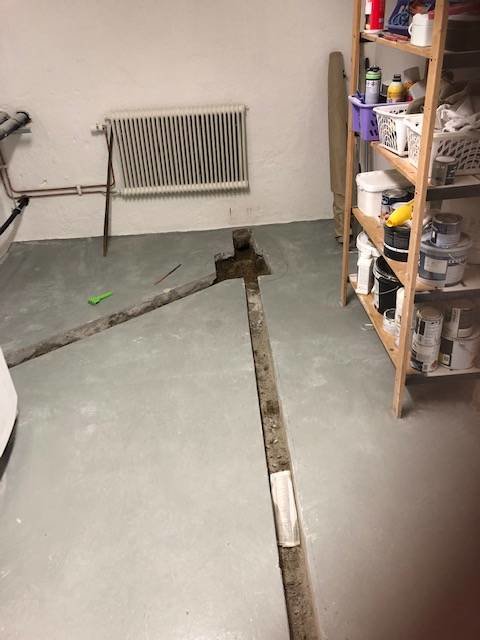
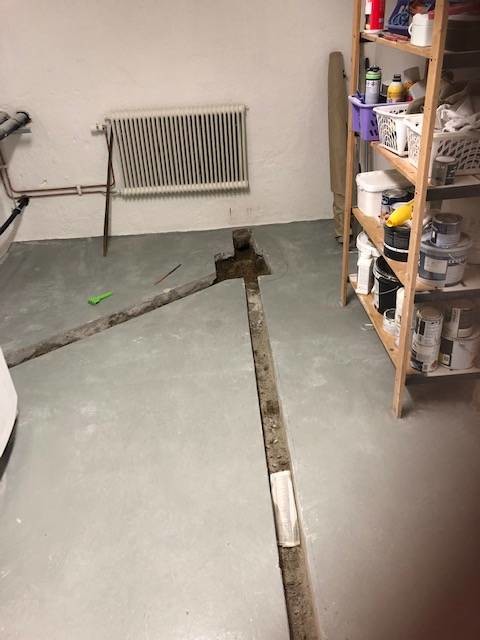
Hello. I've cut up the floor and installed new drainage in the basement. I was planning to interrupt the Christmas break with some lovely concrete work, but I became a bit unsure about something. The channels are at most 15 cm wide, otherwise 10 cm, and the existing slab is 10 cm and not reinforced as far as I've noticed when cutting. Should I try to get some reinforcement/mesh down before the concrete, do you think (a bit tight to drill since it's so narrow), or is it just a matter of wetting the old, priming and pouring? Regards, Hans
The problem will likely be getting it to adhere to the cut surface. If it moves, there's a risk they will slide apart. Hopefully, this prevents it from sliding up or down. For that reason, I would have added short pieces even if I don't believe they add strength.
Good to have some reinforcements at least...
Regardless of reinforcement or not, there will most likely be a shrinkage crack.
The movement between the different slabs will be minimized with dowels in both.
The question is what kind of requirement or rather what final finish you want on the floor?
Just a concrete slab patched together without any aesthetic requirements, or maybe tiles?
If you choose tiles, it looks like you'll need a leveling compound to get a smoother and more easily maintained surface.
You should also lay a reinforcement mesh for the leveling over the trenches to bind it together.
If it is a basement floor that is not insulated and there is a risk of incoming moisture, the leveling compound should be chosen based on these conditions.
Hi L-O. The final finish doesn't need to be perfect, 99 is enough. Well, I've installed new plumbing throughout the basement, so there are 2 more rooms that look the same. I have a fine concrete finisher/mason whom I plan to hire for the fine spackling; he wanted to leave 5-6mm to the old floor. He also recommended using some rebar when I spoke to him at the start. I will just go over with floor paint afterward.
Ok! then it sounds like you are in good hands and can get good help!
To reduce the risk of shrinkage cracks, you can use expanding concrete, it is very expensive compared to fine/coarse concrete but does not shrink as much.
I agree with L-OFast
There will definitely be shrinkage cracks. But it's possible that some reinforcing bars (in the floor ) might improve it a bit.
I've done the same job myself and replaced all the pipes in the basement floor.
There will hardly be any further shrinkage cracks, but there will be a slight separation between the existing slab and the casting of the channel. No amount of reinforcement in the world can avoid that. As mentioned, using expanding concrete will result in a better outcome, but on the other hand, as said, it doesn't matter. Especially not if you're going to apply another surface layer on the floor afterwards.
I have done similar castings many times and so far have not had any problems. But I am no expert in the field. It is not so difficult to do it yourself. Make sure the sides are clean and prime them if you want better adhesion. If you want even better adhesion, you can make small holes in the surface, similar to when chipping a surface, which will make the surface much larger. A grinder with a coarse diamond blade can also work. Then start filling up the channels with pre-mixed coarse concrete. Pack it tightly downwards and towards the sides. Note that the concrete should be more like crumb pie than a liquid. Mix thoroughly with a machine. When there are a couple of centimeters left, do the same with fine concrete. This should also be like crumb pie. If it becomes too dry on the surface, you can easily mist a little water on it. Work the surface by scraping back and forth in all directions until the surface becomes smooth and buttery. Then wait until it is stable and scrub the surface with a tool that looks like a rectangular plate with a handle on it until it becomes smooth and even along the edges. This is not difficult but requires some patience. It may take a few hours before you can scrub the surface really fine.
Is it possible to start with coarse concrete in the gutter and then, when there is 2-3cm left, use expanding concrete? Let the coarse concrete dry for a day before applying the expanding concrete.
Or is that just complicating things? Is there a risk that the expanding concrete will just separate from the coarse concrete? Can I just use coarse concrete all the way and ensure it doesn't dry too quickly? I have an old, ugly visible floor, but I don't want any cracks in it.
Click here to reply
Vi vill skicka notiser för ämnen du bevakar och händelser som berör dig.

 ) might improve it a bit.