
In connection with the drainage, the old oil tank was removed. The tank was placed in a space underground, along the facade/basement with a cast floor and walls made of some type of cement block. Everything was covered by a number of
The space is about 4*2.5m and was covered by 5-6 concrete slabs about 100mm which were discarded after all these years without proper moisture protection due to corroded rebar.
The "room" has now been drained and has a Platon membrane around it, and it's time to once again give it a roof so it can function as a food cellar, and possibly a bottle of wine might fit there too.
Now to the question:
How do I most simply and perhaps cheaply create a new roof for this build? From above, it will only be loaded with a few decimeters of soil and will not be a "real" food cellar, but I still want the roof not to collapse
My thoughts revolve around two solutions, both involving casting:
Option 1) I have received a suggestion for Plannja's Combideck, but cannot find an actual work description. Or information on how thick one should cast, for example.
Option 2) Build your own form and cast, a bit more complicated but perhaps cheaper if you already have some of the formwork timber at home. How thick should the casting be, and how should one think about the reinforcement?
Then, of course, cover it all with suitable roofing felt or equivalent...
Thanks in advance
The space is about 4*2.5m and was covered by 5-6 concrete slabs about 100mm which were discarded after all these years without proper moisture protection due to corroded rebar.
The "room" has now been drained and has a Platon membrane around it, and it's time to once again give it a roof so it can function as a food cellar, and possibly a bottle of wine might fit there too.
Now to the question:
How do I most simply and perhaps cheaply create a new roof for this build? From above, it will only be loaded with a few decimeters of soil and will not be a "real" food cellar, but I still want the roof not to collapse
My thoughts revolve around two solutions, both involving casting:
Option 1) I have received a suggestion for Plannja's Combideck, but cannot find an actual work description. Or information on how thick one should cast, for example.
Option 2) Build your own form and cast, a bit more complicated but perhaps cheaper if you already have some of the formwork timber at home. How thick should the casting be, and how should one think about the reinforcement?
Then, of course, cover it all with suitable roofing felt or equivalent...
Thanks in advance
We poured a roof over the basement stairs with some leftover pieces of Peva 45 (like Combideck). It's very convenient, but I'm not sure if it was done well considering the concrete can't dry downwards. The sheet metal also causes quite a bit of condensation during temperature changes.
To improve it, we added a 70mm layer of isodrän on top and age-resistant plastic before putting the soil on, but it's not a solution that will last.
To improve it, we added a 70mm layer of isodrän on top and age-resistant plastic before putting the soil on, but it's not a solution that will last.
It's not so difficult to form such a small arch on site. Use round, debarked paper wood logs directly from the forest as supports, set them in place, brace them, and snap a chalk line to the right height and cut with a chainsaw. Arched backs of 2x6. All kinds of reused scrap boards are suitable for the form deck as long as they are not rotten and the thickness is the same. If you first lay building plastic and then masonite on top, you get a good surface even if the boards are lousy.
If we skip the sheet, how thick should the casting be? 100mm? 150mm? How much and what dimension should the reinforcement be? In the original, there were reinforcement bars that were 8-10mm thick. Does it work just as well with mesh?
1000 questions and once again you slightly curse yourself for not just letting someone else take payment for the job....
1000 questions and once again you slightly curse yourself for not just letting someone else take payment for the job....
Alright... one summer later and it's high time to tackle this project before winter!
Additional questions have arisen:
I'm thinking of casting the floor with self-mixed concrete. Is it advisable to mix the concrete for the roof yourself as well, or is pre-mixed concrete the way to go?!
A request from the engineer is for the concrete to be frost-resistant. Is this something that can be done yourself, or is it an additive that can only be added at a concrete factory?
The reason for asking is that it seems completely impossible to find concrete workers in the Malmö area, and since the whole thing needs to be done with a slight slope, I'm a bit uncertain about whether I should dare to accept a load of concrete without previous experience in the area...!? Spontaneously, it feels safer to be able to control the pace and volume myself.
Additional questions have arisen:
I'm thinking of casting the floor with self-mixed concrete. Is it advisable to mix the concrete for the roof yourself as well, or is pre-mixed concrete the way to go?!
A request from the engineer is for the concrete to be frost-resistant. Is this something that can be done yourself, or is it an additive that can only be added at a concrete factory?
The reason for asking is that it seems completely impossible to find concrete workers in the Malmö area, and since the whole thing needs to be done with a slight slope, I'm a bit uncertain about whether I should dare to accept a load of concrete without previous experience in the area...!? Spontaneously, it feels safer to be able to control the pace and volume myself.
A small vault can be cast with homemade mixed K25, but homemade mixes should not be calculated for a strength higher than K20, so you need to be generous with dimensions both in terms of concrete thickness and reinforcement. I think K20 doesn't provide enough rust protection for the reinforcement, so aim for K25 if you're mixing yourself.
Frost resistance can mean many different things. It can mean sufficiently good concrete (K25-K30) or it can mean air-entraining admixtures that can only be added at the concrete plant. I don't really understand why you would need air-entraining agents in an underground cellar vault. The vault should be both pitched and covered with platon membrane on top. I would shape the vault with a slight slope so that water drains off better.
If the construction site is accessible with a concrete truck with a chute, I would order ready-mixed K30 concrete. It should be a bit thick in consistency so you can level it with a slight slope. Therefore, it should be delivered with a chute and not with a pump truck. Remember to order a little extra to make sure there is enough, as there should be no casting seams in the vault. If there are three people on site and you rent a poker vibrator, the casting should go well. You can practice on the floor casting.
Floor casting with homemade concrete from sand and gravel and standard cement cures slower than the concrete plant's rapid cement, which has also been on the way for a while after mixing. Therefore, you can have time to tamp the floor concrete with a flat pole on a handle and manage without a vibrator. If there are two or three people on site, the floor casting will go well.
Frost resistance can mean many different things. It can mean sufficiently good concrete (K25-K30) or it can mean air-entraining admixtures that can only be added at the concrete plant. I don't really understand why you would need air-entraining agents in an underground cellar vault. The vault should be both pitched and covered with platon membrane on top. I would shape the vault with a slight slope so that water drains off better.
If the construction site is accessible with a concrete truck with a chute, I would order ready-mixed K30 concrete. It should be a bit thick in consistency so you can level it with a slight slope. Therefore, it should be delivered with a chute and not with a pump truck. Remember to order a little extra to make sure there is enough, as there should be no casting seams in the vault. If there are three people on site and you rent a poker vibrator, the casting should go well. You can practice on the floor casting.
Floor casting with homemade concrete from sand and gravel and standard cement cures slower than the concrete plant's rapid cement, which has also been on the way for a while after mixing. Therefore, you can have time to tamp the floor concrete with a flat pole on a handle and manage without a vibrator. If there are two or three people on site, the floor casting will go well.

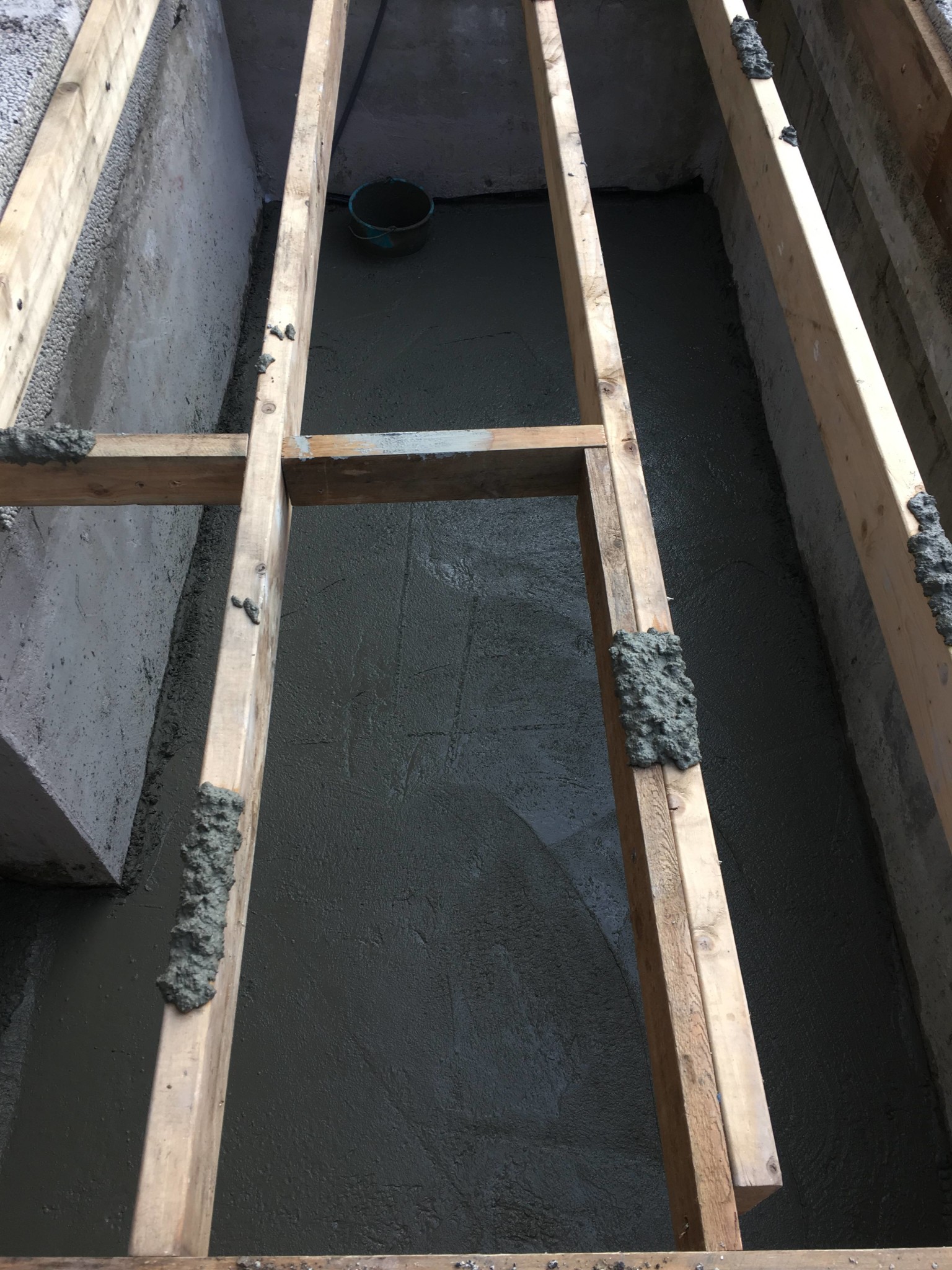
The floor is now cast, it was a simple concrete, and I skipped both reinforcement mesh and vibrating the concrete.
I walked around a bit in the concrete when I raked it out and, following a tip from a construction worker, I finished by densely "nibbling" the surface with the rake to get the aggregates to sink a little.
The result so far is better than expected. I didn't spend much time leveling and didn't have anything to level against, so raking, a little leveling, and gravity were sufficient.
It's worth noting that one cubic meter was supposed to give a 100mm casting. But apparently, the measurement when filling the truck is quite imprecise, so it resulted in about 140mm casting even though I carted away with 4 wheelbarrows. This wasn't a problem, but it might be worth knowing if thickness is important...
I walked around a bit in the concrete when I raked it out and, following a tip from a construction worker, I finished by densely "nibbling" the surface with the rake to get the aggregates to sink a little.
The result so far is better than expected. I didn't spend much time leveling and didn't have anything to level against, so raking, a little leveling, and gravity were sufficient.
It's worth noting that one cubic meter was supposed to give a 100mm casting. But apparently, the measurement when filling the truck is quite imprecise, so it resulted in about 140mm casting even though I carted away with 4 wheelbarrows. This wasn't a problem, but it might be worth knowing if thickness is important...
I have some chipboards at 20mm and plywood boards at 15 mm. Are they suitable as the base (formwork) for the form if protected from moisture?H heimlaga said:It's not that difficult to form such a small arch on site. Use round, unpeeled paper wood logs directly from the forest, placed on site and support and string them to the right height and cut with a chainsaw. Arch backs made of 2x6. All kinds of reused scrap boards are suitable for the form deck as long as they are not rotten and the thickness is the same. If you first lay down construction plastic and then masonite on top, you get a good surface even if the boards are poor.
How tight should the spacing be between the arch backs? Is cc 600 sufficient or does it need to be tighter?
Extremely difficult to estimate how much pressure there will be and what is needed to withstand it. The picture shows part of the construction with cc 35-45.
Click here to reply