I have a company that is currently replacing the panel and painting our townhouse. I had a cantilevered balcony that also needed to be replaced after 43 years.
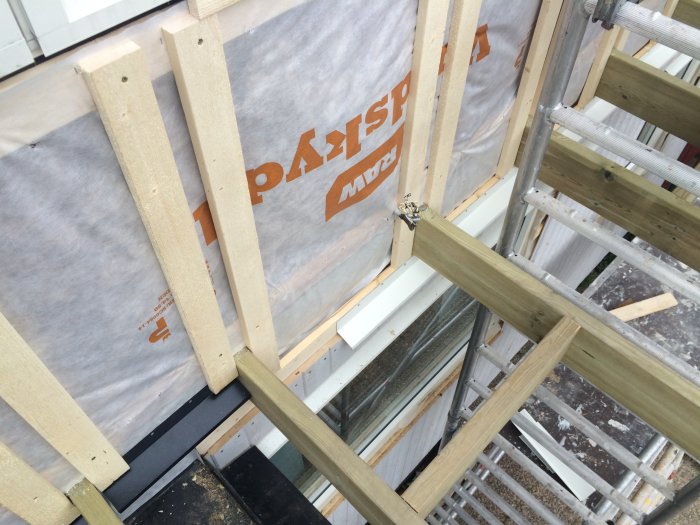
The structural principle is the same as before, where the load-bearing balcony beams are inserted about 1.5 m into the wall and bolted together with the floor joists. Now the beams are 50 cc, whereas they were previously 100 cc, which was a bit wobbly. The material of the beams is 45x145 treated wood.
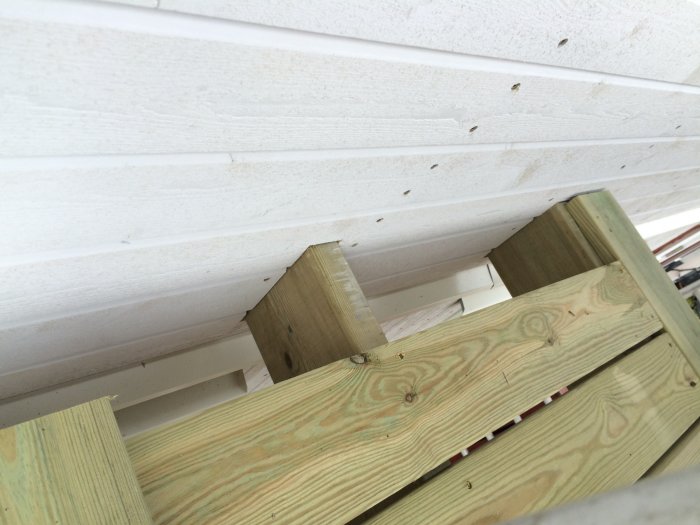
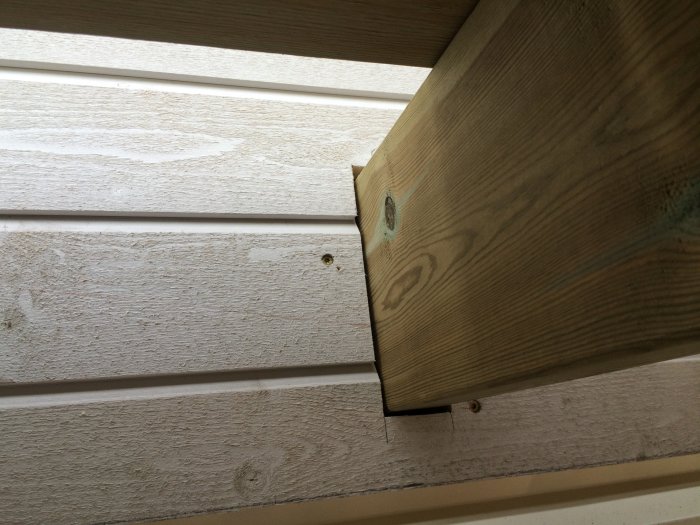
Against the house wall, it is now sealed with foam in the wall. The panel is missing in the picture but will be placed on top of this.
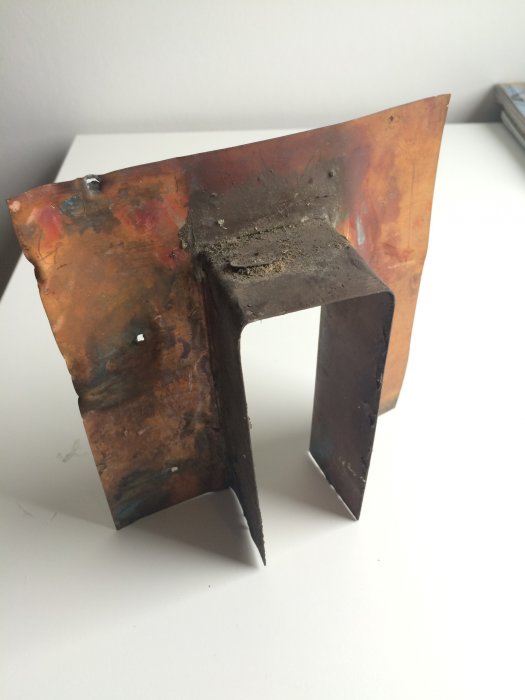
The previous balcony was "sealed" against the house with two such flashings inside the facade that were joined from above and below under each beam:
I don't know if it was directly sealed tight, but it doesn't seem that any moisture damage occurred. There was no real air gap before, with Masonite instead of wind paper.
It feels like it should be sealed more, but I'm having a hard time figuring out how.
The carpenters say that water doesn’t get in; the water that does comes through the air gap inside the facade and then out at the next flashing. They suggest you can special-order new flashings that look like the old ones and place them on the outside of the facade, sealing with silicone, etc. It would be placed under the decking.
What are your thoughts? What is the usual sealing procedure? There are snowdrifts that form there in the winters, and water that lies on a parallel surface doesn’t disappear directly. I’m not entirely convinced.
Thanks for the response.
It actually feels most right to install similar flashing in the absence of any other alternative. Maybe it's enough with flashing from the top side?
The question is also what happens with any water that runs on the backside of the panel in the air gap. Then the water that lands on the studs gets trapped since the flashing prevents the water from running out past the studs. Or what's the thinking here? Ideally, not much water should end up there, but still.
Here are a couple of pictures where the panel and decking are now installed (the last piece of decking is missing against the wall).
Hello
The guys at that company are not quite okay. First and foremost, one should always place sheets like yours behind, just like any other sheets. But more seriously, they have driven all the screws in the panel too far, now you have the same "end grain" at each screw head which is done incorrectly. That's not how it's done, it's as bad as driving drywall screws too far into the boards. So my advice is to pay nothing for this work until they've corrected the mistakes, i.e., replaced the panel and installed sheets (flashing) correctly.
I am having a conversation with the builders regarding the sheets and will try to get them to place new sheets behind the panel, which also seems like the most sensible option. The sheets should be flush against the back of the panel, right? On the "other side" of the air barrier, there is wind barrier paper and then insulation.
Regarding the screws, I saw that they plastered over the screw heads before painting on a neighbor's house last year. Just got a response that they apply construction adhesive over the screw heads before painting. However, I am the only one with the free-hanging balcony, so I have nothing to compare it to other than the old balcony. I will bring this up with them as well.
EDIT: The construction chief just stopped by, and we talked about flashing. He mentioned that flashing shouldn't be necessary as a couple of notches at the top of the studs keep the water away. I wasn't as convinced, so they would check what it costs to produce new flashing.
It might be possible to reuse the old flashing if we just apply it at the top (a notch underneath might work) and skip underneath. Otherwise, it will be a special order, and it could become costly (which might still be worth it).
The construction chief also suggested pressing the flashing against the outside of the panel and sealing behind it. I don't see the advantage of this, except that it would be less work.
Dimensions of the old flashing are 19x19 cm.
Last edited:
Click here to reply
Vi vill skicka notiser för ämnen du bevakar och händelser som berör dig.