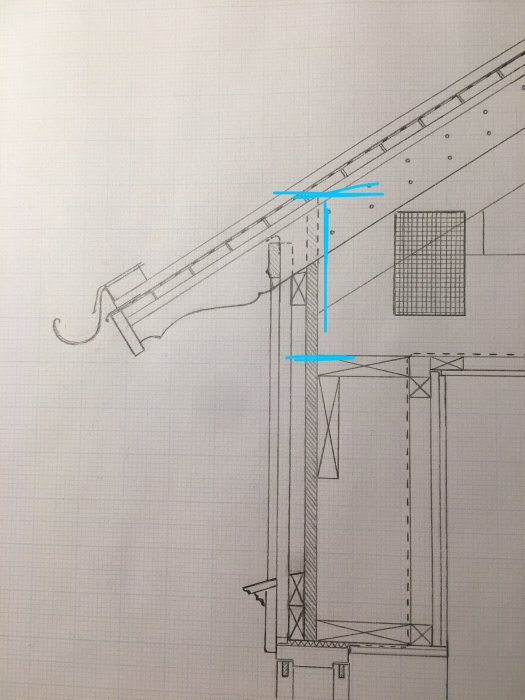
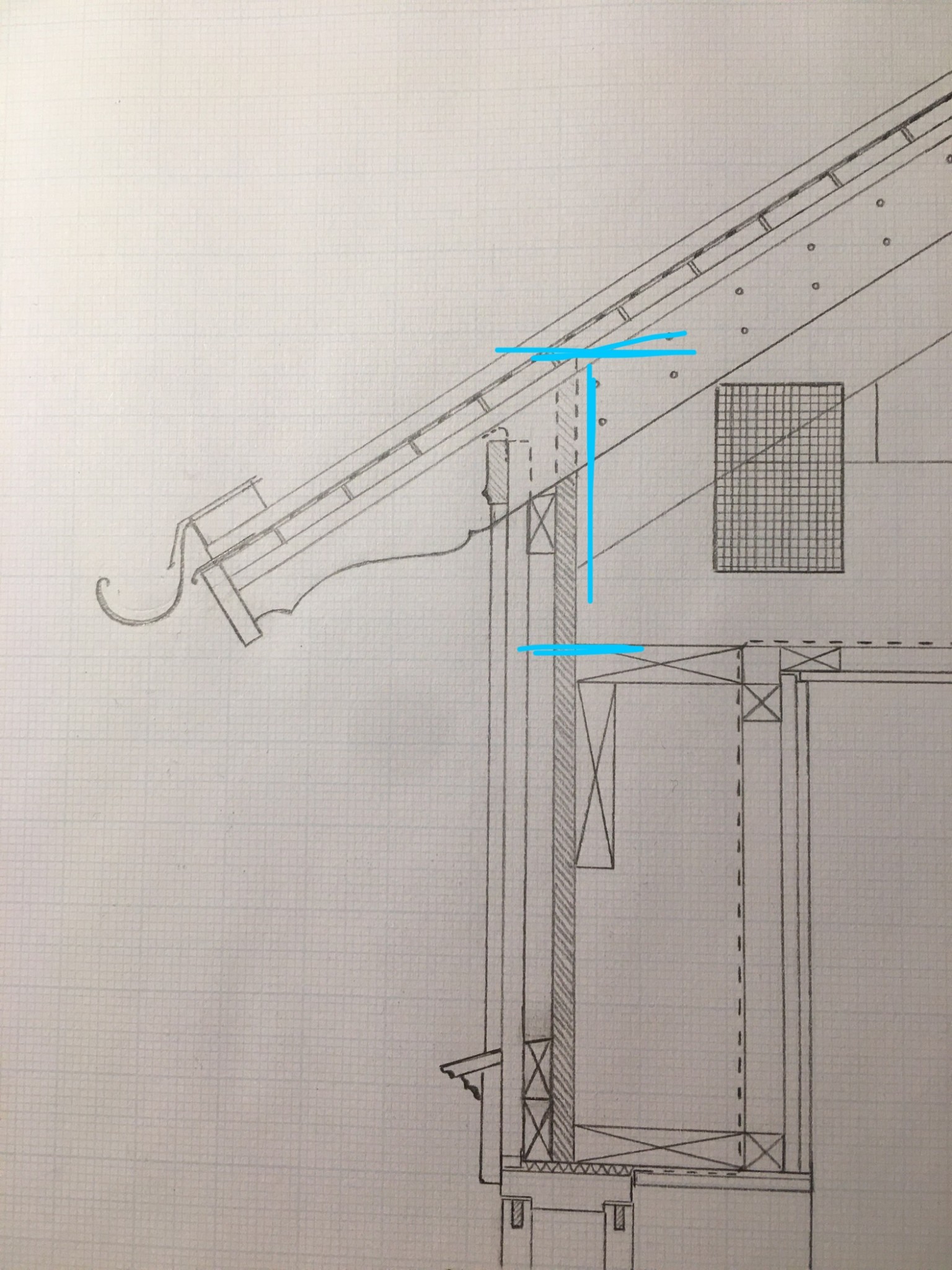
Hello! I'm working on construction drawings and would like to know approximately what the eave height of my trusses will be.
That is, the measurement from the outer edge of the frame, straight up to the top of the truss.
I've contacted two manufacturers, but neither wants to give me this without an order, maybe it's a lot of work to figure it out?
It should not be a problem. The times I have ordered roof trusses, the manufacturer has asked about the height of the truss at the eaves. Most often, you don't want to minimize the height because it doesn't allow for much insulation. But from a construction standpoint, it is usually possible to create a roof truss that is lower in height than the one you have drawn. At least 5 cm can be removed compared to your picture.
There should be no problem. The times I've ordered roof trusses, the manufacturer has asked about the height the truss should have at the eaves. Most often, you don't want to minimize the height because then there isn’t enough space for insulation. But in terms of construction, it's usually possible to make a truss that builds less in height than the one you’ve drawn. At least 5 cm can be reduced compared to your image.
Totally true, yes maybe it's silly of me to make it slimmer. Didn't think about it... I'm thinking 400mm on the roof, what do you think?
I've drawn up the gable and long side on the wall with a pencil and see that the fascia board lands very high. But maybe better to lower the roof height somewhat, adjust the window a bit.
There should be no problem.
The times I've ordered roof trusses, the manufacturer has asked about the height the truss should have at the roof base.
Usually, you don't want to minimize the height because then there's not enough space for insulation. But from a construction standpoint, it's usually possible to create a truss with less height than the one you've drawn. At least 5 cm can be removed compared to your image.
Must ask, saw a post from you in another thread. Is your cold attic still problem-free?
I've also thought of making the attic with extremely limited ventilation. Two gable vents i.e.
Have to ask, I saw a post from you in another thread. Is your cold attic still problem-free?
I've also been thinking about making the attic with very limited ventilation. Two gable vents, that is
Yep.
My philosophy is: the less ventilation in a cold attic, the better. However, this only applies if you can achieve completely sealed plastic against the living space below.
I actually think you can skip the gable vents too; there will always be some air leakage through the panel, tongue and groove, and various gaps.
Naturally, there's a big difference in how well a cold attic does depending on where in the country it is located. Climate, temperature, and humidity likely play a big role.
Yep.
My philosophy is: the less ventilation in a cold attic, the better. However, this only applies if you can have a completely airtight plastic sheeting against the living space below.
I actually think one can ignore the gable vents too, as there will always be some air leakage through the paneling, chipboard, and various gaps.
Then, of course, it can make a big difference how well a cold attic manages depending on where in the country it is located. Climate, temperature, and humidity probably play a big role.
Sounds great! One becomes a bit unsure when some claim the opposite, even when the facts clearly show otherwise.
Sounds great! It makes you a bit unsure when some people claim the opposite, even when facts clearly show otherwise.
You haven't insulated the roof from the outside, have you?
I also built with a tight eaves when I built new. I use cellulose insulation and a vapor-open membrane on the sheathing. But then the house, as already pointed out as important, is very airtight.
The tests I have seen showed it was drier in houses without eaves ventilation. The gable walls are diffusion-open even if you have a tight roof covering. The exception was the first year before the construction moisture was gone. So it's probably not a bad idea to have a dehumidifier the first year and then monitoring. Cellulose is also good, it buffers well over wetter periods.
Sounds great! One becomes a bit uncertain when some people claim the opposite, even when the facts clearly show otherwise.
You haven't insulated the roof externally, have you?
I'm not sure which roof you saw pictures of, but I don't think it was insulated on the outside. I have built and renovated several houses over the years. In my current house (built in '46), I have added external insulation to the decking with 100mm of foam. Since there was previously only a little sawdust in the sloping ceilings, it made a big difference, both in summer and winter.
Hello! I've read several of your threads, and we seem to be in a similar situation with similar material choices - I'm also drawing pencil constructions extensively (for an extension).
How did you solve the issue with the width of the protruding rafter tail?
Hi! I have read several of your threads, and we seem to be in roughly the same situation with similar material choices - I am also sketching pencil designs extensively (for an extension). How did you solve the width of the protruding roof rafter?
Hi! Do you mean the width of the glued-on roof rafter?
If so, I estimate a measurement I find suitable. I will try to widen the rafter as soon as it goes inside the underboard panel. The rafter is also about 80mm wide/thick, allowing for a thinner edge.
Vi vill skicka notiser för ämnen du bevakar och händelser som berör dig.