
21,107 views ·
38 replies
21k views
38 replies
Calculate U-value for construction

It is a well-established insight that air temperature is a poor or at least insufficient description of thermal comfort. Humans are more sensitive to heat transferred through radiation than, for example, convection. In building code contexts, a concept called operative temperature is used, which can be simply described as an average of the air temperature and the temperatures of all surrounding surfaces. In a room with surrounding warm surfaces, one can accept a slightly lower air temperature or vice versa.
Yes, exactly.J justusandersson said:It is a long-known insight that air temperature is a poor or at least insufficient descriptor of thermal comfort. Humans are more sensitive to heat transferred through radiation than, for example, convection. In building code contexts, a concept called operative temperature is used, which can be simply described as an average between the air temperature and the temperature of all surrounding surfaces. In a room with surrounding warm surfaces, you can accept a slightly lower air temperature or vice versa.
I started thinking about this and how one can refine the model so that it behaves more realistically. Perhaps there should be several point domains that influence each other.
- An air domain that is in contact with everything
- A concrete domain containing a heat source (and is in contact with the air)
- An additional domain for interior walls, etc.
- An exterior wall domain that is highly detailed (the one we've seen so far)
The last one is thus a 3D domain with more advanced properties and boundary conditions, while the others are point domains roughly representing each part of the building.
/Anton
Last edited:
Then I'm thinking out loud about the progress of the model.
Assumptions/simplifications
60 cm of internal wall (1.5 m^2) consists of
Indoor air domain
The domain is given high thermal conductivity to represent mixing due to convection. The average temperature of the air is calculated to determine heat transfer to the three other domains (outer wall, floor, thermal inertia domain). Once heat transfers have been determined (in each time step), the effects are applied to the indoor air domain.
100 W * 0.225 m^3/250 m^3 = 0.09 W is continuously added to the indoor air.
Floor domain
The floor domain is 0.09 m^2 and consists of 1 dm of concrete and 14 mm of wood. The top side of the wood is affected by heat transfer from the indoor air. The underside of the concrete is heated by the heating system. Losses downward (to the ground) are ignored (not relevant when examining outer walls). Most heating systems follow outdoor temperature (as far as I know) and calculate a power to be added (or rather a supply temperature).
A quick test shows that if I set a heating curve that means 0 W/m^2 power added at 16 °C outdoor temperature and 6 W/m^2 at -30 °C outdoor temperature, the indoor air stays around 20 °C throughout the year. There might be a smarter or nicer way to do this, but I've tried to mimic how one does it with an actual house (iteratively). Here's what the indoor temperature (air) and outdoor temperature look like from the run:
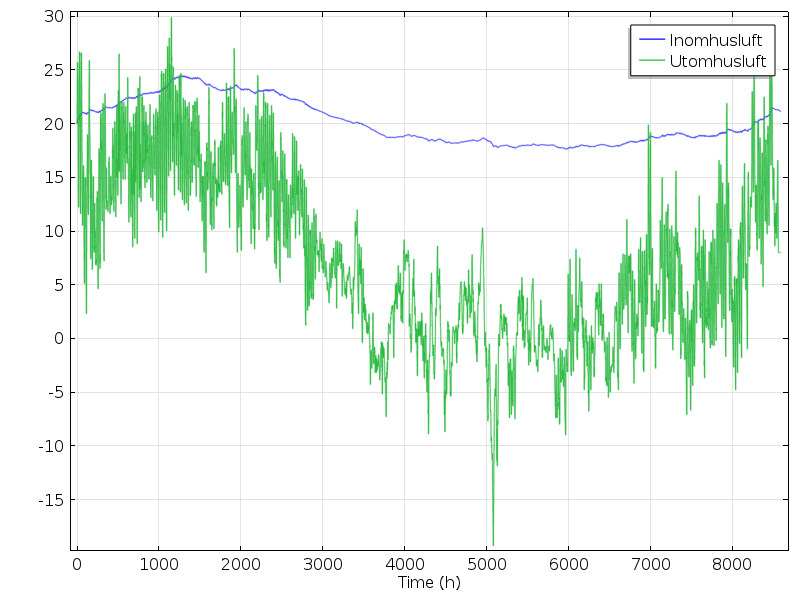
The simulation starts and ends in May. I should increase the power a bit during winter as the temperature drops below 18 °C on several occasions.
Have not extracted anything else yet. Will look into it later.
Should a window be included in the model for losses through that? The risk is just that losses are dominated by it since the window has such high U-values compared to the wall...
/Anton
Assumptions/simplifications
- Assumed a house of 10 x 10 m with a facade height of 2.5 m, which gives a ground slab of 100 m^2 and 100 m^2 of facade. The air volume is 250 m^3.
- The ground slab is made of 1 dm thick concrete with underfloor heating. On the concrete is a 14 mm wooden floor.
- The upper floor is heated in another way and maintains the same temperature as the ground floor, so no heat transfer occurs there.
- No windows or doors on the ground floor.
- The ground floor is divided by two continuous walls (120 mm studs, 600 mm cc, gypsum, and OSB on both sides).
- There is a total of 1000 kg of wood on the ground floor in the form of furniture, glulam beams, and ceilings.
- No radiation effects (solar radiation, etc.).
- People, lighting, and electronics continuously add a total of 100 W to the indoor air.
- 0.09 m^2 of floor (concrete + wood).
- 225 liters of air.
- 0.045 m^2 of internal wall.
- 0.9 kg of pine (point 6 above).
60 cm of internal wall (1.5 m^2) consists of
- 3.7 m wood stud (2.5 + 2*0.6) = 20 liters of pine = 9 kg of pine.
- 3 m^2 gypsum = 39 liters of gypsum = 30 kg of gypsum.
- 3 m^2 OSB = 33 liters of pine = 15 kg of pine.
- Negligible amounts of nails and paint.
- 1.6 kg of pine (0.9 + (9 + 15)*0.045/1.5)
- 0.9 kg of gypsum (30*0.045/1.5)
- Cp = 1450 J/kg/K
- k = 0.17 W/m/K
- rho = 560 kg/m^3
Indoor air domain
The domain is given high thermal conductivity to represent mixing due to convection. The average temperature of the air is calculated to determine heat transfer to the three other domains (outer wall, floor, thermal inertia domain). Once heat transfers have been determined (in each time step), the effects are applied to the indoor air domain.
100 W * 0.225 m^3/250 m^3 = 0.09 W is continuously added to the indoor air.
Floor domain
The floor domain is 0.09 m^2 and consists of 1 dm of concrete and 14 mm of wood. The top side of the wood is affected by heat transfer from the indoor air. The underside of the concrete is heated by the heating system. Losses downward (to the ground) are ignored (not relevant when examining outer walls). Most heating systems follow outdoor temperature (as far as I know) and calculate a power to be added (or rather a supply temperature).
A quick test shows that if I set a heating curve that means 0 W/m^2 power added at 16 °C outdoor temperature and 6 W/m^2 at -30 °C outdoor temperature, the indoor air stays around 20 °C throughout the year. There might be a smarter or nicer way to do this, but I've tried to mimic how one does it with an actual house (iteratively). Here's what the indoor temperature (air) and outdoor temperature look like from the run:
The simulation starts and ends in May. I should increase the power a bit during winter as the temperature drops below 18 °C on several occasions.
Have not extracted anything else yet. Will look into it later.
Should a window be included in the model for losses through that? The risk is just that losses are dominated by it since the window has such high U-values compared to the wall...
/Anton

Know-It-All
· Västra Götaland
· 12 418 posts
On my house, approximately 17% of the outer wall will consist of windows/doors with an average U-value of about 0.8. (single-story villa, interior 15x9m, wall height 2.7m)
Theoretical calculations tend to conclude that windowless rooms are the most energy-efficient. Those of us who have been around for a while know that this is not the case in reality. Even though windows, with their higher U-values, release more energy, they are the most important source of incoming heat. Additionally, the choice of materials for floors, interior walls, and ceilings plays a significant role in the ability to store this heat. I would find it interesting to have a model that also considers these perspectives.
I believe that it's simply a matter of avoiding solar radiation because it's a bit complicated to factor in. You need a lot of information to come up with a reasonable result.J justusandersson said:Theoretical calculations tend to conclude that windowless rooms are the most energy-efficient. Those of us who have been around for a while know that this isn't the case in reality. Even though windows, with their higher U-values, let out more energy, they are the most important source of incoming heat. The choice of materials for floors, inner walls, and ceilings plays a significant role in the ability to store this heat. I would find it interesting to have a model that also considers these points of view.
But sure, let's give it a try!
- The Swedish Meteorological and Hydrological Institute (SMHI) open data provides global solar radiation on a horizontal surface as an hourly average in W/m^2. We need to transform that value to something that applies to a vertical surface (window).
- Additionally, we need to choose a value for solar energy transmission (interesting reading about window physics here: link) for the window.
- Which cardinal direction does the window face?
- Should we assume that it is not shaded at all (eaves, trees...)?
- If we calculate solar radiation, should we also account for radiation losses (and not just incoming radiation)?

The curves look suspiciously sinusoidal, which isn't surprising since it involves rotating bodies. If we assume that all radiation comes directly from the sun (which it doesn't), we can use the above curve and SMHI's data to calculate the power (W/m^2) that a surface perpendicular to the sun would experience. After that, you can transform to any direction you want in the same way. In formulas:
q_SMHI = q_perpendicular * sin(alpha)
Where q_SMHI is the measured value, q_perpendicular is the value that would have been obtained if the measuring surface followed the sun, and alpha is the sun's angle above the horizontal plane (according to the figure above, y-axis). Since we know q_SMHI and alpha, we can calculate q_perpendicular.
q_window also depends on the sun's position sideways (x-axis in the figure above), we call the angle beta, which is 0 for due north direction and 180 for due south. The window's direction also needs an angle, e.g. gamma.
q_window = q_perpendicular * cos(alpha) * cos(gamma-beta)
If beta-gamma becomes greater than 90 or less than -90 then q_window = 0 (the window is in the shade).
As stated, we have assumed that all radiation comes from a point in the sky (the sun). I'm unsure how much comes diffusely from the rest of the sky vault.
/Anton
Impressive work! I'll get back with more comments once I've dealt with various tasks.

Slightly exciting effort you have made! Fun initiative and well-thought-out analyses.
/Another computational engineer
/Another computational engineer
Very interesting thread! I am surprised that A and B differ so little. Now, it's been a long time since you did these simulations, so you may not have the models or interest anymore, but I wonder how big the difference is by having these staggered and/or crossed studs compared to having a single stud/cold bridge from plaster to plaster?A Anton Svensk said:
Click here to reply