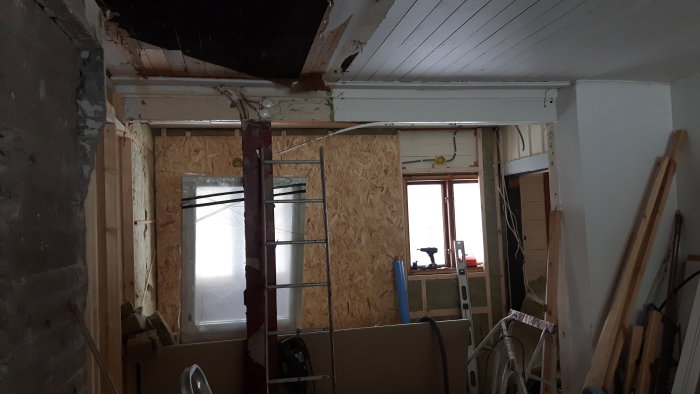
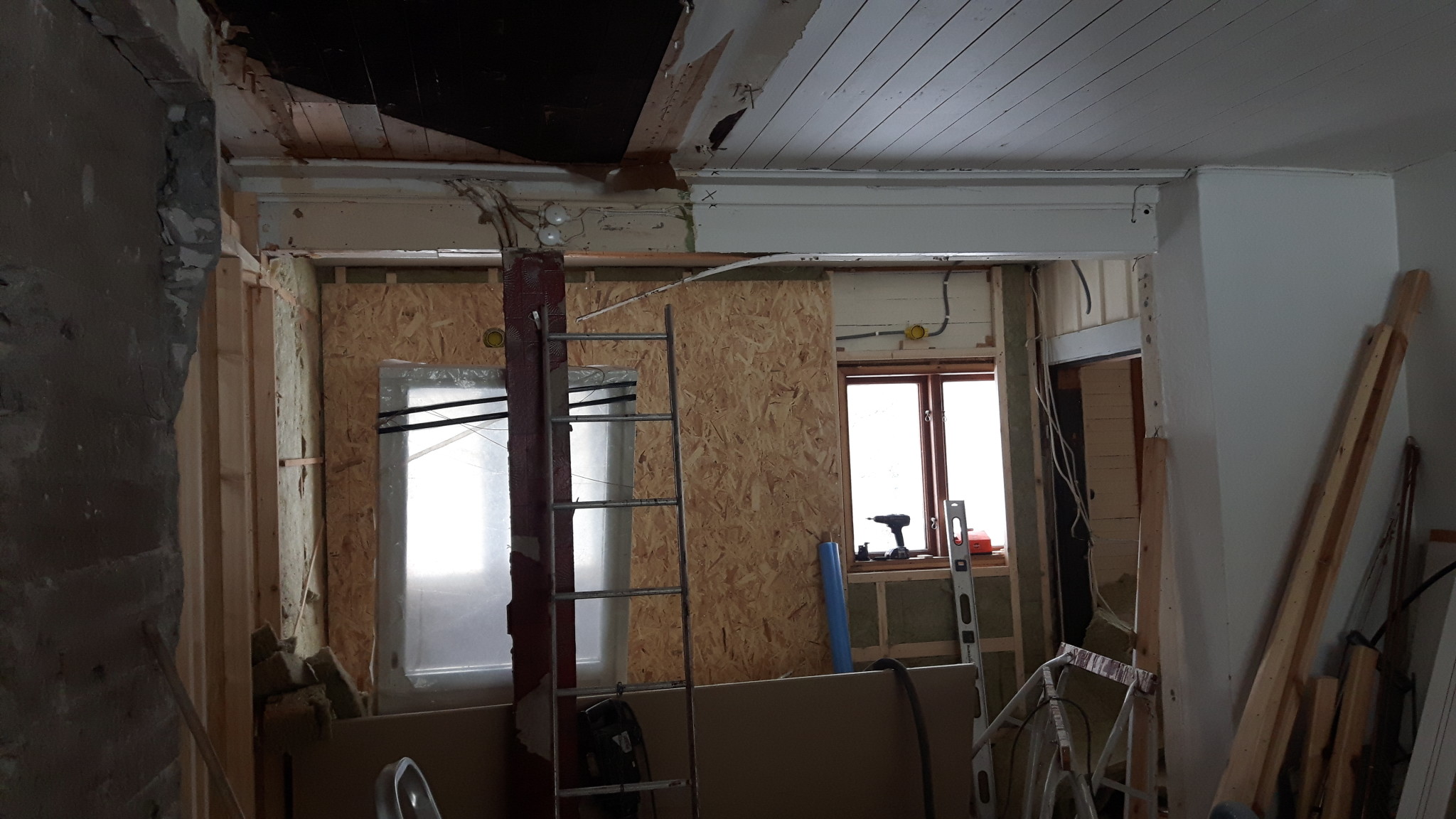
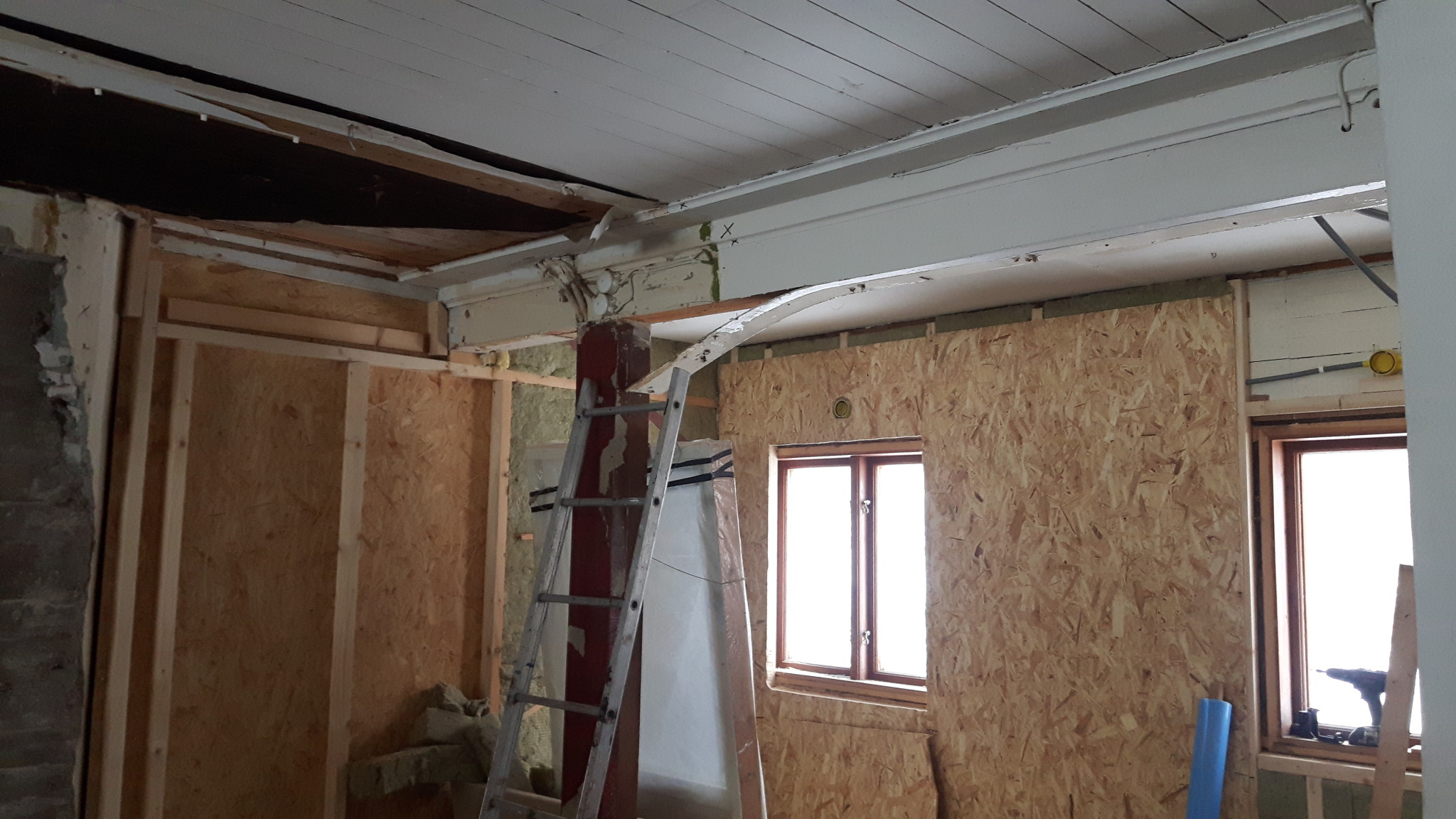
I am working on the construction of an apartment and when we tore down a non-load-bearing wall, a pillar was revealed with a beam on top, the beam is joined right above the pillar.
The pillar stands about 80-100 cm out from the existing (new-old) wall, so I need to remove/move the pillar. The span of the room is about 340 cm, and on the other side of the wall, the beam continues about 250 cm to the next pillar.
A friend who is a carpenter suggested I should brace on both sides, cut away the pillar, screw a 3x8" on each side, on the right side chisel into the wall and use it as support (towards the image) and on the other side, there will be a standing pillar possibly 2x8" screwed in an L shape to provide support both from the back and in the beam's direction, on the left, of course, standing pillars have to be built into the wall that supports both beams.
Does this seem like an okay solution?
Can I otherwise replace the entire beam (up to the wall)? How do you detach it from hundreds of nails from above?
I was considering a U-beam in steel 200x160x200 that can be placed over the existing beam supported by pillars.
The beam is there because it used to be an exterior wall, but later the house was extended by about 150 cm and then the space was opened up.
The house has 1 1/2 stories with a slanted roof on the upper floor where it is about 160 cm out by the outer wall.
The total length of the removed exterior wall is about 9 m with 4 support points.
There you have quite a challenge on your hands! You need to see the whole picture to come up with anything sensible. So plans, preferably some exterior photos. General information like the year of construction, original and extensions. Frame system. How have they resolved the construction of moving the exterior wall? Is it a gable wall? But it can't be when it's 9 meters long. The direction of the roof panel is a bit puzzling. What are the dimensions of the beam? Is it glulam?
No, it is a long side, there is no upper floor on the extension.
Year of construction no idea, from the 40s-60s.
The beam is about 17 wide and maybe 20cm high, probably a sawn log.
The floor/ceiling joists run along the house, which is about 25m long and at the bottom about 8.5m wide.
I think the house was built in stages, possibly it was a barn/stable where I am working now as there are brick walls everywhere and other parts of the house are completely wooden.
The upper floor is also made of wood so it's probably not original either...
I understand that you don't have construction drawings. I was thinking more of a floor plan. The question is what the beam actually supports if it's not the floor above? It should reasonably be the roof structure. The question is how does it transfer down? Do you have any idea about that? If the timber quality is decent, such a beam with a span of 3.4 meters could handle a load of about 8 kN/m, which is quite a lot if it doesn't have any floor load to support.
You don't need to be embarrassed. The sketch explains a lot. Everything becomes a bit clearer. The beam carries roof loads and the wall above the extension. Then it's important to know what the roof trusses look like.
The trusses are like upside-down Vs with a beam running the length of the house about 150cm in from the outer wall, the upper outer wall that is. The width of the house at the top is about 6m.
What these beams rest on, I'm not quite sure... Now that I think about it, on the upper floor, there are 3 pillars that probably support them, but if they connect with the pillar on the lower floor, I don't know, but it's probably the case. I could measure it if it's important.
The best would be a photo of a truss. I believe the beam is there to support loads from the trusses and the remaining part of the outer wall on the second floor. The question is what roof loads might be relevant. The roof pitch is also interesting.
I'm just going to move the column about 80cm sideways and the existing construction has held for maybe 50-60-70 years.
If I get a similar column to the left in the OSB wall, everything should be fine except that the beam is spliced over the column. I can build a maximum of 20cm down from the existing beam but preferably less.
I'm not quite sure I'm following. The joint between the beams should rest on a column. If the joint didn't exist, moving the column towards the center would rather be an improvement. Or do you mean that you intend to move the column to the right and let the joint be unsupported? That could work, but then you need to look at each beam, how long it is and where its supports are.
There's no problem arranging support on the far left in the picture.
On the right, there's a masonry/cast wall where the beam enters.
New beams in 75x200 or similar on each side of the existing beam in the ceiling that are properly screwed, and possibly a 75x200 on the "splash" under the three bolted beams and then support down to the floor on the left side and recessed into the masonry on the right.
Shouldn't that suffice? Possibly a recessed T-iron on each side of the joint at perhaps 1m length.
Vi vill skicka notiser för ämnen du bevakar och händelser som berör dig.