
Hi!
I am going to insulate a small building made of leca, approximately 30m2 in area. I was thinking of a single-step sealed construction without an air gap. I had planned to plaster with regular b/c plaster mortar by hand.
Initially, I wanted to use mineral wool, galvanized mesh, and thick plaster. But the material quotes I've received are ridiculously expensive, so I'm leaning towards foam plastic, since neither byggmax nor bauhaus seem to have mineral wool suitable for plastering on (it must be mineral wool that isn't too soft?).
I saw that byggmax has a foam plastic plaster board from BeWi/thermisol. But there is absolutely no work description for it. Does anyone have experience with this board? I assume you don't need mesh on it. Suitable fasteners? (and spacing?) And can you really plaster with regular plaster on it? Or does it have to be some kind of thin plaster/STO plaster?
According to Byggmax support, it sounded like there were no issues with thick plaster and you could use practically any fasteners... but I'm a bit skeptical, I seem to recall foam plastic = thin plaster?
Grateful for any answers.
I am going to insulate a small building made of leca, approximately 30m2 in area. I was thinking of a single-step sealed construction without an air gap. I had planned to plaster with regular b/c plaster mortar by hand.
Initially, I wanted to use mineral wool, galvanized mesh, and thick plaster. But the material quotes I've received are ridiculously expensive, so I'm leaning towards foam plastic, since neither byggmax nor bauhaus seem to have mineral wool suitable for plastering on (it must be mineral wool that isn't too soft?).
I saw that byggmax has a foam plastic plaster board from BeWi/thermisol. But there is absolutely no work description for it. Does anyone have experience with this board? I assume you don't need mesh on it. Suitable fasteners? (and spacing?) And can you really plaster with regular plaster on it? Or does it have to be some kind of thin plaster/STO plaster?
According to Byggmax support, it sounded like there were no issues with thick plaster and you could use practically any fasteners... but I'm a bit skeptical, I seem to recall foam plastic = thin plaster?
Grateful for any answers.
Okay, mostly opinions from me:
Applying thick plaster on celloplast - never heard of it. Plastering on celloplast without reinforcement mesh (fiberglass) - never heard of it. I've worked with both thick and thin plaster but there might be much I don't know about the field nonetheless.
Completely spontaneous thought as a possible work procedure: Glue the celloplast in a bond, screw with appropriate leca-screw and large plastic washers, type one in the middle of each sheet and one at each T-joint, plaster with fiber-reinforced thin plaster and use fiberglass mesh.
Maybe it's not so important with fiber-reinforced mortar since the frame is made of stone material and maybe it's possible to slather on 1+1cm b-mortar on galvanized plaster mesh instead if you ensure the mesh is well anchored in the leca at least 4 points per square meter.
However, I am skeptical about celloplast since it seals the wall against 99% of all moisture migration. I myself have seen too much of thin plaster-on-celloplast that just turned into crap after a few years to recommend the method at all.
Applying thick plaster on celloplast - never heard of it. Plastering on celloplast without reinforcement mesh (fiberglass) - never heard of it. I've worked with both thick and thin plaster but there might be much I don't know about the field nonetheless.
Completely spontaneous thought as a possible work procedure: Glue the celloplast in a bond, screw with appropriate leca-screw and large plastic washers, type one in the middle of each sheet and one at each T-joint, plaster with fiber-reinforced thin plaster and use fiberglass mesh.
Maybe it's not so important with fiber-reinforced mortar since the frame is made of stone material and maybe it's possible to slather on 1+1cm b-mortar on galvanized plaster mesh instead if you ensure the mesh is well anchored in the leca at least 4 points per square meter.
However, I am skeptical about celloplast since it seals the wall against 99% of all moisture migration. I myself have seen too much of thin plaster-on-celloplast that just turned into crap after a few years to recommend the method at all.
I have no answer to your question, but I'm wondering generally about plaster substrates - is a plasterboard made of foam plastic better or worse than plasterboards made of mineral wool? The mineral wool boards I've seen that have been removed from house foundations have in all cases been quite wet and probably no longer insulated very well. Do they have any advantages against foam plastic?
Or, well, ONE answer I have, about anchoring. Partly glue with suitable adhesive (PL200 or similar that adheres both to foam plastic and whatever you have behind), but I believe in also anchoring with through fasteners, for example the holders intended to attach Isodrän boards: http://www.isodran.se/index.php/tekniska-fakta/isodraen-tillbehoer
They are of the plug type and are intended for basement walls, so they should work well against leca.
Or, well, ONE answer I have, about anchoring. Partly glue with suitable adhesive (PL200 or similar that adheres both to foam plastic and whatever you have behind), but I believe in also anchoring with through fasteners, for example the holders intended to attach Isodrän boards: http://www.isodran.se/index.php/tekniska-fakta/isodraen-tillbehoer
They are of the plug type and are intended for basement walls, so they should work well against leca.
Last edited:
Polish on regular EPS100. Buy reinforcing plaster and splash plaster from, for example, STO. Different components are included in different concepts. Single-stage sealed facade on leca/lightweight concrete/concrete is COMPLETELY OK. People have become confused and don’t know what to do, after all the writings. Single-stage sealed facades on organic material are NOT OK. Comprende amigos?
You can attach the foam board with either STO Construction Adhesive or regular tile adhesive. Screws and washers are not necessary for single-story buildings, but the producer does not advise against them either. It has to do with wind forces. Buy pre-colored silicone plaster (in a bucket), and not mineral plaster (in a bag), which is not as elastic. Mineral plaster is used by many contractors as it is cheaper.
You can attach the foam board with either STO Construction Adhesive or regular tile adhesive. Screws and washers are not necessary for single-story buildings, but the producer does not advise against them either. It has to do with wind forces. Buy pre-colored silicone plaster (in a bucket), and not mineral plaster (in a bag), which is not as elastic. Mineral plaster is used by many contractors as it is cheaper.
I'm just wondering about how condensation works when it's warm inside and cold outside. Shouldn't moisture precipitate on the inside of the foam insulation? How good is it for it to be constantly moisture-saturated there? Please correct me if I'm wrong.
I also don't think you can really compare it with isoleca, which has foam insulation in the middle, as the joints are either continuous or padded with glass wool (=permeable).
I also don't think you can really compare it with isoleca, which has foam insulation in the middle, as the joints are either continuous or padded with glass wool (=permeable).

If it’s warm inside, and cold outside - shouldn't the condensation drip from the attic joist, or?MaxPax said:
Of course, this is not the case, IF the attic joist is sufficiently well insulated. The case with foam plastic in the wall is analogous. Moreover, there is a parameter called specific heat capacity J/(kg·K), which indicates the ability to store heat. Materials that cool faster (e.g., plastic film compared to a foam plastic sheet) become subjects for condensation precipitation.
Ok. I probably don't know enough about vapor pressure, dew point, condensation, and their material relationship to speculate correctly. But personally, I would still avoid sealing the wall too much. Maybe I'll change my mind after studying a bit more about this, which I feel like doing now 
Hi IsoldeI isolde said:Polish on regular EPS100. Buy reinforcing plaster and splash plaster from, for example, STO. Different components are included in different concepts. Single-stage sealed facade on leca/light concrete/concrete is COMPLETELY OK. People have become confused and don't know which way to turn, after all the writing. Single-stage sealed facades on organic material are NOT OK. Comprende amigos?
You can attach the foam plastic with either STO Construction Adhesive or regular tile adhesive. Screws and washers are not needed for single-story buildings, but the manufacturer does not advise against it either. It has to do with wind forces. Buy colored silicone plaster (in a bucket), and not mineral plaster (in a bag), which is not as elastic. Mineral plaster is used by many contractors because it is cheaper.
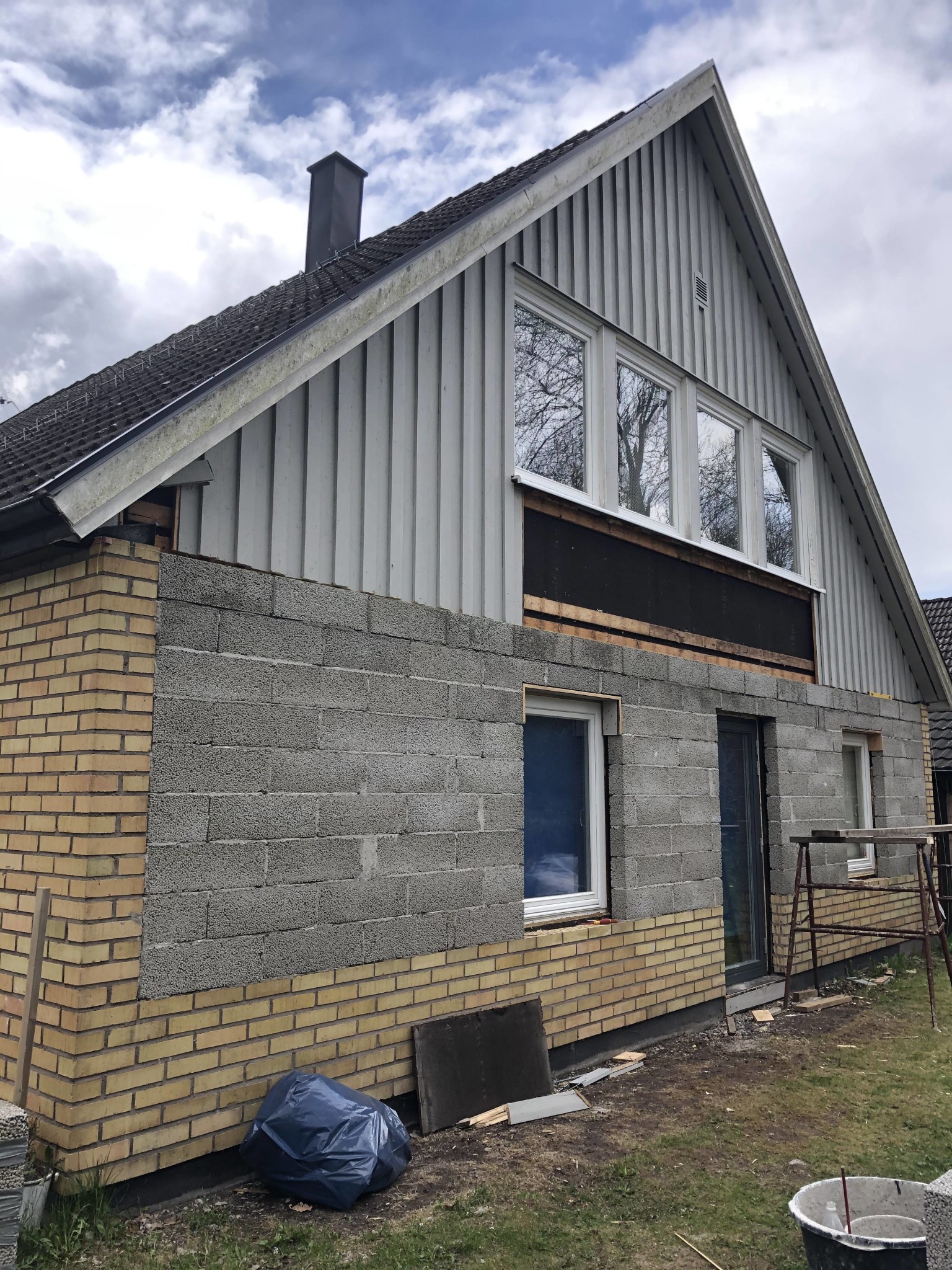
I know this is an old thread but you seem knowledgeable so I want to ask you a question: I have a 70s villa that I want to plaster. I built up to half with leca blocks because I want to build an open terrace with a roof in the future where I want to attach the beam to the roof. I'm afraid to build up to the ridge with leca because of the weight and I'm scared. My question to you is, can I use upward going battens, screw on outdoor gypsum, and glue and screw ESP100 and plaster it on? Of course, a 2-3cm air gap is present all the way up. The only thing I'm afraid of is that the house becomes unstable from halfway up. Ideally, I want to use foam plastic that protrudes above the leca 2-3 cm and a drip edge on it so I protect the windows.
I built a garage with leca, glued and screwed foam plastic on, reinforcement mesh and silicate plaster on, the garage is 5 years old but looks like new.
Click here to reply