
7,852 views ·
5 replies
8k views
5 replies
Building your own entryway roof in 50s style?
I have a plastered house from '52 and I want to install a classic screen/entrance roof similar to those on many small single-family homes from the 50s. So a very low-sloping, sheet metal-covered roof attached to the wall without visible supports or brackets, about a meter wide and 80-90 deep. I might consider a somewhat more modern variant with more slope (i.e. higher at the back) and shorter overhang since it will be less stressed when the snow comes.
Now the question is how to smartly build this so that it does not become too heavy and so that it can be attached to my wall, which is lightweight concrete on the outside and possibly concrete a few centimeters in. I'm considering making some kind of metal bracket that is lowered into the plaster behind the roof and a bit above the rear edge of the roof. On the wall above the roof, a piece of the roof sheet should be drawn up (as is customary with this type of roof). A carpenter suggested some kind of glued and screwed wooden beam against the wall.
So my question is about both the construction and attachment. Does anyone know how the original roofs from the 50s were constructed and attached?
Now the question is how to smartly build this so that it does not become too heavy and so that it can be attached to my wall, which is lightweight concrete on the outside and possibly concrete a few centimeters in. I'm considering making some kind of metal bracket that is lowered into the plaster behind the roof and a bit above the rear edge of the roof. On the wall above the roof, a piece of the roof sheet should be drawn up (as is customary with this type of roof). A carpenter suggested some kind of glued and screwed wooden beam against the wall.
So my question is about both the construction and attachment. Does anyone know how the original roofs from the 50s were constructed and attached?
Ended up in that situation as well. Would love to see how you've done it.
Don't think you should wait for Andreas' reply, he hasn't logged in since 2010.
It was a ready-made purchase, time constraints before polishing and how heavy I estimated it would be made the decision. Designtaks hipped. Blended very nicely into the house. The frame is ridiculously stable, with welded aluminum profiles and nicely executed sheet metal work.
I assembled it myself but recommend a friend when it's lifted into place.
In our case with render on a wooden frame, we removed the rendering completely where the roof should sit according to the mason's request. Then a track was screwed on with large wood screws, and the finished roof, which I believe weighed 25-30 kg, was hung on it; a few more screws and it was secure, and the sheet metal under-roof was quickly mounted. We opted for LED lighting as an additional feature. The mason smoothly rendered it when we did the rest of the facade.
It stung the stinginess, but I wouldn't have done it any other way.
I assembled it myself but recommend a friend when it's lifted into place.
In our case with render on a wooden frame, we removed the rendering completely where the roof should sit according to the mason's request. Then a track was screwed on with large wood screws, and the finished roof, which I believe weighed 25-30 kg, was hung on it; a few more screws and it was secure, and the sheet metal under-roof was quickly mounted. We opted for LED lighting as an additional feature. The mason smoothly rendered it when we did the rest of the facade.
It stung the stinginess, but I wouldn't have done it any other way.
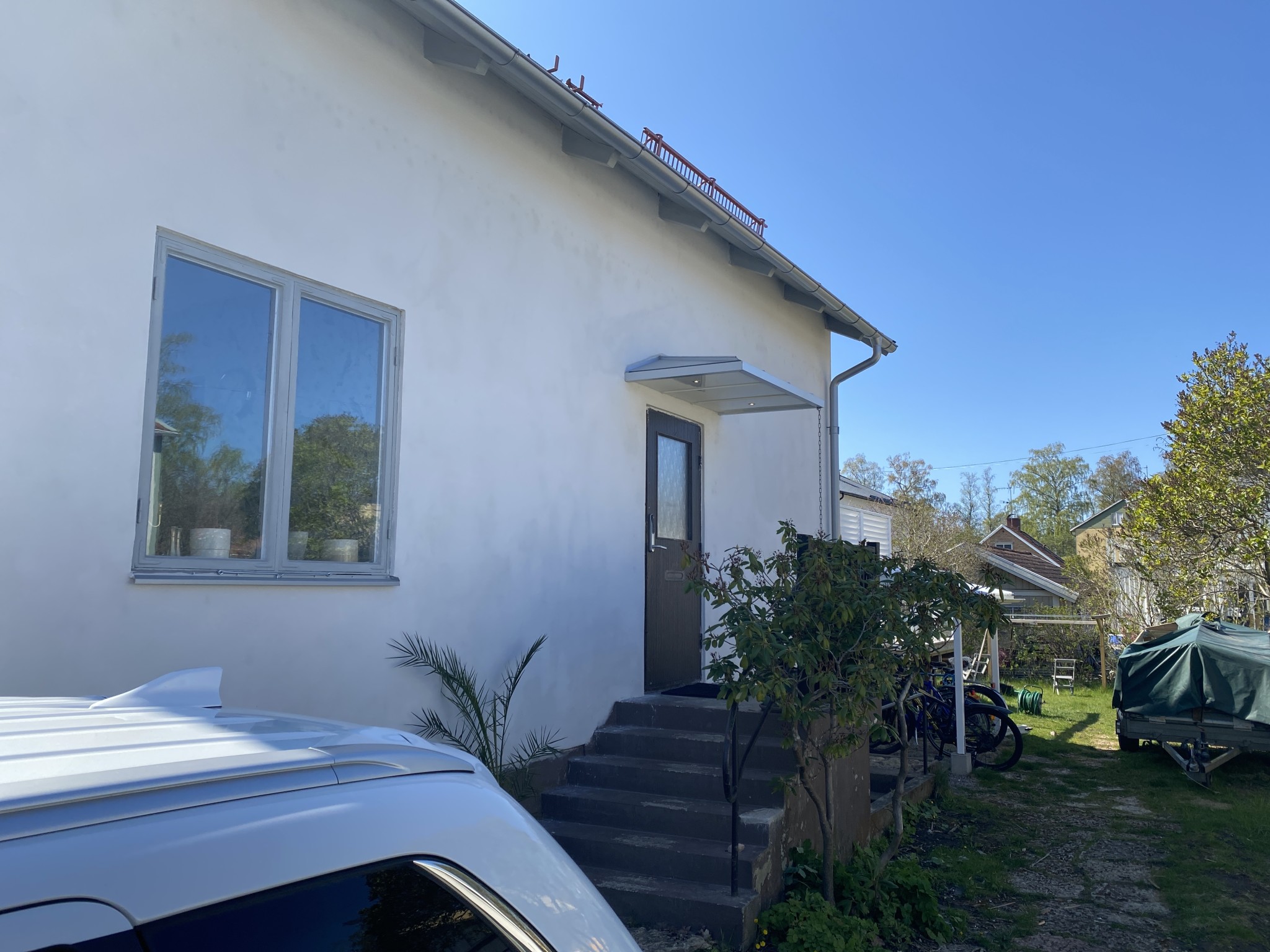
Last edited:
Nice.
Thanks for the quick and detailed response. I also looked at their roof. Leaning towards that solution.
Thanks for the quick and detailed response.
I also looked at their roof. Leaning towards that solution.OlleOh said:
It was a ready-made purchase, lack of time before plastering and the heaviness I assessed it to be made the decision. Designtaks hipped. Blended in very nicely with the house. The frame is ridiculously stable, with welded aluminum profiles and nicely executed sheet metal work.
I installed it myself but recommend a friend when lifting it into place.
In our case with boarding on a wooden frame, we removed the plaster completely where the roof should sit according to the mason's request. Then a rail was fastened with French wood screws and on that, the finished roof was hung, which weighed 25-30 kg, I think, a few more screws and it sat well and the sheet metal underroof was quickly installed. We took LED lighting as an option. The mason plastered it in nicely when we did the rest of the facade.
It stung in my frugality but I wouldn't have done it any other way.
Click here to reply