
4,314 views ·
7 replies
4k views
7 replies
Building on a concrete garage slab - problems with thermal bridge?
Hello,
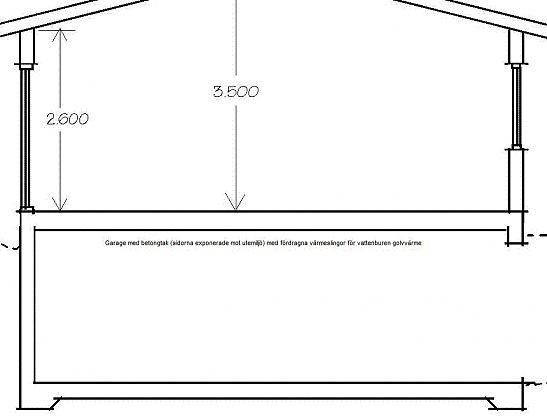
We are considering extending our house with an addition that will sit on an existing concrete garage slab. The garage is located in a basement level with a certain overhang over the garage entrance. The slab has embedded pipes for future underfloor heating (planned floor was to be tiles), made by the previous owner. Now I've learned from a structural engineer that there is a risk of placing a wooden structure on the slab as the concrete edge of the slab acts as a thermal bridge. That is, there is a risk that cold is conducted under the wooden structure and creates condensation, which can lead to rot/mold. Additionally, of course, waste heat from the underfloor heating will leak out through the concrete sides, which leads to increased energy consumption. Does anyone knowledgeable on the forum have a clever solution to the problem that also works aesthetically? Does the structural engineer's risk assessment hold true (I've had 2 other structural engineers come out to look at the drawings and load-bearing capacity who did not react to this problem)? Drawings and building permit are otherwise clear, and this is currently the major obstacle (apart from finding good craftsmen who can do the job at a reasonable cost). Grateful for all solution suggestions. Attached is part of the drawing for information
We are considering extending our house with an addition that will sit on an existing concrete garage slab. The garage is located in a basement level with a certain overhang over the garage entrance. The slab has embedded pipes for future underfloor heating (planned floor was to be tiles), made by the previous owner. Now I've learned from a structural engineer that there is a risk of placing a wooden structure on the slab as the concrete edge of the slab acts as a thermal bridge. That is, there is a risk that cold is conducted under the wooden structure and creates condensation, which can lead to rot/mold. Additionally, of course, waste heat from the underfloor heating will leak out through the concrete sides, which leads to increased energy consumption. Does anyone knowledgeable on the forum have a clever solution to the problem that also works aesthetically? Does the structural engineer's risk assessment hold true (I've had 2 other structural engineers come out to look at the drawings and load-bearing capacity who did not react to this problem)? Drawings and building permit are otherwise clear, and this is currently the major obstacle (apart from finding good craftsmen who can do the job at a reasonable cost). Grateful for all solution suggestions. Attached is part of the drawing for information
That it would get so cold in the concrete slab that condensation could occur is hard to believe, considering you have underfloor heating. Additionally, there's nothing stopping you from insulating the slab with foam board on the sides. But there will be a tremendous heat leakage downwards, there's no doubt about that. There's another issue related to this, which concerns what happens when the underfloor heating is turned off. Then, it seems there may be a moisture rush into the slab that significantly raises the relative humidity. But everything depends on the circumstances surrounding your house, and whether the slab is placed on a proper layer of capillary-breaking material and so on.
In the basement, there is a garage that maintains at least 5-10°C even in winter. In the ceiling, there are already "insulation panels" made of pressed cement fiberboards (don't know what they're called). The problem the building engineer indicated was more related to side exposure and that the concrete material would allow cold to seep inward because the thermal bridge wasn't broken. Which could result in condensation under the walls. So you don't think that's a problem? Do you think the energy consumption will be high for the same reason? But maybe it's possible to put insulating elements (does anyone have suggestions for brands?) or similar on the sides, but I don't know how it will look aesthetically.
I don't think it would be a problem even if you didn't insulate, no. Not with underfloor heating in the slab. Besides, you would have tiles, right? They are hardly moisture-sensitive. The base is also not in direct contact with the slab.
The best way to insulate is with foam plastic, 50-100 millimeters, which you then finish with fiber-reinforced thin plaster.
The best way to insulate is with foam plastic, 50-100 millimeters, which you then finish with fiber-reinforced thin plaster.

The problem, from my point of view anyway, mainly concerns whether it is insulated under the slab or if it is a concrete joist, vault, or similar that allows for insulation underneath afterward. Heat leakage to the sides can be relatively easily fixed by digging down some cellular plastic (100-300 mm). At the same time, it's also appropriate to review/improve the drainage.
But if it isn't insulated under the slab and it's not possible to insulate, it seems quite risky to use the underfloor heating. Hmm, not risky, just very expensive ...
But if it isn't insulated under the slab and it's not possible to insulate, it seems quite risky to use the underfloor heating. Hmm, not risky, just very expensive ...
Now when I read clabbe's 2nd post, I think I understand that he means the wall of the sutterängplan, the one that is visible above ground...
The same recipe is desirable, at least 10 cm of foam insulation outside, but then it clearly becomes both an aesthetic problem and a problem with the connection to the outer wall of the 2nd floor.
The same recipe is desirable, at least 10 cm of foam insulation outside, but then it clearly becomes both an aesthetic problem and a problem with the connection to the outer wall of the 2nd floor.
Thanks for the info (Danish keyboard hence the strange letters)! Since nothing is built yet, I imagine that if the edges are insulated 10 cm out + plaster, then the insulation itself should also be extended outward when the walls are built so that it harmonizes and the panel ends up outside the insulated edge.Mikael_L said:Now that I read clabbes 2nd post, I think I understand that he means the wall of the semi-basement, the one that is visible above ground...
The same approach is probably desirable, meaning at least 10 cm of foam insulation on the outside, but then it clearly becomes both an aesthetic problem and a problem with the connection to the 2nd floor's outer wall.
Does anyone have a good suggestion on which insulation material (brand, manufacturer?) to use and that can be plastered on? I also have an overhang at the garage entrance, which means I have to insulate under the overhang. As an alternative, regular insulation (or foam insulation) can perhaps be used with paneling on the outside instead. I assume it's difficult to get the plaster to adhere upwards to the overhang?
What do you think? Does it sound reasonable?
Click here to reply