
3,975 views ·
23 replies
4k views
23 replies
Building Moisture Panic!
Building a garage with loose timber and have insulated the first layer, now starting to apply plastic and nail on 45mm horizontal studs when I see that water is dripping from the sill!
My amateur analysis is that during the construction period, without plastic, moisture has seeped out, freezing into ice on the windbreak fabric. Now that it's insulated and I've raised the room temperature inside in combination with it being only -1C outside, the ice is melting and running down between the fabric and insulation to the sill.
While waiting for the house to be completed, we planned to live temporarily in the garage, so it was supposed to be ready by the end of the month. Does it need to dry out for a longer period now? What should I do? Turn up the heat as much as possible?
Attaching two pictures, one showing how it looks in many places by the studs, and one showing after I removed some insulation boards.
My amateur analysis is that during the construction period, without plastic, moisture has seeped out, freezing into ice on the windbreak fabric. Now that it's insulated and I've raised the room temperature inside in combination with it being only -1C outside, the ice is melting and running down between the fabric and insulation to the sill.
While waiting for the house to be completed, we planned to live temporarily in the garage, so it was supposed to be ready by the end of the month. Does it need to dry out for a longer period now? What should I do? Turn up the heat as much as possible?
Attaching two pictures, one showing how it looks in many places by the studs, and one showing after I removed some insulation boards.
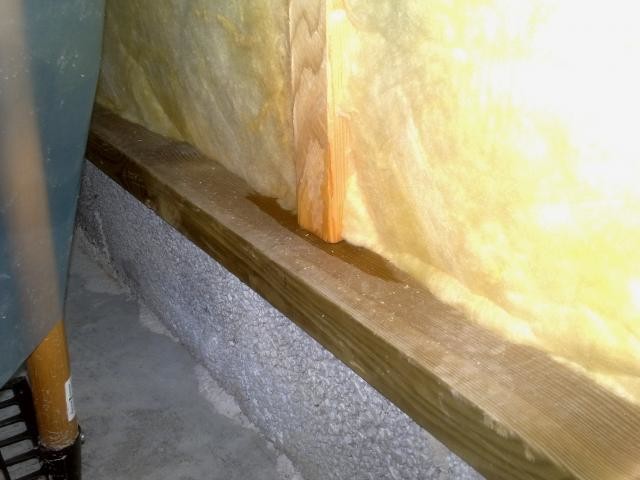
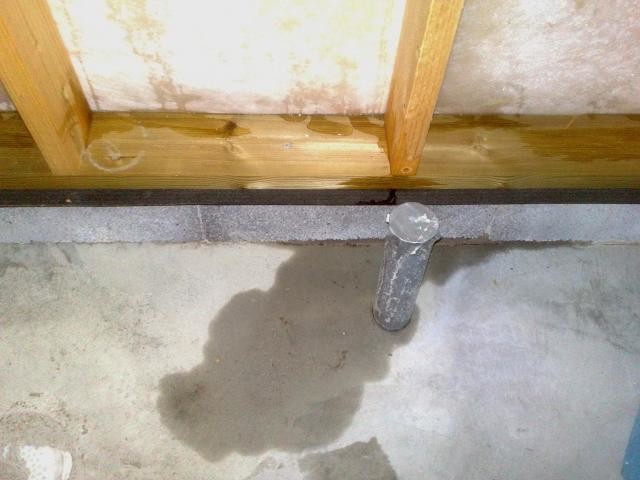
The intended wall looks like this:
Outer panel - battens - wind barrier - 145mm frame & insulation - plastic - 45mm frame & insulation - OSB - gypsum
The sill is pressure-treated and sits on sill paper, which is on top of concrete blocks.
After finishing insulating the 145mm layer, I have now started with the plastic and the 45mm studs. I have stapled and nailed this on about 5m of the wall out of a total of around 20-25m.
I can add that there is a lack of outer panel on part of the wall due to delivery issues with it, but there seems to be the same ice/frost on the cloth everywhere.
Outer panel - battens - wind barrier - 145mm frame & insulation - plastic - 45mm frame & insulation - OSB - gypsum
The sill is pressure-treated and sits on sill paper, which is on top of concrete blocks.
After finishing insulating the 145mm layer, I have now started with the plastic and the 45mm studs. I have stapled and nailed this on about 5m of the wall out of a total of around 20-25m.
I can add that there is a lack of outer panel on part of the wall due to delivery issues with it, but there seems to be the same ice/frost on the cloth everywhere.
"tinnat"? Is it a misspelled word or a word I've never heard? Do you mean I should remove the insulation? Won't it be the same problem again when you put it back? Or maybe not if you wrap everything in plastic as you go along?
I have read that insulation doesn't directly absorb moisture? But of course, it prevents the air from reaching and drying it out.
I guess I'll have to go there and tear it down tomorrow then
But if you're trying to see the positive side, it's better this way than if I had finished building and then the ice melted when it's all sealed and the boards and everything are in place. Then you probably wouldn't have seen the water and it might have molded.
I guess I'll have to go there and tear it down tomorrow then
But if you're trying to see the positive side, it's better this way than if I had finished building and then the ice melted when it's all sealed and the boards and everything are in place. Then you probably wouldn't have seen the water and it might have molded.

How much water are we talking about? Is it flowing? Is there more coming?
Can't you set up a dehumidifier and wait to plastic? The warmth holds quite well with just 145mm insulation. Then you can see how it seems in a week and if it's dry then, you can just continue as planned with the construction. But personally, I don't think there's any danger, the moisture will dry out through the wind barrier if there's just a little frost and not a leak causing new water to come in from outside. Mold only occurs with constant humidity, so it being wet during construction is rarely a problem since it will dry out with the correct air gap etc.
How much is it? Well, it's a bit wet as the first picture shows at many of the studs but not all. When I removed 3 insulation boards to look, I felt that the fabric was a bit icy and that there was a thin layer of ice on part of the sill. Without insulation, this thawed pretty quickly and then, of course, it dripped from the sill, but it also stopped quite quickly.
It's unlikely that there's a leak; when the roofing felt was laid, it rained, and I checked then if the sheathing got wet anywhere, which it didn't. Now I have tiles on, and there has been snow on the roof without insulation inside with the construction fan on full, resulting in large icicles from the gutter outlet. No moisture has been seen on the sheathing either.
It's unlikely that there's a leak; when the roofing felt was laid, it rained, and I checked then if the sheathing got wet anywhere, which it didn't. Now I have tiles on, and there has been snow on the roof without insulation inside with the construction fan on full, resulting in large icicles from the gutter outlet. No moisture has been seen on the sheathing either.
What kind of wind cloth do you have, it shouldn't normally flow in like that.