
5,377 views ·
2 replies
5k views
2 replies
Building interior wall steel studs
Hello!
I am going to build a wall that is about 2600mm high and 2700mm wide in my apartment. The wall will only function as a partition wall since I am dividing the dining area in the kitchen to create a small bedroom. No heavy objects will be attached to the wall; I will only run electrical wiring and try to install approximately 80x60 glass blocks to let in some light.
I have bought basic gypsum and OSB boards 12000mm and steel studs that are 45X steel studs. Due to pipes being in the way, I have chosen the smallest dimension for the studs.
Now to my little dilemma. It's the first time I am doing this, and I only have this weekend to complete it. The floor and ceiling are concrete. What should I use to attach the steel profile to the floor and ceiling? Which screws and plugs, and how thick should they be to support the boards? Is it important to use the right kind of plug for this, or doesn't it matter much?
When I'm using OSB as the first layer, I wonder if I should still use sheet metal screws so that it threads into the screw? Screws of about 20mm should suffice since the OSB board is only 11mm thick.
One last thing. The studs that end up on the outermost sides, which are normally supposed to attach to the walls. I will only be able to attach one side with screws. There are pipes and drainage on one wall, and it's just plaster. Do you think there could be any issues with the stability of the wall? I will, of course, fasten it securely in other places.
I am going to build a wall that is about 2600mm high and 2700mm wide in my apartment. The wall will only function as a partition wall since I am dividing the dining area in the kitchen to create a small bedroom. No heavy objects will be attached to the wall; I will only run electrical wiring and try to install approximately 80x60 glass blocks to let in some light.
I have bought basic gypsum and OSB boards 12000mm and steel studs that are 45X steel studs. Due to pipes being in the way, I have chosen the smallest dimension for the studs.
Now to my little dilemma. It's the first time I am doing this, and I only have this weekend to complete it. The floor and ceiling are concrete. What should I use to attach the steel profile to the floor and ceiling? Which screws and plugs, and how thick should they be to support the boards? Is it important to use the right kind of plug for this, or doesn't it matter much?
When I'm using OSB as the first layer, I wonder if I should still use sheet metal screws so that it threads into the screw? Screws of about 20mm should suffice since the OSB board is only 11mm thick.
One last thing. The studs that end up on the outermost sides, which are normally supposed to attach to the walls. I will only be able to attach one side with screws. There are pipes and drainage on one wall, and it's just plaster. Do you think there could be any issues with the stability of the wall? I will, of course, fasten it securely in other places.

Sounds like it can become a stable wall!
Not so critical that it really supports the ceiling and wall since it's the possibility of the wall tipping that we are after.
I mostly use metal nail anchors to attach the battens to the floor and ceiling, but regular nail anchors work just as well. Say, 6x40 metal nail anchors would work just fine. Like these:
https://www.bauhaus.se/metallspikplugg.html
Don't forget to attach the first stud to the wall with anchors as well.
You screw the OSB into the metal stud with chipboard screws designed for metal studs, usually 30mm long. Like these:
https://www.bauhaus.se/boardskruv-b-3-9x30-fo-1000.html
You then screw the plasterboard with the joints staggered against the OSB using drywall screws intended for wood, or alternatively, combi screws that work in both wood and plasterboard. Like these:
https://www.bauhaus.se/gipsskruv-3-9x57-fzb-100.html
As long as you properly secure the OSB, battens in the floor and ceiling, you can always supplement with glue or something to make the finish sit nicely... OSB stiffens things up more than you might think.
After carrying up your 120 sheets, you'll realize that next time it's easier to go with 90 cm sheets to spare your back!
Not so critical that it really supports the ceiling and wall since it's the possibility of the wall tipping that we are after.
I mostly use metal nail anchors to attach the battens to the floor and ceiling, but regular nail anchors work just as well. Say, 6x40 metal nail anchors would work just fine. Like these:
https://www.bauhaus.se/metallspikplugg.html
Don't forget to attach the first stud to the wall with anchors as well.
You screw the OSB into the metal stud with chipboard screws designed for metal studs, usually 30mm long. Like these:
https://www.bauhaus.se/boardskruv-b-3-9x30-fo-1000.html
You then screw the plasterboard with the joints staggered against the OSB using drywall screws intended for wood, or alternatively, combi screws that work in both wood and plasterboard. Like these:
https://www.bauhaus.se/gipsskruv-3-9x57-fzb-100.html
As long as you properly secure the OSB, battens in the floor and ceiling, you can always supplement with glue or something to make the finish sit nicely... OSB stiffens things up more than you might think.
After carrying up your 120 sheets, you'll realize that next time it's easier to go with 90 cm sheets to spare your back!
Hello and thanks for the response, slacker!
I fell a bit behind this weekend when I ran into issues with the ceiling. In one spot, my cheap hammer drill managed to get through. But further into the ceiling, it was stopped.
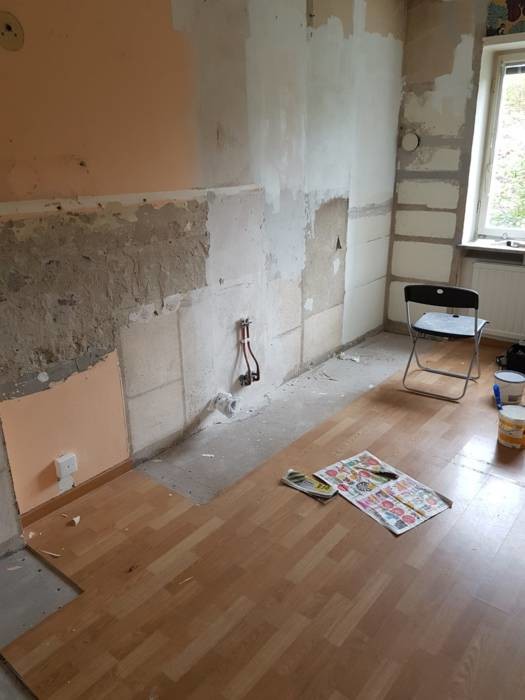
I bought nail plugs 5X35mm and 6X40mm just like you recommended. However, they were not metal but regular plastic plugs. I'm a bit worried about hitting something in the ceiling when I drill. The wall will be placed either just to the right of the copper pipes or to the left, between the copper pipes and the drain. Do you have any idea how these pipes are typically routed? I live in a middle apartment, so I have neighbors on both sides. There are 4 pipes coming into my kitchen, 2 go on to the neighbor behind the wall in the picture and 2 stay with me. The question is if they split and go through the ceiling in some way?
I fell a bit behind this weekend when I ran into issues with the ceiling. In one spot, my cheap hammer drill managed to get through. But further into the ceiling, it was stopped.
I bought nail plugs 5X35mm and 6X40mm just like you recommended. However, they were not metal but regular plastic plugs. I'm a bit worried about hitting something in the ceiling when I drill. The wall will be placed either just to the right of the copper pipes or to the left, between the copper pipes and the drain. Do you have any idea how these pipes are typically routed? I live in a middle apartment, so I have neighbors on both sides. There are 4 pipes coming into my kitchen, 2 go on to the neighbor behind the wall in the picture and 2 stay with me. The question is if they split and go through the ceiling in some way?
Click here to reply