
Hello,
my first post in this forum, I have read a lot and found many good things, thank you!
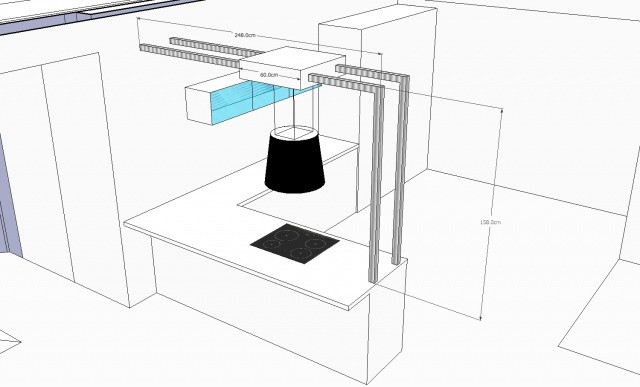
I am planning to build a small roof above a kitchen island, the ceiling is quite high in the kitchen, about 4.5 meters. There is a sketch attached showing what I have in mind.
What do you think would be the right choice of materials for such a solution, some kind of metal pole I guess? Where could one order such things? (I live in Stockholm). Will it hold? The fan hanging in the "ceiling" weighs about 23 kg. Feel free to share thoughts and ideas about the solution ..
..
Best regards,
Niklas
my first post in this forum, I have read a lot and found many good things, thank you!
I am planning to build a small roof above a kitchen island, the ceiling is quite high in the kitchen, about 4.5 meters. There is a sketch attached showing what I have in mind.
What do you think would be the right choice of materials for such a solution, some kind of metal pole I guess? Where could one order such things? (I live in Stockholm). Will it hold? The fan hanging in the "ceiling" weighs about 23 kg. Feel free to share thoughts and ideas about the solution
..Best regards,
Niklas
Last edited:

Hi again,
after checking with a metalworking company about the construction above, they said that it would bend with stainless steel.
Then I thought that one could have the roof completely clad in gypsum boards and some sturdier beams inside. I checked a bit on how to calculate if there will be permanent deflection using formulas from this post: http://mobil.byggahus.se/forum/byggmaterial-byggteknik/74330-berakna-hea-balk.html.
The calculations look like this with two glulam beams 42mm x 90mm:
wood density is set to = 500kg/m^3
Distributed load:
(5 * q * L^4) / (384 * E * i)
q = force - N/m
L = length - m
E = Modulus of Elasticity - Pa - N/m^2
i = Moment of Inertia
self-weight force = b * h * L * wood density * 9.81 = 0.042 * 0.09 * 2.5 * 500 * 9.81 = 46.4N
force from gypsum boards = 22.5 * 9.81 / 2 = 110.35N
q = self-weight + gypsum boards
i = (b*h^3) / 12 =
b = 0.042m
h = 0.09m
L = 2.5m
E = 11,600 MPa = 11,600,000,000 N/m^2
(5 * (110.35 + 46.4)/2.5 * 2.5^4) / (384 * 11600000000 * ((0.042*0.09^3) / 12))=0.001077m
Point load:
(q * L^3) / (48 * E * i)
q = 23 * 9.81 / 2 = 112.8N
(112.8 * 2.5^3) / (48 * 11600000000 * ((0.042*0.09^3) / 12)) = 0.00124m
So the total deflection is 0.001077 + 0.00124 = 0.002317m
It must not exceed, as I understand it, L/400 = 2.5/400 = 0.00625m, which it manages to do.
What do you think about the calculation, is there more that needs to be considered? It's not a super load-bearing construction meant to hold up an entire roof with a lot of snow on it, but should I consult with a structural engineer just to be safe?
Strength values for glulam I got from: http://http://www.svensktlimtra.se/Upload/File/Press/Sv_Limtra_Eurokod5_lowres.pdf
One question though, should one take the modulus of elasticity for parallel to the fibers or perpendicular to the fibers? There is quite a big difference...
Regards,
Niklas
after checking with a metalworking company about the construction above, they said that it would bend with stainless steel.
Then I thought that one could have the roof completely clad in gypsum boards and some sturdier beams inside. I checked a bit on how to calculate if there will be permanent deflection using formulas from this post: http://mobil.byggahus.se/forum/byggmaterial-byggteknik/74330-berakna-hea-balk.html.
The calculations look like this with two glulam beams 42mm x 90mm:
wood density is set to = 500kg/m^3
Distributed load:
(5 * q * L^4) / (384 * E * i)
q = force - N/m
L = length - m
E = Modulus of Elasticity - Pa - N/m^2
i = Moment of Inertia
self-weight force = b * h * L * wood density * 9.81 = 0.042 * 0.09 * 2.5 * 500 * 9.81 = 46.4N
force from gypsum boards = 22.5 * 9.81 / 2 = 110.35N
q = self-weight + gypsum boards
i = (b*h^3) / 12 =
b = 0.042m
h = 0.09m
L = 2.5m
E = 11,600 MPa = 11,600,000,000 N/m^2
(5 * (110.35 + 46.4)/2.5 * 2.5^4) / (384 * 11600000000 * ((0.042*0.09^3) / 12))=0.001077m
Point load:
(q * L^3) / (48 * E * i)
q = 23 * 9.81 / 2 = 112.8N
(112.8 * 2.5^3) / (48 * 11600000000 * ((0.042*0.09^3) / 12)) = 0.00124m
So the total deflection is 0.001077 + 0.00124 = 0.002317m
It must not exceed, as I understand it, L/400 = 2.5/400 = 0.00625m, which it manages to do.
What do you think about the calculation, is there more that needs to be considered? It's not a super load-bearing construction meant to hold up an entire roof with a lot of snow on it, but should I consult with a structural engineer just to be safe?
Strength values for glulam I got from: http://http://www.svensktlimtra.se/Upload/File/Press/Sv_Limtra_Eurokod5_lowres.pdf
One question though, should one take the modulus of elasticity for parallel to the fibers or perpendicular to the fibers? There is quite a big difference...
Regards,
Niklas
Last edited:
42x90 is probably not a glulam beam. It's a standard stud...
Then I'm wondering what kind of stainless steel beam you need that bends with a load of 25-30 kg in the middle? Shouldn't it rest on the posts and then be fastened to the wall on the left?
Then I'm wondering what kind of stainless steel beam you need that bends with a load of 25-30 kg in the middle? Shouldn't it rest on the posts and then be fastened to the wall on the left?
Hello,
Yes exactly, it should be fastened inside the wall... I also thought it would hold. I said I wanted a quote on stainless steel beams/pipes with a suitable standard size. I'll look into that more...
Regarding the wood dimensions, I've got them from this document with glulam standards: http://www.svensktlimtra.se/Upload/File/Press/Sv_Limtra_Eurokod5_lowres.pdf
Thanks for the input.
/Niklas
Yes exactly, it should be fastened inside the wall... I also thought it would hold. I said I wanted a quote on stainless steel beams/pipes with a suitable standard size. I'll look into that more...
Regarding the wood dimensions, I've got them from this document with glulam standards: http://www.svensktlimtra.se/Upload/File/Press/Sv_Limtra_Eurokod5_lowres.pdf
Thanks for the input.
/Niklas
Click here to reply