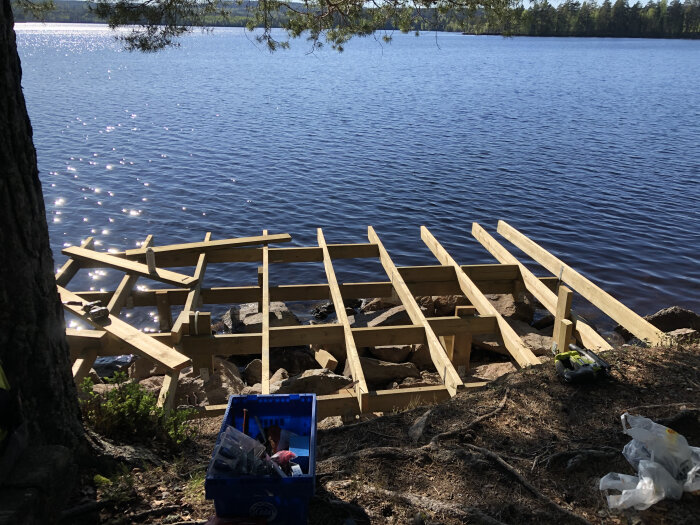
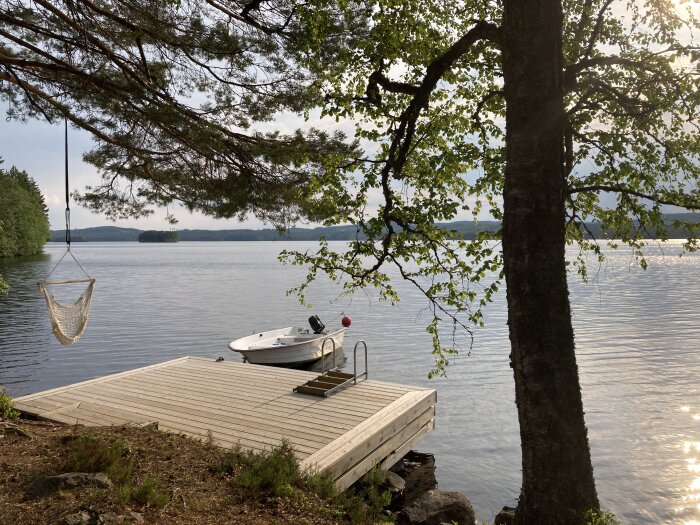
A couple of years ago, I built a dock at our summer place. Unfortunately, I didn't take enough consideration for the ice, and after two winters, the ice has crushed large parts of the dock.
The dock is built on a rock in combination with a stone scree. When the ice releases on the lake and the wind blows, there are enormous forces at play.
My idea now is to rebuild the dock. I would prefer a solution where I don't have to take the dock in and out every year.
Hence the idea of building a sturdy stone crib.
Does anyone here have experience in designing and building a stone crib? The one I've drawn up now would hold about 3T of stone. As a novice, it's hard to know if this is sufficient.
If a stone crib is preferable, can I use the current dock as a work platform and thus install the stone crib and fill it with stones?
Attached are a couple of images below from the construction to the completion of the current dock;
A small reminder. Don't forget to report your water activity to your county administrative board before you start working.
I don't know how the concerned county administrative board reasons, and it probably depends a lot on the conditions and environment in the specific case. But generally, piled jetties are most advantageous from an environmental perspective, followed by floating jetties, and finally stone cribs. There is a document about this from Lst Stockholm, "Våra bryggors påverkan på växter och djur" ("The impact of our jetties on plants and animals").
Additionally, it's not good if the jetty breaks and you repeatedly need to repair it, as that also causes disruption. Which means that a stone crib is still justified in some cases.
A small note. Don't forget to submit a notification for water activities to your county administrative board before you start working.
I don't know how they reason at the concerned county administrative board and it probably depends a lot on the conditions and environment in the specific case. But generally, pile-driven piers are most advantageous from an environmental perspective, followed by floating docks and lastly, stone cribs. There is a document about this from Lst Stockholm, "The Impact of Our Piers on Plants and Animals".
Of course, it's not good if the pier breaks and you need to repeatedly fix it, as it also causes disturbance. Which makes stone cribs still justified in some cases.
Interesting that they're ranked so categorically. But it's understandable that a large crib makes more of a difference than a few piles. In some places, piers probably benefit wildlife greatly. Somewhere I read that stone cribs are often a boon for wildlife as they offer such multifaceted protection. Suitable for everything from shrimp and fish underwater to insects and mammals above the water surface.
Interesting that rankings are made so categorically. But one understands that a large crib makes more difference than some poles. In some places, piers probably do a lot of good for wildlife. Somewhere I read that a stone crib is often a godsend for wildlife as they offer such multifaceted protection. Suitable for everything from shrimp and fish underwater to insects and mammals above water.
It's not an absolute ranking, more of a principle.
The idea that piers are good for wildlife is a common myth. I haven't seen any study that supports it. Sure, there are probably many fish at piers, but it's best, of course, to leave them alone. A stone crib is the most impactful because it takes up bottom space permanently, making it inaccessible for bottom-dwelling animals.
When building a pier, which can certainly be justified, one can choose one that is most suitable overall.
Click here to reply
Vi vill skicka notiser för ämnen du bevakar och händelser som berör dig.