
6,850 views ·
25 replies
7k views
25 replies
Building a garage from own forest
Hello!
I hope this is the right subforum. I've searched quite hard both here and on other forums but haven't really found a thread that fits, so I'm creating a new thread. Apologies if I've missed something!
I'm thinking of building a heated garage, which should withstand the snow load in northern Norrland, approximately 8x10 meters, 2.5m internal ceiling height, and use as much of my own forest and labor as possible due to current prices and, well, you know, the uncertain future. (I've delved into pre-fabricated element constructions for about a year, but they've become so expensive that I don't know if I can survive the cost).
I understand that the answers can get complicated, and how I present the issues here is both roughly and gravely oversimplified... but let's go:
1) How many trees (x) of size do I need to cut down to get sawed (z) material for the construction
..if z, the build, is everything above the poured slab except the roof trusses. Since I assume the trusses should probably be ordered from someone who knows how to make them.
Is there some sort of equation or template for roughly calculating this? Or is it best to hire the local carpenter you trust the most?
2) Will spruce work for all of this? Spruce is mostly what I have to cut down.
3) Depending on whether it's spruce or pine that should be felled (still hoping just for spruce) - what is the right season for the steps? (felling, sawing, resting, etc.)
Apologies if this is a messy post and line of questioning. I'm very grateful for input on even the smallest detail!
I hope this is the right subforum. I've searched quite hard both here and on other forums but haven't really found a thread that fits, so I'm creating a new thread. Apologies if I've missed something!
I'm thinking of building a heated garage, which should withstand the snow load in northern Norrland, approximately 8x10 meters, 2.5m internal ceiling height, and use as much of my own forest and labor as possible due to current prices and, well, you know, the uncertain future. (I've delved into pre-fabricated element constructions for about a year, but they've become so expensive that I don't know if I can survive the cost).
I understand that the answers can get complicated, and how I present the issues here is both roughly and gravely oversimplified... but let's go:
1) How many trees (x) of size
do I need to cut down to get sawed (z) material for the construction..if z, the build, is everything above the poured slab except the roof trusses. Since I assume the trusses should probably be ordered from someone who knows how to make them.
Is there some sort of equation or template for roughly calculating this? Or is it best to hire the local carpenter you trust the most?
2) Will spruce work for all of this? Spruce is mostly what I have to cut down.
3) Depending on whether it's spruce or pine that should be felled (still hoping just for spruce) - what is the right season for the steps? (felling, sawing, resting, etc.)
Apologies if this is a messy post and line of questioning. I'm very grateful for input on even the smallest detail!
Thank you for the reply ArneTW!
Is there any reason for the timber itself and its future quality to fell in winter? Is the only thought there to minimize damage to the roots of trees that remain, or is there something more for the timber itself?
I was thinking if you fell now and saw next week, instead of waiting a year?
Is there any reason for the timber itself and its future quality to fell in winter? Is the only thought there to minimize damage to the roots of trees that remain, or is there something more for the timber itself?
I was thinking if you fell now and saw next week, instead of waiting a year?
If you fell trees in the winter, you have more time to handle the logs before mold sets in. It's so frustrating to end up with black mold on the timber. It takes a while to saw, stack, and cover the timber. Of course, it naturally depends on the resources you have available, but for me, as someone who does this infrequently and amateurishly, winter is the only sensible option.
Thanks Bjober!
Good info overall from your two responses.
I also have a few hooks out with local talents who seem to know this as well. I'll update the thread in the future, which I hopefully will remember to do - as a thank you for the help, that is. Hope it's appreciated as "payment."
Good info overall from your two responses.
I also have a few hooks out with local talents who seem to know this as well. I'll update the thread in the future, which I hopefully will remember to do
- as a thank you for the help, that is. Hope it's appreciated as "payment."A relative of mine allowed a company to harvest forest in exchange for a good price on timber.
That deal is logical and good, but unfortunately, I don't have a slot for final felling right now. Even if I did, it seems quite common for timber buyers/forestry companies to write a multi-year contract on when it must be completed by - so it's unfortunately also against my timeframe.C Carl Johansson said:
In winter, the trees are the driest. Then it's important to get started and saw during the drying period in spring.
Spruce should work excellently, I believe paneling should be spruce.
I've done some sawing this spring on a Logosol F2. Calculated about 350 SEK/hour after tax by sawing myself compared to buying.
Spruce should work excellently, I believe paneling should be spruce.
I've done some sawing this spring on a Logosol F2. Calculated about 350 SEK/hour after tax by sawing myself compared to buying.
Thanks for the answer. I'm interested in the "drying period." As far as I understand, you can fell and saw the timber almost immediately in the spring - but how long should it dry before it can be used?V Vardon said:During winter, the trees are at their driest. Then it's important to get started with the sawing to keep up with the drying period in the spring.
Spruce should work excellently, I believe paneling should be spruce.
I've done some sawing this spring on a Logosol F2. Calculated about 350 SEK/hour after tax by sawing myself instead of buying.
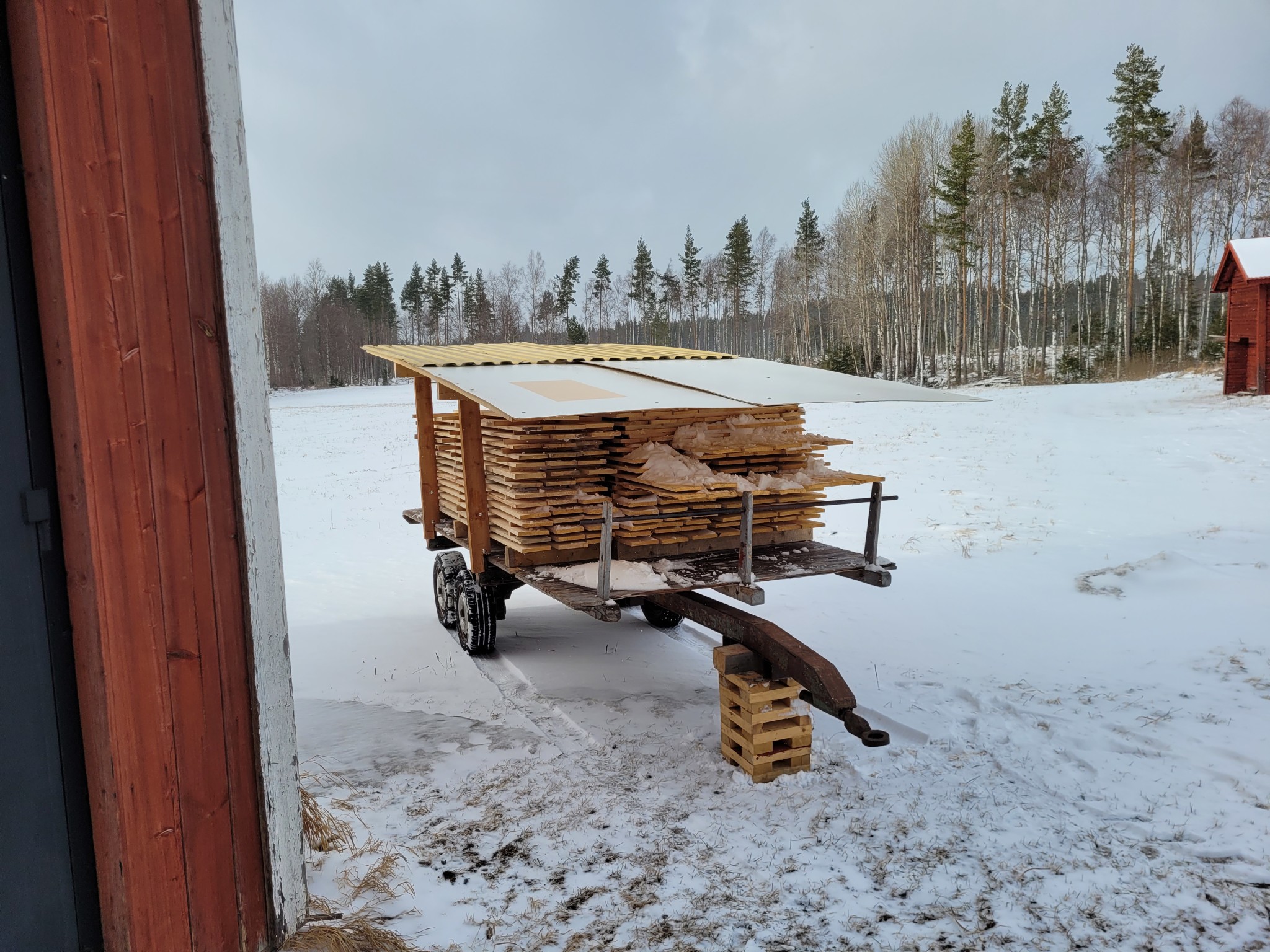
No, I have about 2.47 x2 so almost 5 m which becomes about 2.30 panels as the plan and then they were about 3.20 for the gables with some a bit longer just in case.Arvid Stålsträng said:
Otherwise, I usually take about 4.5 m as it fits quite well where I store the timber, etc.
It was the panels and about 20 2x8.25" and about 30 1x8.25" along with the next picture with "scrap wood" from the panels.
The panels should last well into spring. I'm always afraid of building in moisture so I would have measured and looked up how dry it should be.
Flooring should be allowed to lie indoors for about a year.
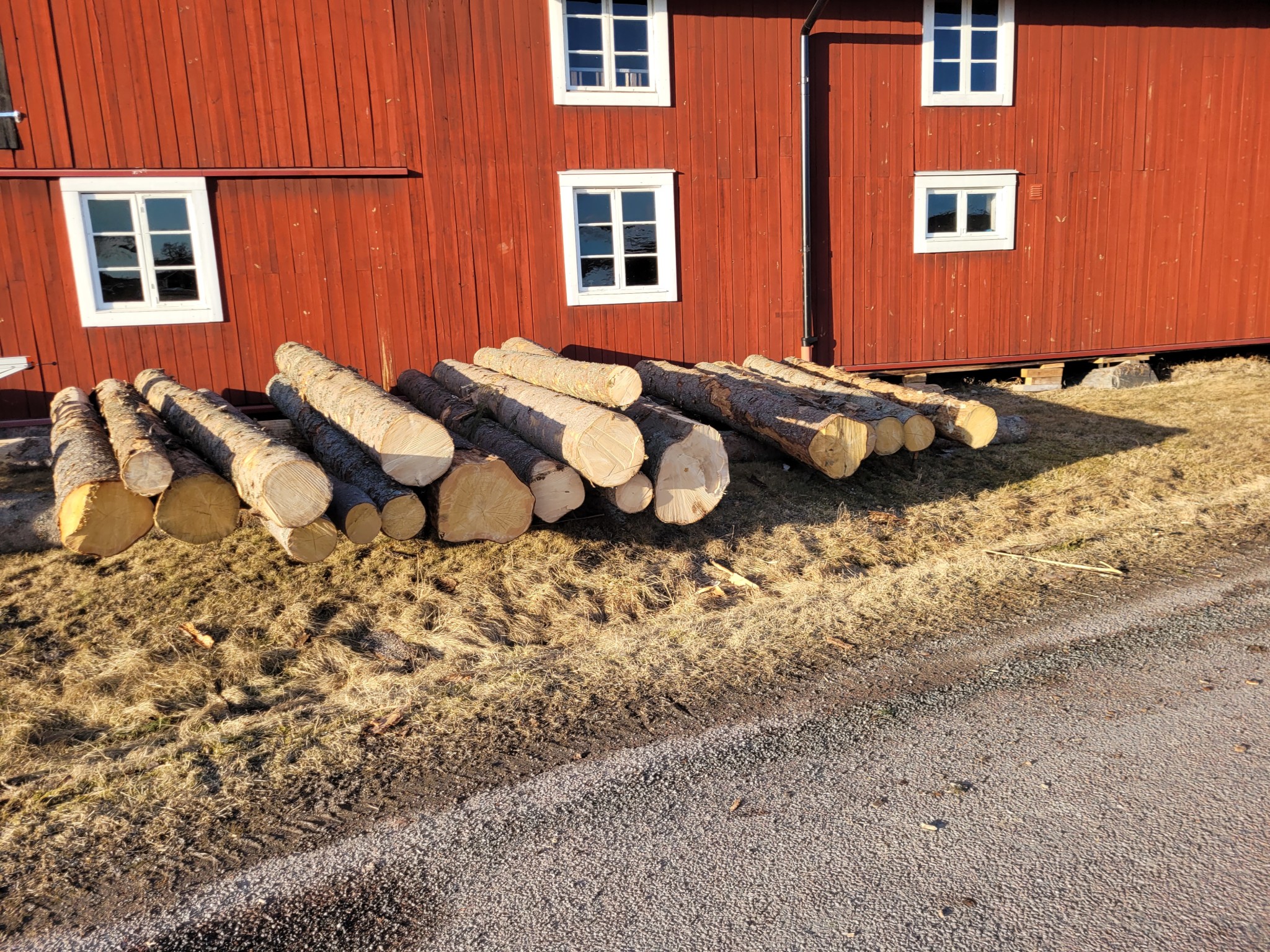
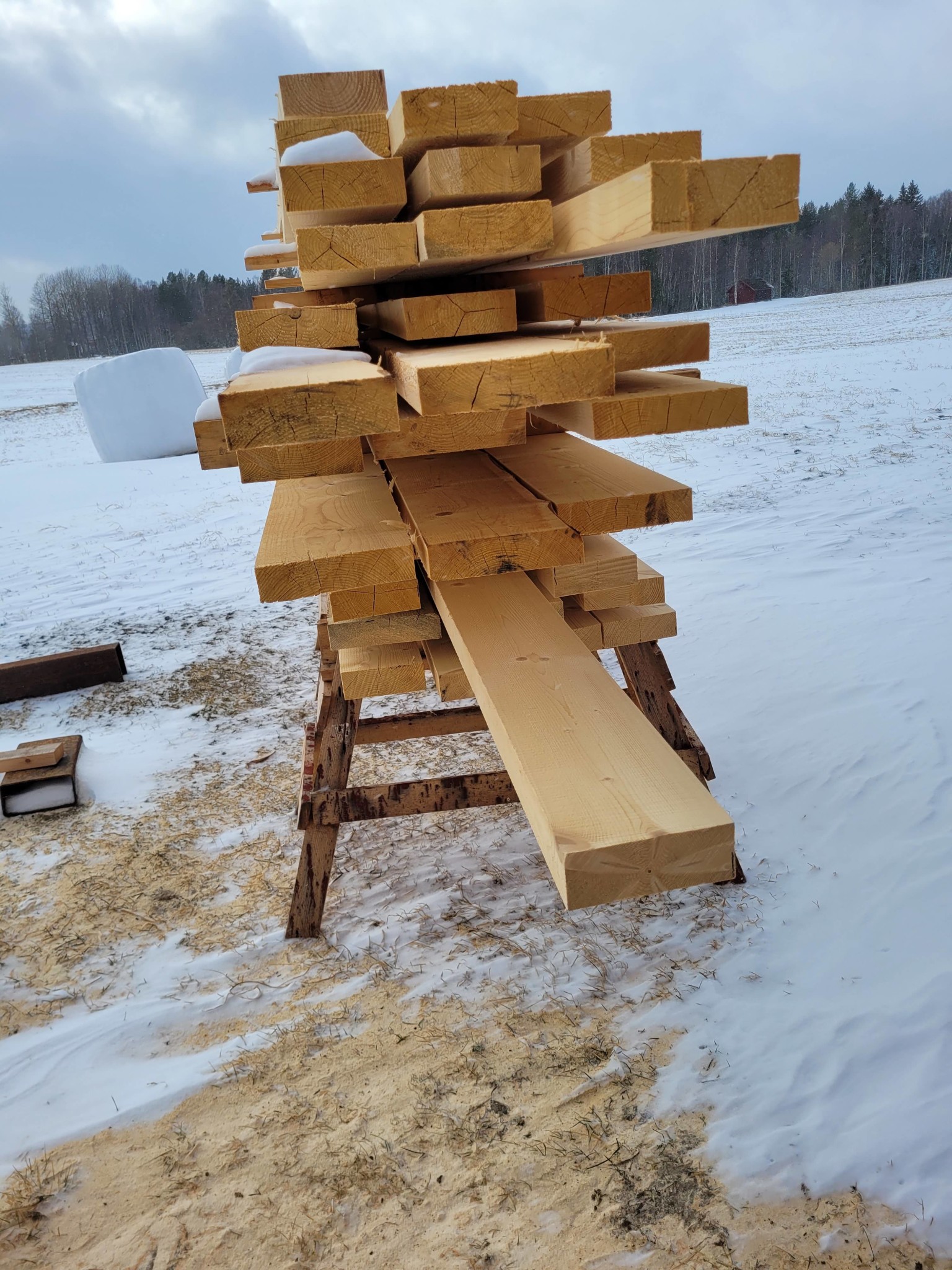
Interesting, thanks! When considering log length for cutting and transporting from the forest, would you go with 4.5m lengths for everything, or another length? I'm mostly thinking about efficiency. I just know that forestry companies like 4.5m, but that doesn't mean we as "self-builders" have to use the same measurements..
Edit: that last picture with timber and drifting snow. What a picture!
Edit: that last picture with timber and drifting snow. What a picture!
You choose the timber length based on what you are going to build, possibly adding 'stötfot' if you want the option to trim the timber and remove any end cracks.
That is, if you want a 2.5m high wall, choose at least 2.5m log length or possibly 2.8m including the stötfot, which can later be adjusted and cut off during the sawing and building process (waste).
If you are skilled in felling, transport, and sawing, drying, and storage, you might consider reducing the 'stötfot' and thus the waste by perhaps sawing the logs for the outer panel on a 2.5m wall to 255cm in the forest.
Consider how much shorter wall studs than panel timber you need; if the walls are to be built with 2-inch thick timber, you might possibly deduct for the thickness of the sill plate and top plate and saw the logs for the wall studs to 245cm in the forest.
If you find timber as short as approximately 2.5m difficult to handle, you might consider doubling the lengths of the logs, i.e., sawing a 51dm log in the forest and calculating to get one piece 51dm long, which you then cut into pieces 255cm long, suitable for a 250cm high outer wall panel when it is time to nail up the dried panel.
That is, if you want a 2.5m high wall, choose at least 2.5m log length or possibly 2.8m including the stötfot, which can later be adjusted and cut off during the sawing and building process (waste).
If you are skilled in felling, transport, and sawing, drying, and storage, you might consider reducing the 'stötfot' and thus the waste by perhaps sawing the logs for the outer panel on a 2.5m wall to 255cm in the forest.
Consider how much shorter wall studs than panel timber you need; if the walls are to be built with 2-inch thick timber, you might possibly deduct for the thickness of the sill plate and top plate and saw the logs for the wall studs to 245cm in the forest.
If you find timber as short as approximately 2.5m difficult to handle, you might consider doubling the lengths of the logs, i.e., sawing a 51dm log in the forest and calculating to get one piece 51dm long, which you then cut into pieces 255cm long, suitable for a 250cm high outer wall panel when it is time to nail up the dried panel.
Understood!F fribygg said:Choose the timber length based on what you are building, possibly adding 'stötfot' if you want the option to cut the timber cleanly and remove any end cracks. In other words, if you want a 2.5m wall height, choose at least 2.5m log length, possibly 2.8m including the 'stötfot', which can later be adjusted and cut off (waste) during the sawing and building process.
If you are skilled in logging, transport, and sawing, drying, and storage, you might consider reducing the 'stötfot' and thus the waste, you might saw the logs for the outer panel to 255cm in the forest for the 2.5m wall.
Consider how much shorter wall studs need to be compared to panel timber; if the walls are to be built with 2-inch thick timber, you might deduct for sill and top rail thickness and saw the logs for the wall studs 245cm in the forest.
If you find timber as short as approximately 2.5m difficult to handle, you might consider doubling the lengths of the logs, i.e., saw a 51dm log in the forest and calculate on getting 1 piece 51dm long which you then divide into 255cm long pieces suitable for a 250cm high outer wall panel when it's time to nail up the dried panel.
Thank you so much for that information. Understood.F fribygg said:Choose the timber length based on what you are building, possibly adding 'stötfot' if you want the option to cut the timber cleanly and remove any end cracks. In other words, if you want a 2.5m wall height, choose at least 2.5m log length, possibly 2.8m including the 'stötfot', which can later be adjusted and cut off (waste) during the sawing and building process.
If you are skilled in logging, transport, and sawing, drying, and storage, you might consider reducing the 'stötfot' and thus the waste, you might saw the logs for the outer panel to 255cm in the forest for the 2.5m wall.
Consider how much shorter wall studs need to be compared to panel timber; if the walls are to be built with 2-inch thick timber, you might deduct for sill and top rail thickness and saw the logs for the wall studs 245cm in the forest.
If you find timber as short as approximately 2.5m difficult to handle, you might consider doubling the lengths of the logs, i.e., saw a 51dm log in the forest and calculate on getting 1 piece 51dm long which you then divide into 255cm long pieces suitable for a 250cm high outer wall panel when it's time to nail up the dried panel.