There is a creek at the back that had a rotten and rather poorly built bridge when we moved in, which we dismantled quite promptly. But now it’s time to build a new one as the children are getting big enough to run across it.
The span across the creek will be somewhere between 4-5 meters. I haven’t been able to measure exactly due to slightly high water now during the snowmelt, but it should be roughly between those measurements?
We plan to build the bridge with decking timber, and I am now wondering what dimensions are required for it to be stable with that span. It’s intended to have 3 joists on edge. Will 195 or 220 joists work, or is something even thicker needed?
On top of this, a railing and decking floor of 34*145mm will be built.
45x220 manages 4.0m with cc 40cm if we're talking about a deck, should probably be equivalent for your application
Yes, then it should work without any problems. Might try to drive stakes in the middle if it doesn't become stable enough. But I would prefer to go without them as I want it free underneath so it doesn't risk getting caught with brush and junk.
I think an arch bridge (with a fairly low rise) is much more elegant than a beam bridge. From a static point of view, you also utilize the material better. Two arches are enough for you to place the decking on top. 34x145 mm can handle a 750 mm span without any problems. If you're handy, you can make the arches yourself from laminated treated boards. From a dimensional point of view, you should consider that unprotected wood outdoors ends up in climate class 3, which significantly reduces stiffness (modulus of elasticity) over time. There won't be very large loads, but it’s mainly the flexibility when walking over the bridge that you need to keep an eye on. Wobbly bridges are not fun.
I also like the idea of a railing as a truss, although I think it's difficult to make it look good using only wood.
3sr 145x 45 screw-glued to two beams clamped together with threaded rod. Joist 45x95 projecting 450mm every third on cc450mm for struts to the railing. Then, of course, 34x145mm as you mentioned for the walkway.
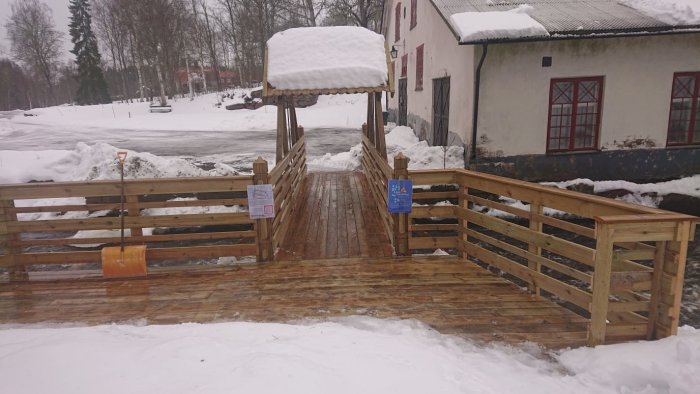
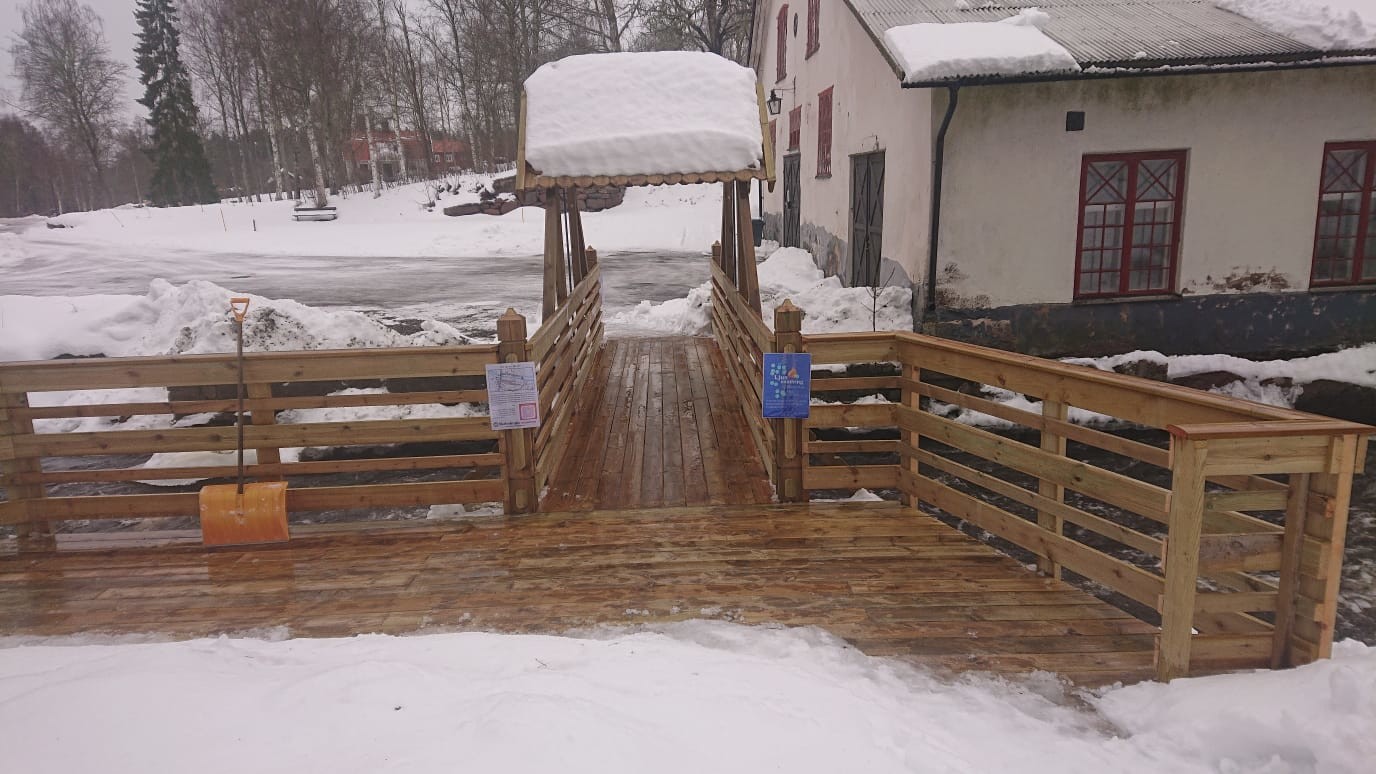
2 bridges built here in the village with a longer span, 13 miles south of Gävle, attaching a picture of one:
Thanks for all the responses, the idea of an arched bridge is appealing, but it will probably be a straight bridge with railings like in Huzzbutt's picture but without a roof. I'm a bit pressed for time with a lot of projects this summer and feel that I don't have enough knowledge to create an arched bridge in a nice way under time pressure, but if the circumstances change, it will probably be one of those.
3sr 145x 45 screw-glued onto two beams tightened together with threaded rod.
You mean that each beam is 3pcs 145x45 screw-glued. You have no support under that bridge, just 2 beams laying straight across? It will be great if it works with that dimension, otherwise the bridge becomes a bit cumbersome in height if you have a larger dimension, especially if you want to go up to 220.
If you have access to telephone poles, another classic with inspiration from the archipelago is to treat this as a bridge between two stone piers. With appropriate supports on each side, you run telephone poles across, on which you lay decking. Obviously, the shapes are a bit trickier than perfectly planed pressure-treated wood from the lumber yard, but if you're lucky with access to poles, it's significantly cheaper.
Nice effect with decking in the walking direction as in the picture in post #10. Telephone poles become very stiff and good. Can look nice with a little effort.
Nice effect with decking in the direction of travel as in the picture in post #10. Telephone poles become very stiff and good. Can look nice with a little effort.
Aesthetically nice, but one should not enhance the slippery effect that occurs on frosted wood.
My opinion is that it should lie crosswise.
Vi vill skicka notiser för ämnen du bevakar och händelser som berör dig.



Luddis_1 said: