My first thought was that the brick wall would be load-bearing, but I don't know what the minimum depth is for that - meaning two layers of brick and if there should be extra internal insulation?
As in this picture, for example
One of the neighbors has built a house with two layers of brick as load-bearing on the first floor and one layer on the second floor (upper level). Additionally, about 170 mm of stone wool on the outside. Approved by the municipality!
I meant the span of the trusses, but with 25m2 it's not that large, so 70x45 should work, but a check calculation is good to do. Snow zone also plays a role.
Good. So if I understand correctly, 108mm brick + 20mm air gap + OSB board + 70mm studs with 50mm insulation + 1.2 x2 plasterboards works. Am I missing something?
TS probably wants brick on the outside, likely for aesthetic reasons. Due to different thermal movements, it's probably not a good idea to have both brick and "regel" (great choice of words, right?) load-bearing. If you build a good load-bearing "regel" structure with 45x90, fill it with 90 mm insulation, ensure you avoid thermal bridges and drafts, and then add a thin brick wall on the outside, it will be a good cabin.
Good. So if I understood correctly, 108mm brick + 20mm air gap + osb board + 70mm studs with insulation 50mm + 1.2 x2 plasterboard works. Am I missing something?
If you absolutely want an OSB board, put it on the inside instead of plasterboard, then you have something to hang the pictures on. On the outside of the framework, you put better wind paper.
TS wants brick on the outside, probably for aesthetic reasons. Due to different thermal movements, it's probably not a good idea to have both brick and stud (good choice of words, right?) load-bearing.
If you build a good load-bearing framework with 45x90, fill it with 90 mm insulation, make sure to avoid thermal bridges and drafts, and then put a thin brick wall on the outside, it will be a good cabin.
That's correct. Partly for aesthetics but also because when I compare my first plan, i.e., with Finja Isolations block 290mm and plastered wall, if I go with a brick wall with wooden studs, I "might" gain a few cm inside (we're talking a total of 80cm total, better for home theater).
I would prefer to avoid wood as a load-bearing element if it can be solved with concrete blocks or double layers of brick.
Brick has very poor insulation value, leca also, so a wooden frame wall with insulation and facade brick will be significantly thinner with the same "energy value".
One should try to keep more balls in the air at the same time. Brick has an insulation value at best that corresponds to 1/9 of mineral wool, but a brick facade is practically maintenance-free. If you build a solid brick wall with insulation in the middle, you can also achieve an indoor wall that is maintenance-free and provides a rustic feel. The same type of reasoning can be applied to wooden frames and solutions based on lecasten. A load-bearing brick wall should be a solid brick wall. It is possible to build load-bearing wall frames based on 45x70 studs instead of 45x95 studs. A 45x70 stud in a wall construction can take a load of 9 kN (about 900 kg). The corresponding value for a 45x95 stud is 21 kN (about 2100 kg). 9 kN every 600 mm meets most needs that arise in a single-story building.
Brick has poor insulation value, so does leca, so a wooden frame wall with insulation and brick veneer becomes significantly thinner with the same "energy value"
Ok.
My quick calculation from everything said here then.
Wooden frame with brick: 108mm brick with air space and weather barrier, 95mm stud with 90mm insulation, plus drywall on the inside.
One should try to keep more balls in the air at the same time. Brick has at best an insulation value equivalent to 1/9 of mineral wool, but a brick facade is practically maintenance-free. If you build a solid brick wall with insulation in the middle, you can also get an interior wall that is maintenance-free and gives a rustic feel. The same type of reasoning can be applied to wooden frames and solutions based on lecasten. A load-bearing brick wall should be a full brick wall. It is possible to build load-bearing frame structures based on 45x70 studs instead of 45x95 studs. A 45x70 stud in a wall construction can bear a load of 9 kN (about 900 kg). The corresponding value for a 45x95 stud is 21 kN (about 2100 kg). 9 kN every 600 mm meets most needs that arise in a single-story building.
Hmm. Yes, solid brick wall was my first idea but with drywall inside, for sound insulation. But when I calculated, I would lose interior space and continued to consider the idea of fine brick instead, cheaper and maintenance-free as you say, but mainly to gain a little extra space.
So if I choose brick, I interpret everyone's answers to mean that I can easily frame up with 70mm/or 90mm studs with a brick facade and sleep well thereafter?
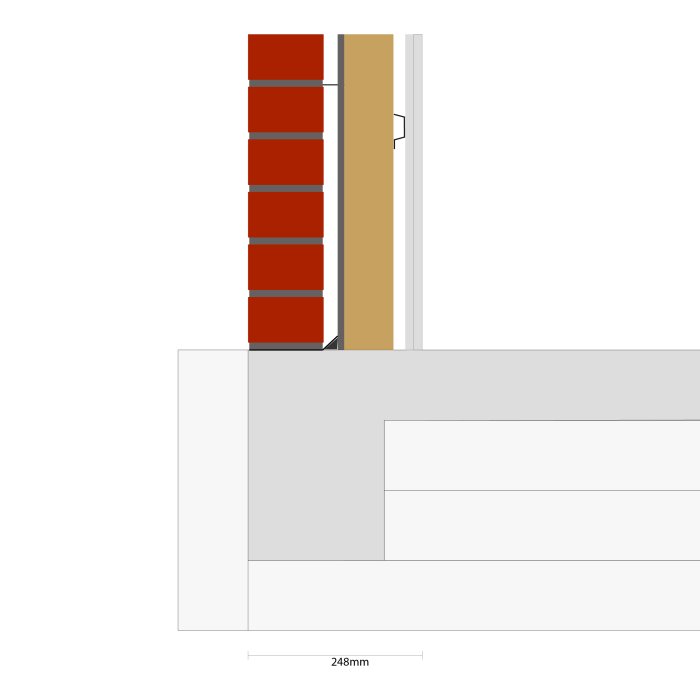
As it stands now, I will proceed as in image 1 - brick - outdoor gypsum - 70mm studs with 50mm insulation and gypsum.
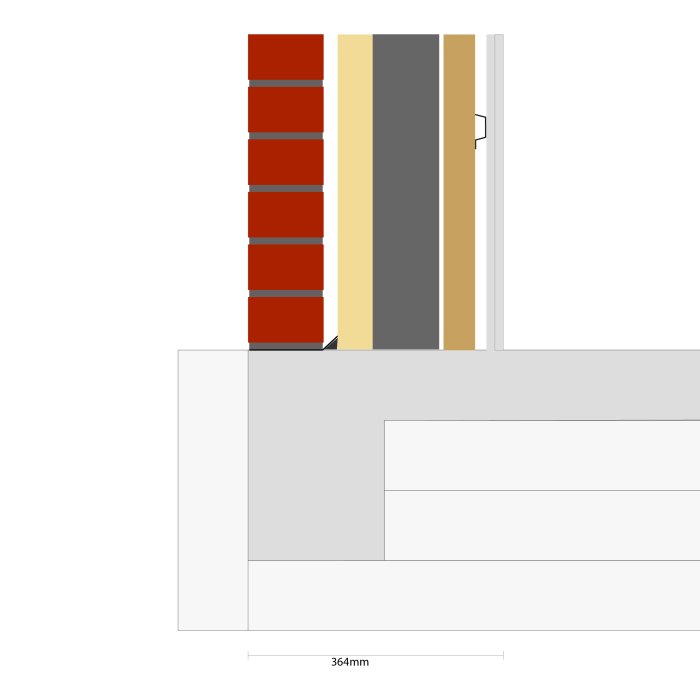
The second option is Image 2 - Brick - 50mm insulation - 95mm concrete block - 45mm studs and gypsum.


Johannes Carlsson said:
Sebkarlbjork said: