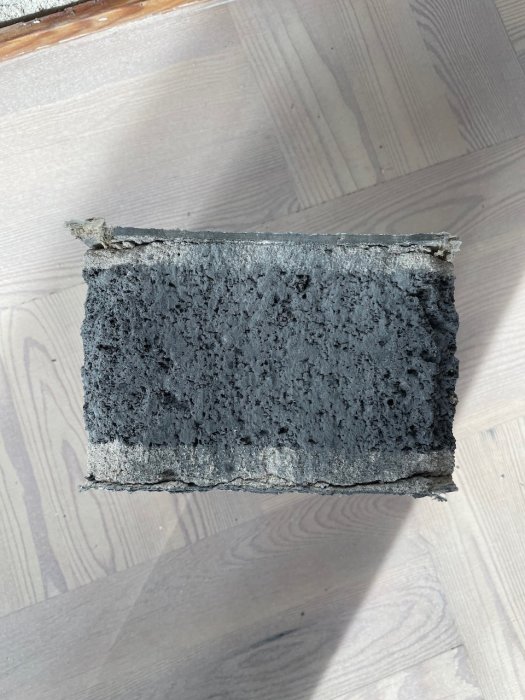
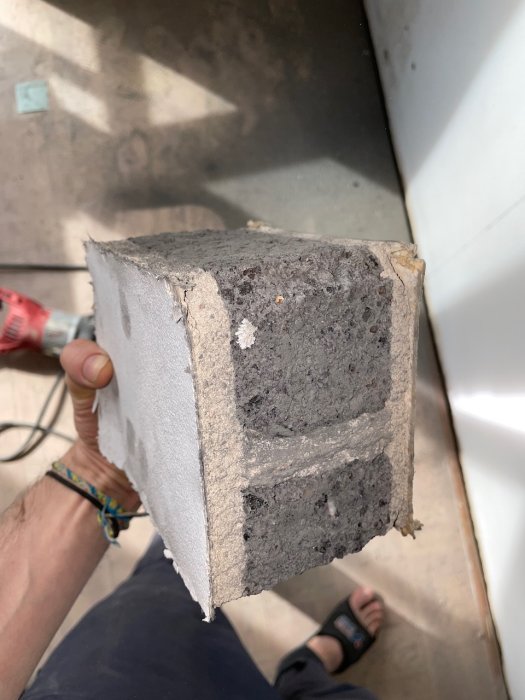
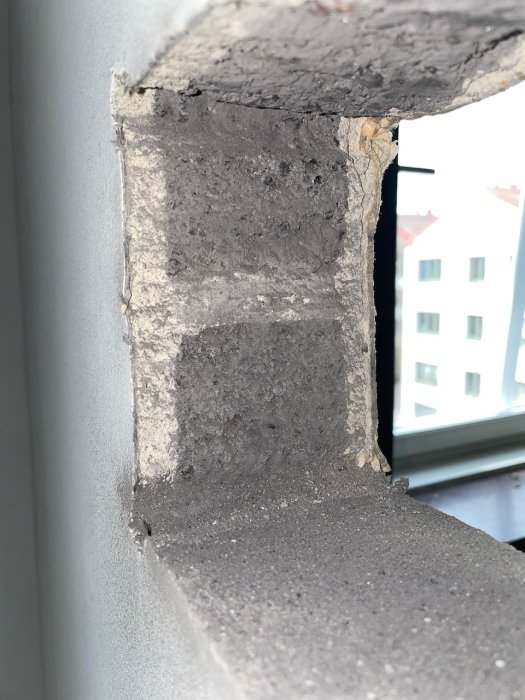
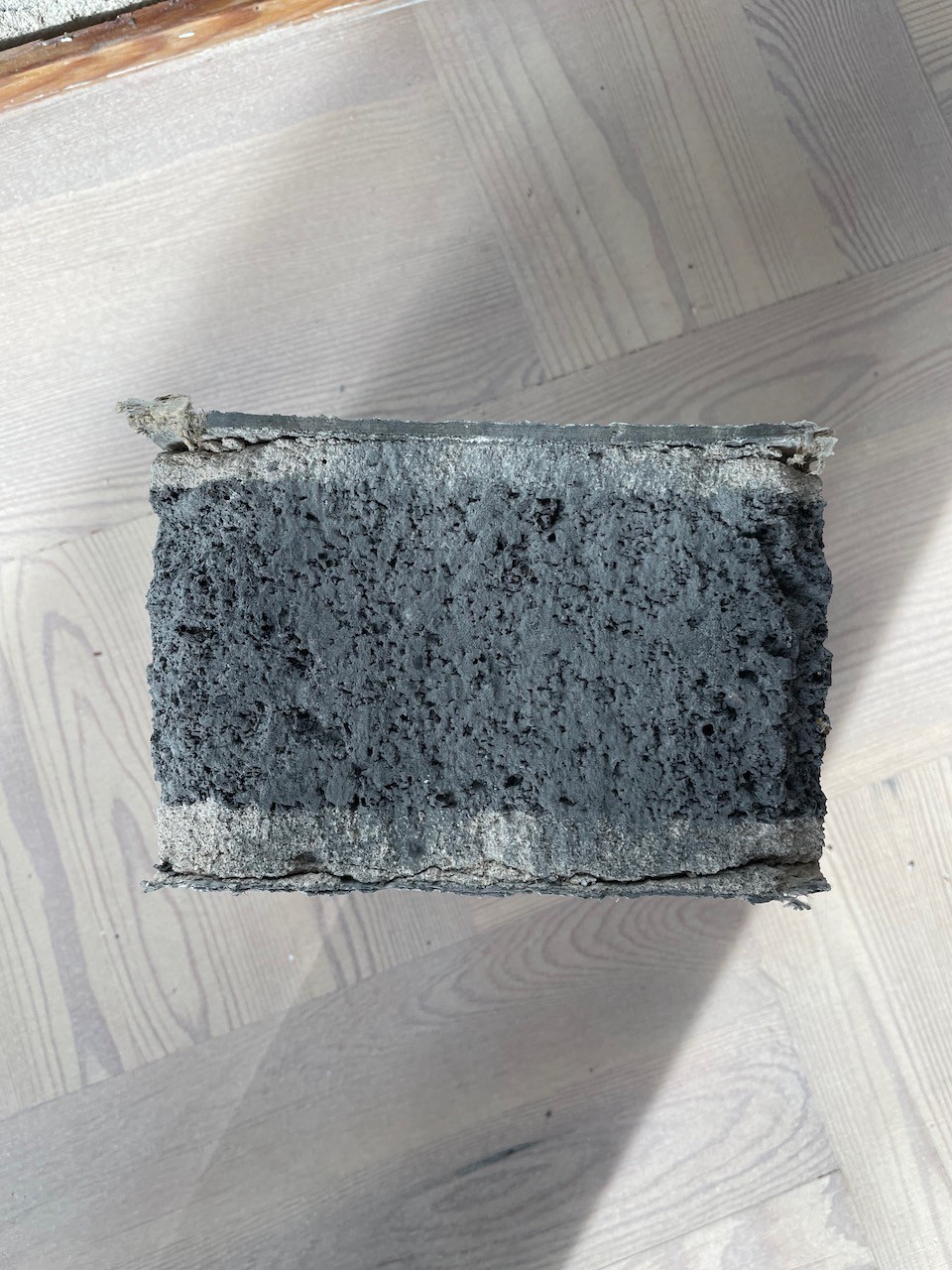
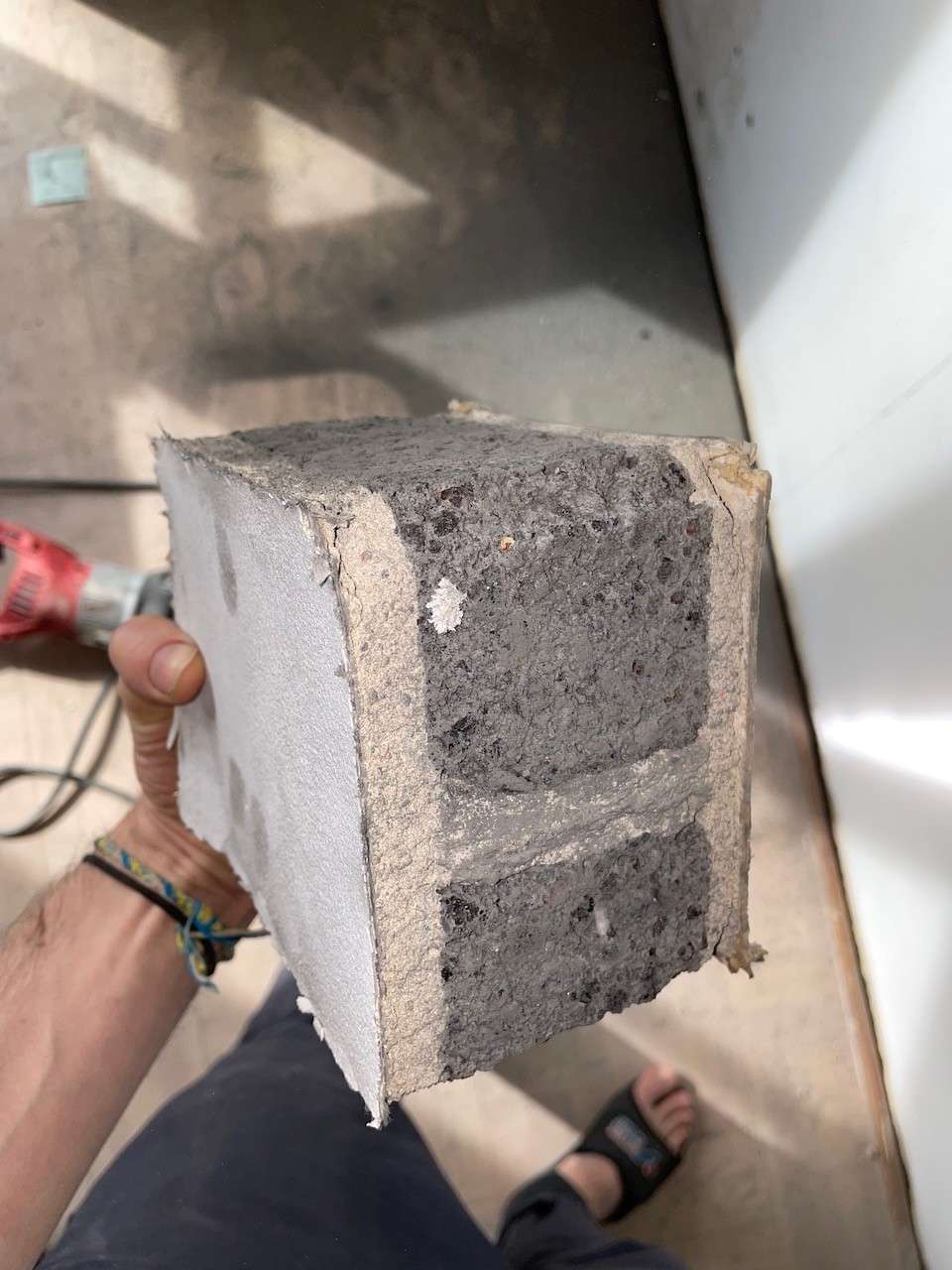
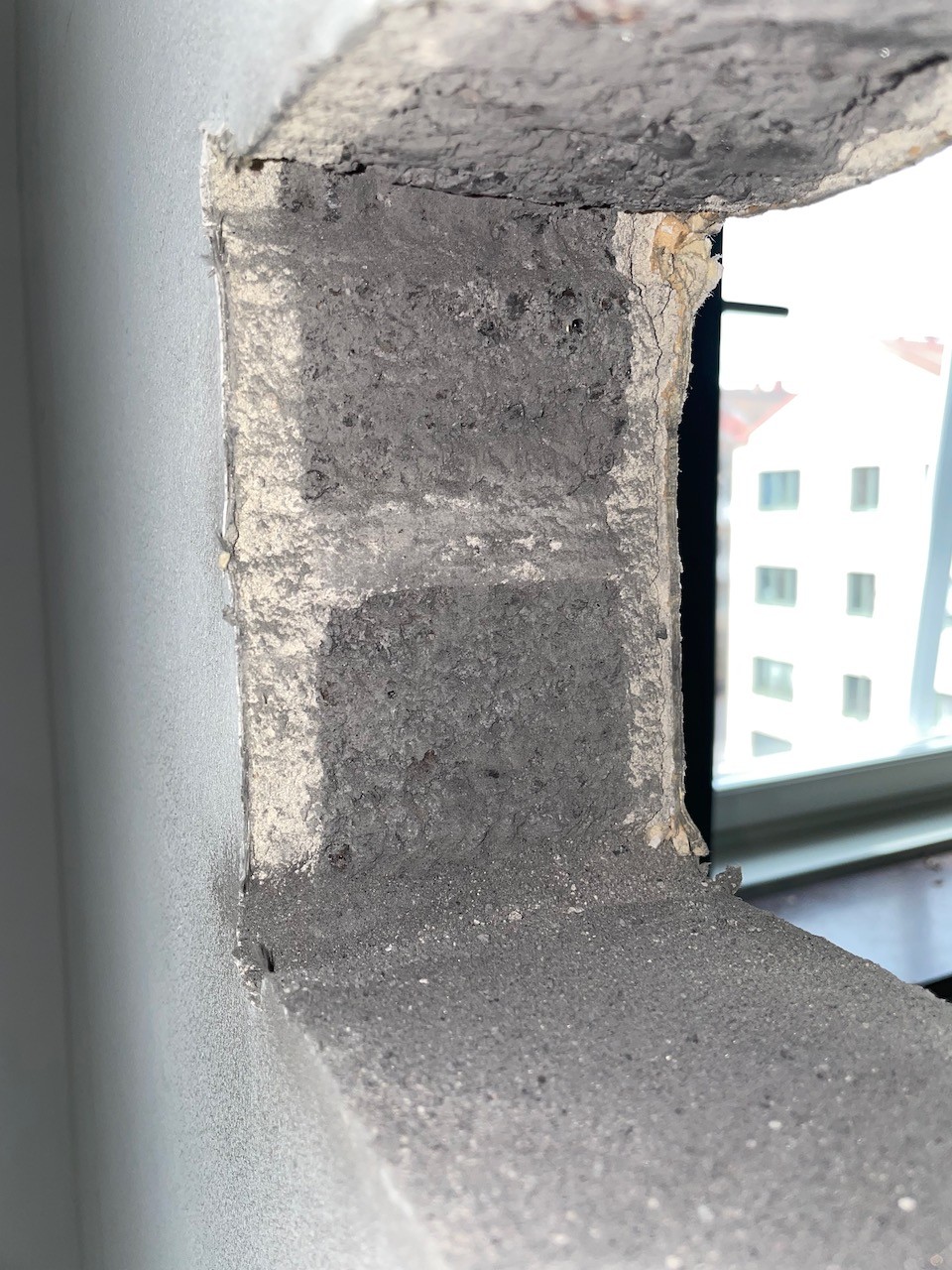
I am in the process of making a doorway in an interior wall that I originally thought consisted of lightweight concrete throughout but turned out to be something else. On the outside, it is 10-15 mm of light plaster, but the middle of the wall seems to consist of about 70 mm of black material, which I am unsure about. I rented a reciprocating saw for the job, and the blade that came with the saw (Hilti WD 30 6), according to the person I rented it from - a former craftsman - should be suitable for lightweight concrete. However, it only took a few minutes before the teeth were completely worn out on the saw blade.
The person I rented the saw from suspected blåbetong. I don't know for sure, and after a lot of googling, I'm torn between blåbetong or slag stone/slag plates. The house is a multi-family house in the Stockholm region built in 1943. See the attached images below of the piece of wall I managed to remove.
What I am wondering about and would like your help with:
What is the material in the wall?
How do I best cut through it? After failing with the reciprocating saw, the plan right now is to rent a cut-off saw with a diamond blade (Hilti DCH 300). Is it an option to rent the reciprocating saw again and use a different blade?
How would you attach a door frame to the material? Right now, I have a bunch of Essev 120 mm concrete screws. Earlier this week, I bought their corresponding lightweight concrete screws but went to Bauhaus and exchanged them for the "regular" concrete screws after today's discovery.
Thanks in advance!
---
Without flash. Best to see color and contrast against the plaster.
Blue concrete is porous and quite soft. I don't think your wall looks like blue concrete, and the fact that the blade was damaged so quickly also speaks against it.
I think you should opt for cutting with a diamond blade. If nothing else, it will go much faster.
I have cut through some blue concrete walls with a reciprocating saw when dismantling walls in the basement. In our case, the plaster on the walls wore down the saw blade much more than the blue concrete did.
That looks like lecablock but it doesn't match at all if the wall is from the year it was built. Maybe slag plate. It doesn't look like any lightweight concrete in any case, it usually has smaller pores and is a bit more homogeneous than what you see in the picture.
Lecablock, and perhaps also slag plate, are really hard on saw blades. It requires carbide teeth and even they wear out in my (albeit limited) experience after not too long.
In my condominium from 1936, the interior walls are made of slag plates, and they leave a black dust that is almost like soot and dirties things immensely.
Just as someone already wrote, the plaster wears immensely on saw blades for lightweight concrete.
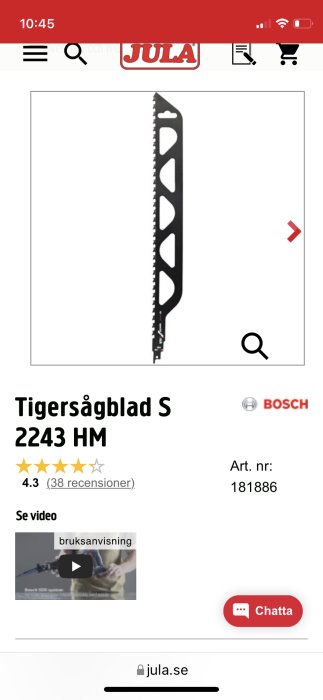
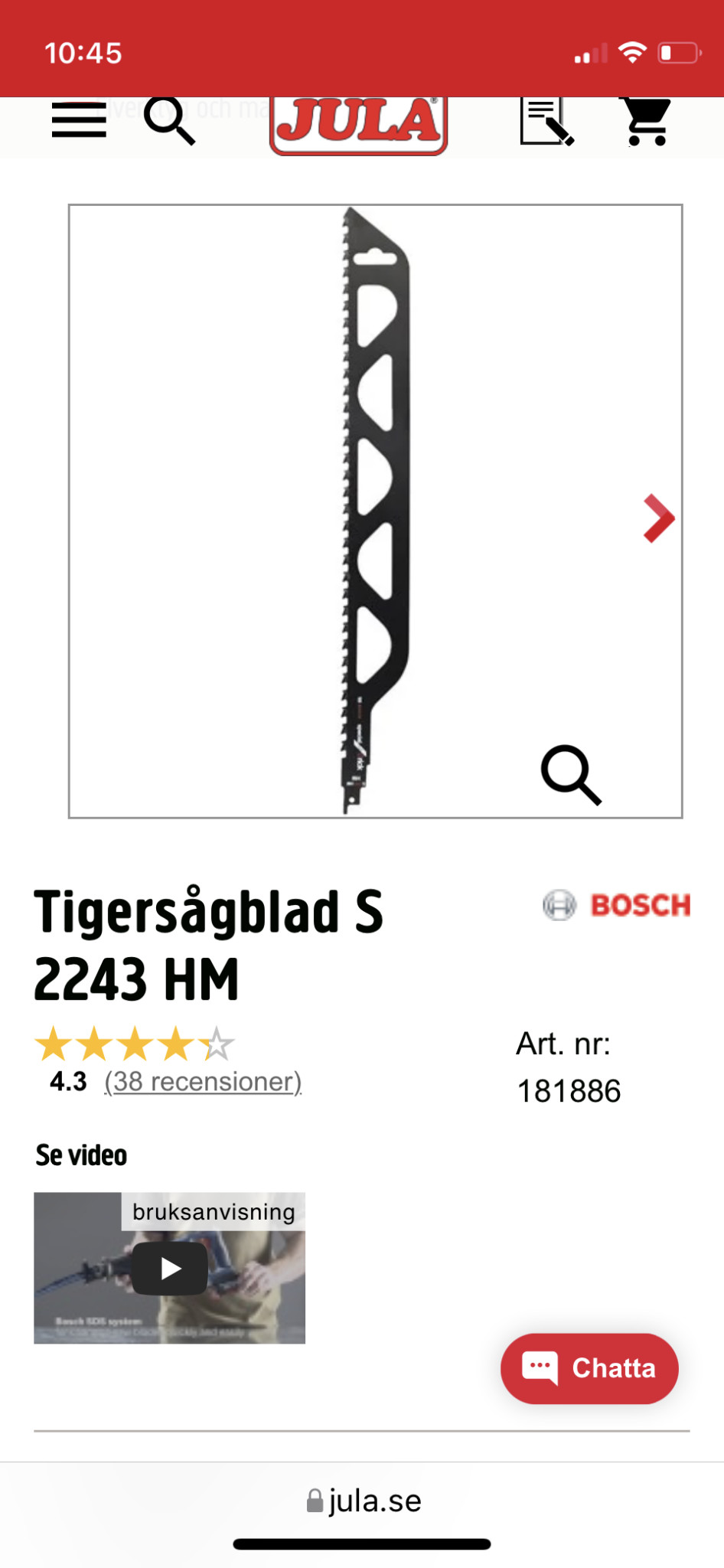
I don't know which reciprocating saw blade you used. But the blade in the picture I'm sending should work. I have used those on both old slag walls and lecablock. Take it a bit easy when you're cutting! The saw will cut in a completely different way than before! There is a risk that it shakes off plaster and that slag blocks shake loose. The alternative is a cutoff machine with a diamond blade, but it creates an incredible amount of dust! Regarding attaching a frame in slag walls, it's a hell of a task! They crack so easily.
Scattered showers on the material! I don't think the black material is very porous, but you can slowly peel off parts of it with a Morakniv. I haven't wanted to go at it with a handsaw and risk ruining the blade unnecessarily.
OOaken said:
I don't know which reciprocating saw blade you used. But the blade in the picture I'm sending should work. I've used them on both old slag walls and leca blocks. Take it easy when cutting! The saw will remove material in a completely different way than before! There's a risk of shaking loose the plaster and the slag blocks. The alternative is a cutoff saw with a diamond blade, but it produces an incredible amount of dust! Fitting frames into slag walls is a hell... They crack incredibly easily.
The blade that came with the machine had finer teeth than that. It was the WD 30 6 blade that's listed here. It's listed as "Heavy Wood / Metal" and "Demolition," so maybe that explains why the blade didn't like the material? However, he seemed sure that it would be sufficient for lightweight concrete…
I'm still leaning towards the cutoff saw. As for the dust, all the furniture is covered with plastic, and I'm borrowing a construction vacuum and a dust eater. Hopefully, that will save me somewhat!
Then it will be interesting to see how it goes with the frame screws. Do you have any tips along the way? As mentioned, the plan right now is to use 120 mm concrete screws straight into the block. Pre-drill, but without a plug.
ZZipLock said:
In my condo from 1936, the interior walls are made of slag plates and they leave a black dust that is almost like soot and dirties everything enormously.
Just as someone already wrote the plaster wears down blades for lightweight concrete enormously.
The black dust that dirties everything is familiar here too!
The material you are cutting is not lightweight concrete but burnt clay. The predecessor to leca.
Unfortunately, no good tips for the assembly, but a small tip could be that if you use a plug, you can set the plug so it expands upwards and downwards instead of sideways. The plug usually expands in all directions but more in a certain direction.
Click here to reply
Vi vill skicka notiser för ämnen du bevakar och händelser som berör dig.