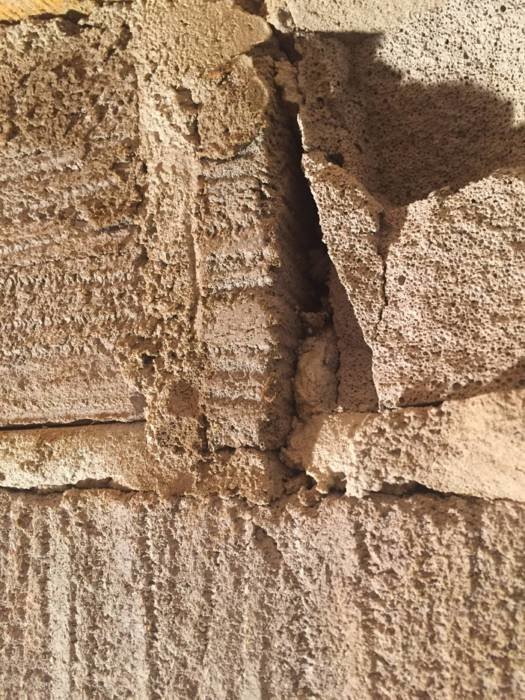
Hi, I'm wondering what you think this is? Whether it's blåbetong or not? Located about 70-80 cm away from the slab in the basement on a cast ledge about 5 cm thick...
But unsure if it's blåbetong or not?
Okay is this some kind of common standard stone, you think? Was a bit unsure since it's an old house and the stones behind are a bit blue/gray.. And it was very easy to nail something into them and apparently it should be if it was blåbetong
Blue concrete is a type of gas concrete, it consists of a mass of gas bubbles. It appears more as if the aggregate has been removed from the concrete and the aggregate has been packed together and allowed to "burn together."
This is how blue concrete looks, at least the one we have (most of it has been removed).
Edit: Not all gas concrete/lightweight concrete is far from blue concrete. Whether blue concrete radiates (and if so, how much) or not depends on where the alum shale comes from.
Thanks for the response! Yes, I have googled a bit and tried to get some info regarding this... and I think the pictures of what everyone calls "blåbetong" looked so different that it made me unsure if it was that or not... The house was built in 1936 so it's old and I saw that they used blåbetong as a building material back then!
The wall section a little further down in the article looks exactly like our untreated walls did.
I borrowed a gammameter from work and checked the walls. The walls that were painted/wallpapered emitted almost nothing, while the untreated ones emitted a bit more. But we have/had very low-radiating blåbetong.
Here is a Byggahus article about blåbetong,
[link]
The wall piece a little bit down in the article looks exactly like how our untreated walls looked.
I borrowed a radiation meter from work and checked the walls. The walls that were painted/wallpapered emitted almost nothing, while the untreated ones emitted a bit more. But we have/had very low-radiating blåbetong.
If I had to guess, I would assume that your blåbetong didn't emit much because it contains small amounts of alum shale. Alum shale is rich in uranium, hence the radiation. Alum shale also gives blåbetong its characteristic color. I wouldn't even say that what you're showing is blåbetong. Other rocks can also emit radiation. It's strange that it doesn't radiate as much where it's painted. Paint can protect against the exuding "randon" but to protect against radiation, it's primarily distance or lead that helps.
But if you've measured it, then it is what it is, not saying you're lying but it contradicts what I think I know in this subject.
Thanks for the answers should I just sand it down and knock off the loose plaster and repair the wall where needed, basically? Or should I do something since it's installed with an air gap behind ? I was wondering if it might get damp and settle between without being visible, if you know what I mean.
Click here to reply
Vi vill skicka notiser för ämnen du bevakar och händelser som berör dig.





Demmpa said:
Here is a Byggahus article about blåbetong,
Stefan N said: