

Hobby carpenter
· Västmanland
· 214 posts
So, I have welded for the first time in my life and bought small solid square irons at a hardware store, which are pure iron (kind of, not stainless steel anyway) and have welded them together to create a shelf.
But when you weld, and especially like me when welding for the first time, there’s a lot of finishing work with the angle grinder, which grinds down to reveal the shiny inner iron and removes the darker (oxidized?) surface.
So the question is, how do I blacken it again? I've seen Americans use some "blackener," both as a gel and something more liquid that they brush on. Here is Jimmy Diresta with a gel (9:17) and here is something more liquid (2:34). The one in this link looks really quick and effective.
Is there anything similar in Sweden? Where can you get it if so? I've googled "blacken metal" but only find tips about linseed oil that should be burned into the metal...
But when you weld, and especially like me when welding for the first time, there’s a lot of finishing work with the angle grinder, which grinds down to reveal the shiny inner iron and removes the darker (oxidized?) surface.
So the question is, how do I blacken it again? I've seen Americans use some "blackener," both as a gel and something more liquid that they brush on. Here is Jimmy Diresta with a gel (9:17) and here is something more liquid (2:34). The one in this link looks really quick and effective.
Is there anything similar in Sweden? Where can you get it if so? I've googled "blacken metal" but only find tips about linseed oil that should be burned into the metal...
In some video this fall, he talked about what he used and showed a spray bottle.
I'll see if I can find the right video. I'll get back to you.
Edit: I can't find the video I was thinking of right now, but in one of the latest where he's building a steel sideboard with glass doors, he shows a container with "Presto Black MKP" from the manufacturer Birchwood. But according to my limited Google skills, it's not available in Europe.
Try searching for "steel blackener."
I'll see if I can find the right video. I'll get back to you.
Edit: I can't find the video I was thinking of right now, but in one of the latest where he's building a steel sideboard with glass doors, he shows a container with "Presto Black MKP" from the manufacturer Birchwood. But according to my limited Google skills, it's not available in Europe.
Try searching for "steel blackener."
Last edited:

Could it be the concepts of browning/bluing you are looking for?
"Browning of iron.
In 0.9 liters of distilled water, mix 50 ml of denatured alcohol, 60 g of copper nitrate, 75 g of iron chloride, and 150 g of iron sulfate. The liquid is thinly brushed onto the iron object. The object is allowed to dry in a warm place and polished with steel wool. Repeat until the desired result is achieved. Finish by oiling the object with linseed oil or another suitable oil."
Source: http://www.alternativ.nu/index.php?topic=57123.0
The liquid in the second film is bluish and thus appears to contain copper nitrate.
Bluing solution:
http://www.stockholmsvapenfabrik.se/zencart/index.php?main_page=product_info&products_id=653
"Browning of iron.
In 0.9 liters of distilled water, mix 50 ml of denatured alcohol, 60 g of copper nitrate, 75 g of iron chloride, and 150 g of iron sulfate. The liquid is thinly brushed onto the iron object. The object is allowed to dry in a warm place and polished with steel wool. Repeat until the desired result is achieved. Finish by oiling the object with linseed oil or another suitable oil."
Source: http://www.alternativ.nu/index.php?topic=57123.0
The liquid in the second film is bluish and thus appears to contain copper nitrate.
Bluing solution:
http://www.stockholmsvapenfabrik.se/zencart/index.php?main_page=product_info&products_id=653
Last edited:
An old classic method to blacken iron for indoor use is to heat the iron in the embers of a wood fire and then brush on linseed oil.
The black surface on new iron is called mill scale. It forms in the rolling mill when the surface of the hot iron oxidizes and is compressed by the rollers.
The black surface on new iron is called mill scale. It forms in the rolling mill when the surface of the hot iron oxidizes and is compressed by the rollers.
Can be achieved with gas welding, heat the entire piece until it is dark red and then use acetylene to carburize the surface.
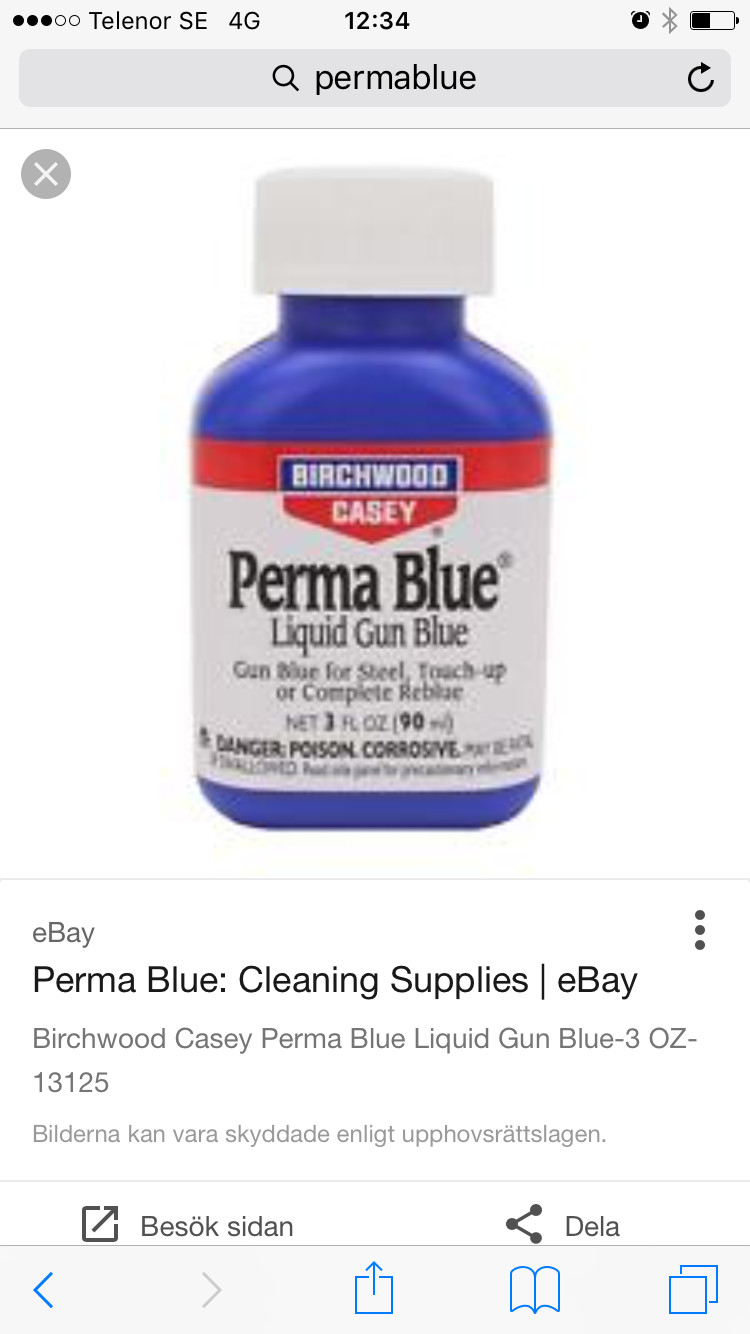
This works well and is very long-lasting.
Available for purchase at certain paint stores and gun shops.

Hobby carpenter
· Västmanland
· 214 posts
Yes, I have read about that - but it's tricky to get an entire living room table into a wood fire though, and a gas burner can't heat up an entire table for then brushing, and since linseed oil is apparently very flammable, it doesn't feel right to heat up parts with a gas burner, brush on oil, burn the next part, etc...heimlaga said:
It seemed like doing it chemically as in the links I had in my post would be much easier.

I have a thought..
A floor plate in front of the stove needs to be made and those black ones for the ceiling are not very good for lying on a kitchen floor.
So I'm thinking about blue concrete or burning linseed oil but when it's a sheet metal piece that is about 1.5*1m with a little cut out.
How do you approach that?
A floor plate in front of the stove needs to be made and those black ones for the ceiling are not very good for lying on a kitchen floor.
So I'm thinking about blue concrete or burning linseed oil but when it's a sheet metal piece that is about 1.5*1m with a little cut out.
How do you approach that?
Last edited:
Maybe paint the sheet with linoljefärg in iron oxide black? A few drops of lacknafta/terpentine to make it liquid, and you'll get a thin black iron oxide surface.
https://ottossonfarg.com/produkt/jarnoxidsvart/
https://ottossonfarg.com/produkt/jarnoxidsvart/
Yes, but wouldn't you end up in the same situation where a scratch in the paint is clearly visible?Claes Sörmland said:
Think vacuum cleaner, dog claws, gravel...
Click here to reply