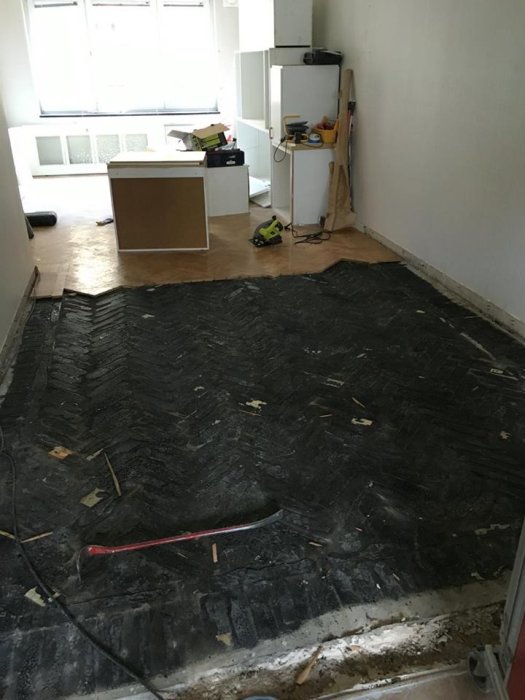
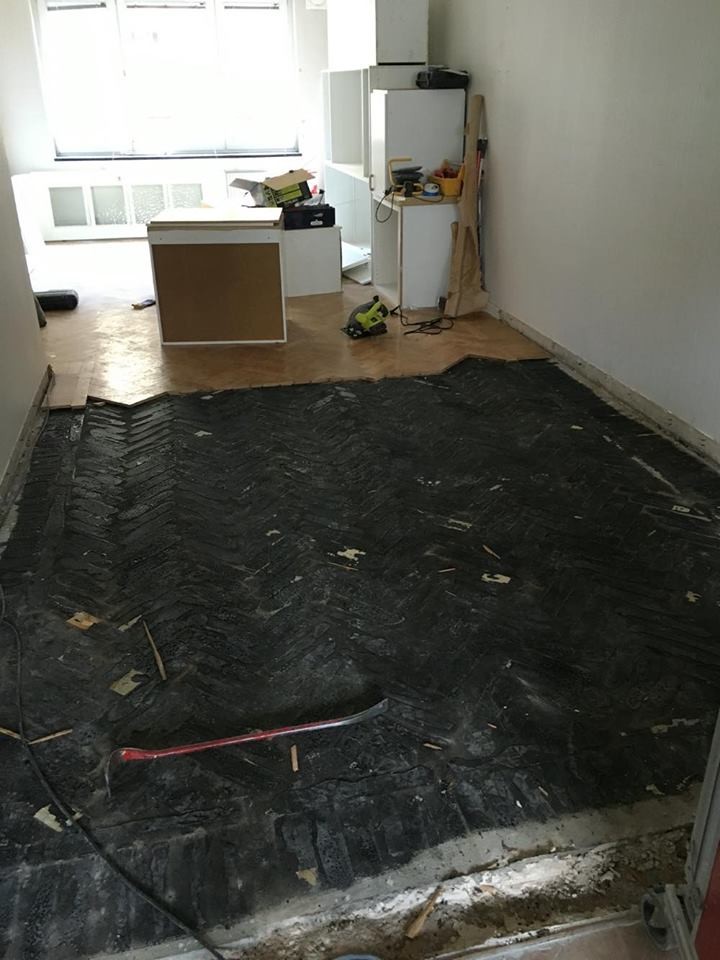
The herringbone parquet that was to be removed was probably glued with black adhesive, after tearing up about 10 square meters I realized this...
so the question is, how big is the risk of breaking up the planks from the black adhesive? I've heard that it's when you sand the stuff that asbestos fibers can be spread?
It was mostly vinyl flooring that was glued with black adhesive containing asbestos. Not all black-colored adhesive contains asbestos. You have to send it for analysis to know. The problem is that asbestos fibers remain in the air for a very long time, so it's not only during demolition/grinding that you need to protect yourself but also ensure it is aired out and wet wiped over and over again...
You can at least take some simple basic precautions such as using a respirator, isolating the room you are working in from the surroundings, and finishing with wet wiping.
Then you have at least made a very significant improvement to the whole situation in case there happens to be asbestos in the adhesive.
The breathing mask should have a P3 filter and the vacuum cleaner a HEPA filter, so at least that thing is sorted. Then it's about limiting spread with plastic and tape. Minimize the affected area, so to speak. Do not create any overpressure in the room whatever you do.
Have encountered parquet flooring with black adhesive that contained asbestos, so it's not entirely uncommon. I would prefer wet mopping over vacuuming.
Yes, there has been a dust trap/circulation air purifier in the apartment since Thursday, and I have tried to avoid vacuuming where there is black adhesive, but I have vacuumed with the dust separator in the rest of the apartment every day since Friday. I have used a mask that painters usually have, with two replaceable filter cartridges on the sides, with a brown stripe around it. Regarding the negative pressure, the exhaust duct has no control valve but has been left open. However, I haven't been able to screen it off as all the walls are torn down.
As you can see, the floor was glued directly to the concrete... what would it cost to sand this away, do you think? Or does it have to be sanded away if you're going to lay new flooring over it?
Clearly best to remove it. You then need a company with equipment to handle potential asbestos. If you leave it, I would at least use self-leveling compound to cover it. Alternatively, paint or something...
Brown stripe is a carbon filter. These have, in some cases, p3 particle-protective properties, but should not be used primarily against particles, but against solvents and such.
Click here to reply
Vi vill skicka notiser för ämnen du bevakar och händelser som berör dig.