
11,477 views ·
9 replies
11k views
9 replies
Beam staircase, design and manufacturing
Hello,
I'm in the early stages of planning to build a beam staircase up to a small loft I have in my apartment. I would appreciate some feedback and I plan to post some pictures during the construction process.
I'll start with some conditions. The loft will be used infrequently, so I am willing to accept a small, narrow, and steep staircase to avoid losing more space in the apartment than absolutely necessary. The loft will be used for a bit of storage and there is room for a guest bed, but as mentioned, there won't be much traffic on the stairs, perhaps up and down a few times a month.
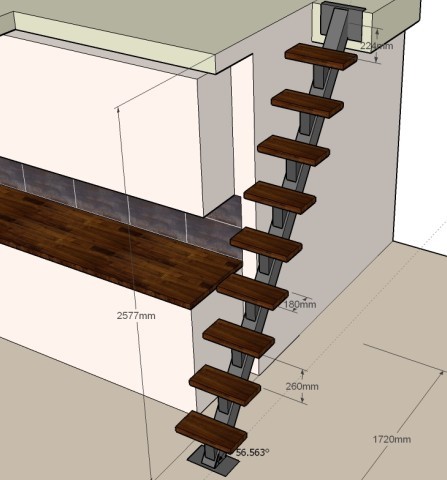
I would still like to get opinions if you think this construction will work practically. I have a step height of 260mm and a tread depth of 180mm. I reduced the top step from 260mm to 224mm as it seems to be too far down, still looks a bit odd but better this way at least.
Regarding the construction, I initially calculated that a rectangular tube 80x80x3 would suffice. It would flex about 2mm in the middle when used, but I deemed that as not noticeable. In reality, the staircase will be 3 times stiffer since I managed to find a 100x100x5 tube on the block.
The steps are then mounted on a 70x70x5 tube, which was also a block find so it will be used. For attaching the steps, a flat bar will be welded on top of the 70x70 tube, with dimensions of either 120x4 or 120x5 depending on what is easiest to obtain. The width of the flat bar will be 300mm.
I will make the steps from a 40mm thick countertop. I would prefer walnut, but to keep costs down, it might be oak that I will try to treat with black lye or something to make it dark.
Thanks to the block finds, the staircase will be quite inexpensive, I'm estimating under 3000kr, but a bit more expensive if I still choose walnut. (The price does not include a miter saw for 3000 and a welder for 8000). The total will still be cheaper than buying a ready-made staircase and I will have the welder and saw for future projects.
The parts for the staircase will be cut with an Evolution Rage chop/miter saw so you'll get some feedback on it after this build as well.
As mentioned, feedback regarding the step height of 260mm is requested, does it work at all?
/Björn
I'm in the early stages of planning to build a beam staircase up to a small loft I have in my apartment. I would appreciate some feedback and I plan to post some pictures during the construction process.
I'll start with some conditions. The loft will be used infrequently, so I am willing to accept a small, narrow, and steep staircase to avoid losing more space in the apartment than absolutely necessary. The loft will be used for a bit of storage and there is room for a guest bed, but as mentioned, there won't be much traffic on the stairs, perhaps up and down a few times a month.
I would still like to get opinions if you think this construction will work practically. I have a step height of 260mm and a tread depth of 180mm. I reduced the top step from 260mm to 224mm as it seems to be too far down, still looks a bit odd but better this way at least.
Regarding the construction, I initially calculated that a rectangular tube 80x80x3 would suffice. It would flex about 2mm in the middle when used, but I deemed that as not noticeable. In reality, the staircase will be 3 times stiffer since I managed to find a 100x100x5 tube on the block.
The steps are then mounted on a 70x70x5 tube, which was also a block find so it will be used. For attaching the steps, a flat bar will be welded on top of the 70x70 tube, with dimensions of either 120x4 or 120x5 depending on what is easiest to obtain. The width of the flat bar will be 300mm.
I will make the steps from a 40mm thick countertop. I would prefer walnut, but to keep costs down, it might be oak that I will try to treat with black lye or something to make it dark.
Thanks to the block finds, the staircase will be quite inexpensive, I'm estimating under 3000kr, but a bit more expensive if I still choose walnut. (The price does not include a miter saw for 3000 and a welder for 8000). The total will still be cheaper than buying a ready-made staircase and I will have the welder and saw for future projects.
The parts for the staircase will be cut with an Evolution Rage chop/miter saw so you'll get some feedback on it after this build as well.
As mentioned, feedback regarding the step height of 260mm is requested, does it work at all?
/Björn
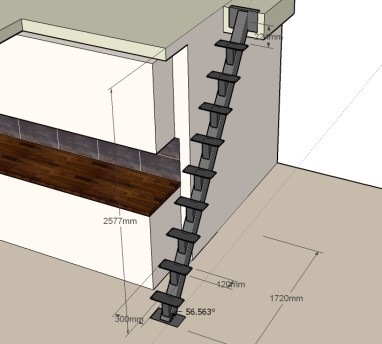
Discovered why the upper step looked so strange, and it was simply because the beam is mounted too high. With a few adjustments there, it is possible to fit in another step, and the step height will then be 237mm, which doesn't feel as extreme as 260mm.
I'm still placing the upper step a bit closer to the loft floor because it looks better that way. The beam should have ideally been positioned even lower to avoid this issue, but I'm not sure how to solve it practically.
This is how it will be, and I feel satisfied with this solution, so I'm going with it (unless any of you discover some fundamental error, that is).
I'm still placing the upper step a bit closer to the loft floor because it looks better that way. The beam should have ideally been positioned even lower to avoid this issue, but I'm not sure how to solve it practically.
This is how it will be, and I feel satisfied with this solution, so I'm going with it (unless any of you discover some fundamental error, that is).
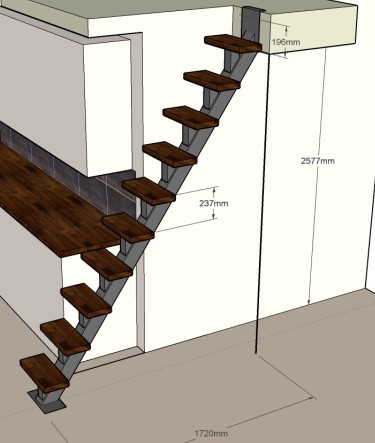


A handrail would, as mentioned, not be a bad idea. 237 in step height is still tough to navigate. The step depth isn't exactly a showstopper either. You'll have to walk down backwards to feel safe. I wonder if a ladder might have been better in this case?
How large is the mounting surface under the risers? A cheap countertop is not always designed to be cantilevered at the front edge, meaning it can break at the laminate seam.
Thanks for the tips.
I hadn't thought at all about the countertop and assumed they would hold. There's a flat iron that is 120mm wide underneath, so given the minimal tread depth (which you also commented on), most of the step still rests on the iron. But maybe I should still go up to 150mm, I haven't purchased the flat iron yet.
Regarding the tread depth, I have considered making cutouts (every other step) like those often found in attic stairs, but the problem is that I just find them terribly ugly (here, aesthetics take precedence over function).
A ladder is better, hmm now I'm a bit hesitant. I think I've climbed some really steep stairs in my days, but unfortunately, I've never brought a tape measure. You should be able to get away without backing down, but sure, you might have to walk sideways a bit, and I can accept that.
Railing is a good point. The sketch is a bit misleading because it doesn't show a hand rail beam on the outside of the stairs (in the longitudinal direction of the stairs) so you can hold onto the beam after taking a few steps. The distance between the beam and the wall inside the stairs is only 45cm, and you have to squeeze yourself in there. I was thinking of attaching some pipe from the beam down to step 4 or 5 (or maybe more), so you have something to hold on to on the way up. I'll address this when the stairs are in place, and you can feel where it makes sense. I still want it to be as airy as possible.
The construction has at least begun, and this is what I worked on yesterday:
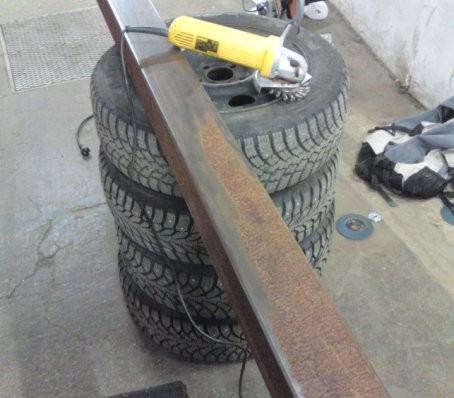
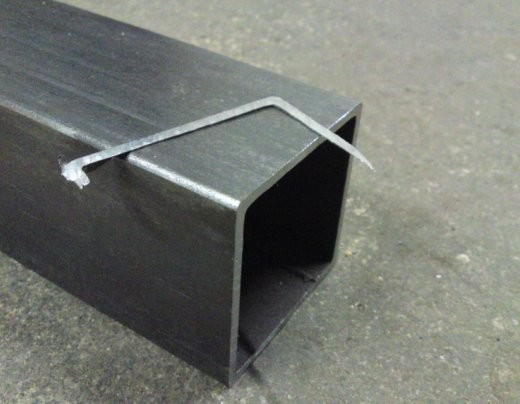
1. Used beams from the block that had rusted took quite a bit of time to clean
2. Evolution Rage chop miter saw was thoroughly tested. You can make quite thin cuts with it; the small piece has a thickness of 0.2mm at its thinnest. However, I'm not entirely satisfied with the saw. I spent a lot of time trying to adjust it just to be able to cut straight 90-degree cuts, but it turned out to be impossible. I used an 80mm wide MDF board to adjust the saw and got it to cut perfectly perpendicular when sawing it flat. I then set it on its edge, and it sawed perfectly perpendicular again. But then when it came time for the real deal, cutting through a 70x70mm rectangular steel tube, it was no longer straight. The saw is a bit shaky in the bearings, so with a bit of load on the blade, it seems to move a bit. Instead of perfectly perpendicular cuts, it instead varies up to 0.5mm on a 70mm width. Annoying, to say the least.
In the ad for the saw, they claim there are spark-free cuts, but that's not quite true. Sure, it doesn't spray like an angle grinder, but yes, it does spark. Additionally, it splatters quite a lot of chips, some of which are hot, so you can burn yourself.
Its final verdict would be a 3. It does what it's supposed to do but nothing more. For comparison, my DW707 gets a 5.
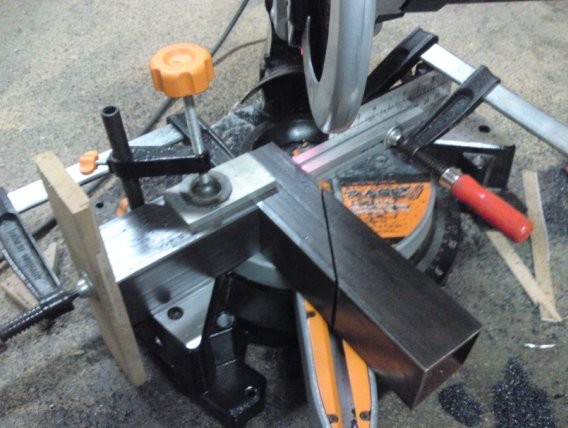
3. A bit tricky to clamp for a 57-degree cut
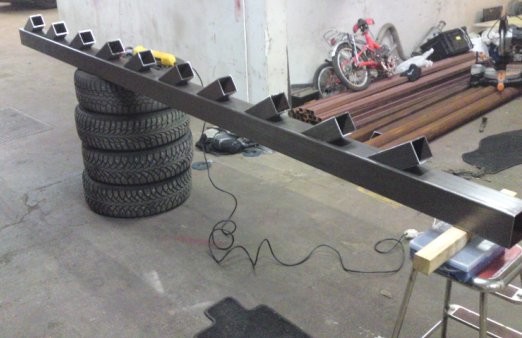
4. First batch of pieces ready (not welded)
I hadn't thought at all about the countertop and assumed they would hold. There's a flat iron that is 120mm wide underneath, so given the minimal tread depth (which you also commented on), most of the step still rests on the iron. But maybe I should still go up to 150mm, I haven't purchased the flat iron yet.
Regarding the tread depth, I have considered making cutouts (every other step) like those often found in attic stairs, but the problem is that I just find them terribly ugly (here, aesthetics take precedence over function).
A ladder is better, hmm now I'm a bit hesitant. I think I've climbed some really steep stairs in my days, but unfortunately, I've never brought a tape measure. You should be able to get away without backing down, but sure, you might have to walk sideways a bit, and I can accept that.
Railing is a good point. The sketch is a bit misleading because it doesn't show a hand rail beam on the outside of the stairs (in the longitudinal direction of the stairs) so you can hold onto the beam after taking a few steps. The distance between the beam and the wall inside the stairs is only 45cm, and you have to squeeze yourself in there. I was thinking of attaching some pipe from the beam down to step 4 or 5 (or maybe more), so you have something to hold on to on the way up. I'll address this when the stairs are in place, and you can feel where it makes sense. I still want it to be as airy as possible.
The construction has at least begun, and this is what I worked on yesterday:
1. Used beams from the block that had rusted took quite a bit of time to clean
2. Evolution Rage chop miter saw was thoroughly tested. You can make quite thin cuts with it; the small piece has a thickness of 0.2mm at its thinnest. However, I'm not entirely satisfied with the saw. I spent a lot of time trying to adjust it just to be able to cut straight 90-degree cuts, but it turned out to be impossible. I used an 80mm wide MDF board to adjust the saw and got it to cut perfectly perpendicular when sawing it flat. I then set it on its edge, and it sawed perfectly perpendicular again. But then when it came time for the real deal, cutting through a 70x70mm rectangular steel tube, it was no longer straight. The saw is a bit shaky in the bearings, so with a bit of load on the blade, it seems to move a bit. Instead of perfectly perpendicular cuts, it instead varies up to 0.5mm on a 70mm width. Annoying, to say the least.
In the ad for the saw, they claim there are spark-free cuts, but that's not quite true. Sure, it doesn't spray like an angle grinder, but yes, it does spark. Additionally, it splatters quite a lot of chips, some of which are hot, so you can burn yourself.
Its final verdict would be a 3. It does what it's supposed to do but nothing more. For comparison, my DW707 gets a 5.
3. A bit tricky to clamp for a 57-degree cut
4. First batch of pieces ready (not welded)
I embedded LED in my similar staircase, ran the cables through the beam, and routed grooves under the risers. I used LED tape (about 5 cm/3 diodes per step) and a 4W transformer. cost about 500. I also hid the transformer in the beam (with a small inspection hatch).
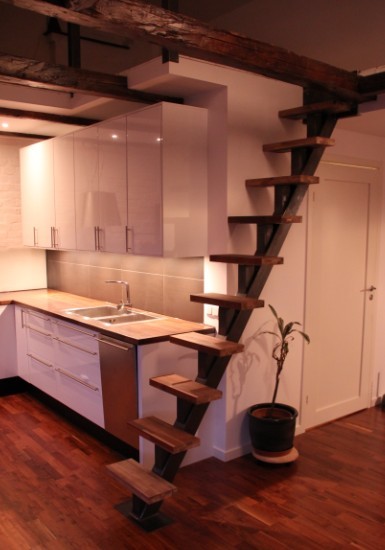
It's been a while since the stairs were installed, so it's about time to show some pictures of how it turned out. The stairs ended up being very steep, as discussed earlier in the thread. No problem going up, but going down you have to take it slowly and walk sideways. Still, I am very pleased with the result. It works, and as mentioned, the loft is not used very often, and this solution takes up minimal space in the apartment.
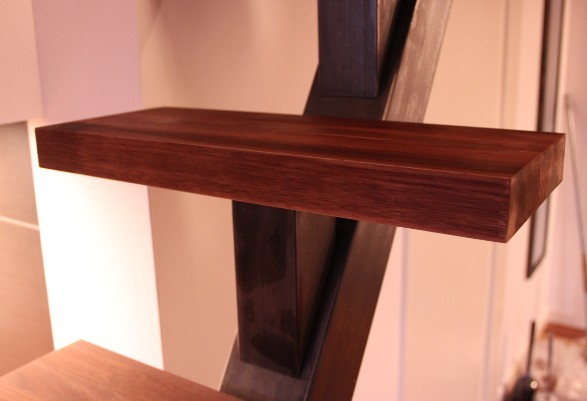
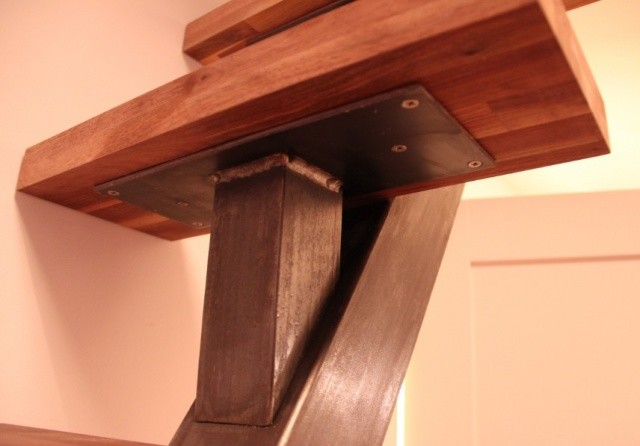
Very nice staircase!
Hi
I think your staircase turned out amazingly well. I'm planning to make a similar one for my basement stairs. The problem is that I don't have a welder and can't weld. If I buy the parts, would you consider welding it together for me? For a reasonable amount of money?
Kind regards
Jonas
I think your staircase turned out amazingly well. I'm planning to make a similar one for my basement stairs. The problem is that I don't have a welder and can't weld. If I buy the parts, would you consider welding it together for me? For a reasonable amount of money?
Kind regards
Jonas
Click here to reply