
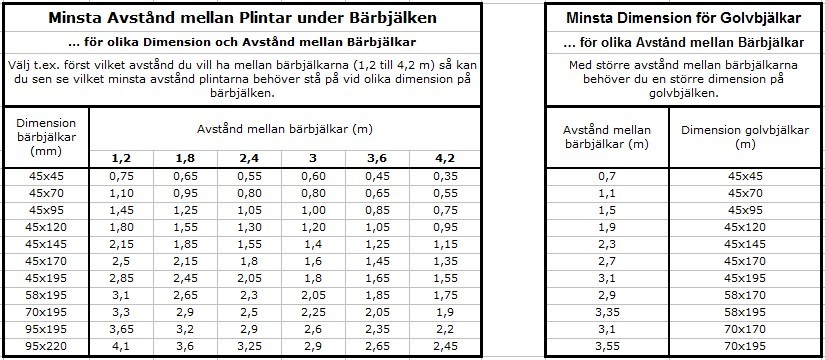
Assuming you attach a bearer beam to the house and then two rows of piers for this for 4 m.
If you look in the column for 2.4 m and 45*170, it gives you 1.8 meters between the piers.
If you look in the right table, you need a floor joist that can handle at least 2 m between bearer beams, which is 45*145.
If you look in the column for 2.4 m and 45*170, it gives you 1.8 meters between the piers.
If you look in the right table, you need a floor joist that can handle at least 2 m between bearer beams, which is 45*145.
Thanks. Now I know. Many thanksH huggan said:Assume you attach a support beam to the house and then two rows of concrete piers on this for 4 m.
If you look at the column for 2.4 m and 45*170 it gives you 1.8 meters between the concrete piers.
If you look at the right table, you need a floor joist that can handle at least 2 m between support beams, which is 45*145.
N Nygge72 said:Thank you.
I went to measure at the construction site today and received the question in this way. If I don't attach a carrier beam to the house and have a freestanding deck. Can I manage with 2 rows of footings if I have overhang on each side?
I'm thinking deck size 4x5.5 or 3.5x5.5m
What dimensions do I need then and how many footings to manage with 2 rows of footings?
Still have to ask, I feel. Now I've been measuring at the construction site and have the choice of a deck of 4x5.5m or 3.5x5.5m.H huggan said:I assume you attach a carrying beam to the house and then two rows of posts on this for 4 m.
Looking at the column for 2.4 m and 45*170, it gives you 1.8 meters between the posts.
Looking at the right table, you need a floor joist that handles at least 2 m between the carrying beams, which is 45*145.
If I'm not putting a carrying beam on the house, which I probably won't do, is it possible to still manage with 2 rows of posts if I use a certain overhang on each side? What size should the carrying beam, floor joists, and post spacing be, and how much overhang (preferably not too much)?
Have you seen these two simple calculators:
https://www.byggbeskrivningar.se/dimensionering/golvbjalklag-ute/
https://www.byggbeskrivningar.se/dimensionering/altan-utan-takkonstruktion/
/Göran
https://www.byggbeskrivningar.se/dimensionering/golvbjalklag-ute/
https://www.byggbeskrivningar.se/dimensionering/altan-utan-takkonstruktion/
/Göran
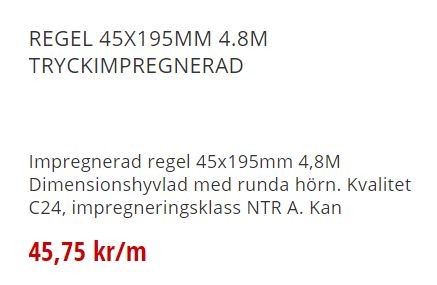
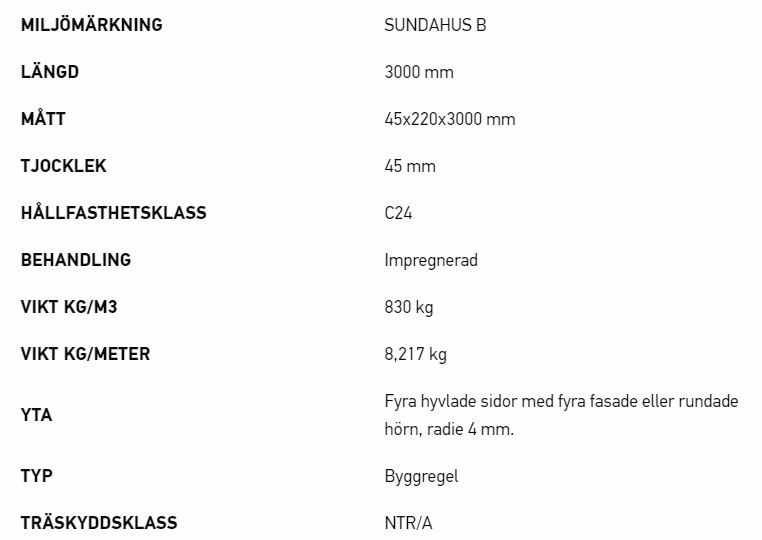
Beijer says that pressure-treated building studs have a strength class of C24 - Karl Hedin says that pressure-treated building studs are not classified as C24 but correspond to C24. So they are probably expressing the same thing differently.
But I interpret it as considering it C24.
/Göran
But I interpret it as considering it C24.
/Göran
Okay. Personally, I think pressure-treated feels much softer than regular wood. But it might just be a feeling.Sharky58 said:
Beijer says that pressure-treated building lumber has a strength class of C24 - Karl Hedin says that pressure-treated building lumber is not classified as C24 but corresponds to C24. So they probably express themselves differently about the same thing.
But I interpret it as considering it as C24.
/Göran

Click here to reply