
5,209 views ·
9 replies
5k views
9 replies
Bathroom floor, construction suggestions needed
Renovating the original bathroom from 1963.
During the renovation, it was discovered that a radiator pipe had leaked (discussed in another thread), and the insurance company removed some concrete to expose the sill for drying.
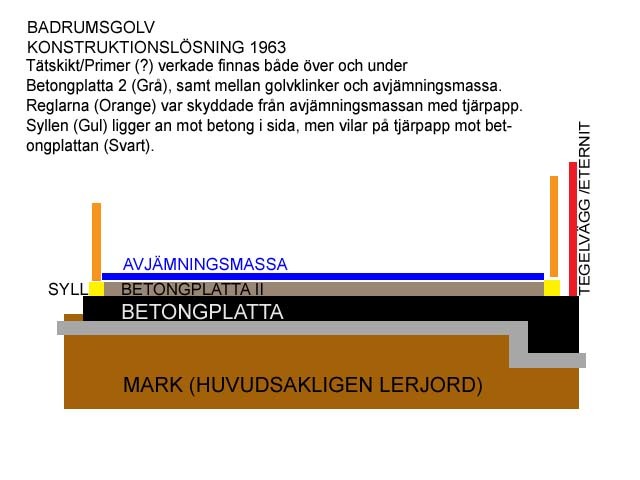
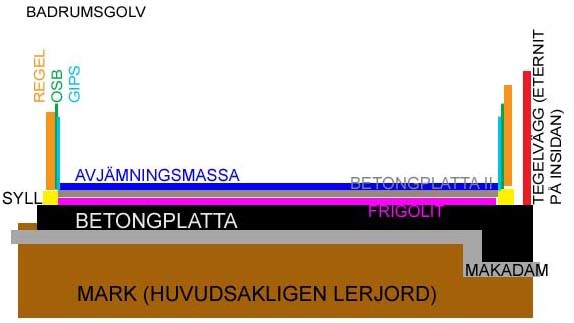
Now that everything will soon be rebuilt, we are considering whether the construction should be changed. The construction company mentioned placing styrofoam between concrete slabs 1 and 2 (see sketch), especially since we are planning underfloor heating.
We are considering:
- There was no moisture on top of the original floor tiles (Intact waterproofing layer!?)
- Should we have a waterproofing layer now, and if so, where?
- Should we build according to the original construction or with styrofoam? (Assuming the sill should be protected in that case?)
According to the sketch in the next post.
Grateful for any ideas and suggestions.
During the renovation, it was discovered that a radiator pipe had leaked (discussed in another thread), and the insurance company removed some concrete to expose the sill for drying.
Now that everything will soon be rebuilt, we are considering whether the construction should be changed. The construction company mentioned placing styrofoam between concrete slabs 1 and 2 (see sketch), especially since we are planning underfloor heating.
We are considering:
- There was no moisture on top of the original floor tiles (Intact waterproofing layer!?)
- Should we have a waterproofing layer now, and if so, where?
- Should we build according to the original construction or with styrofoam? (Assuming the sill should be protected in that case?)
According to the sketch in the next post.
Grateful for any ideas and suggestions.

I've been further investigating how to construct the bathroom floor, and as has been mentioned here, most experts (certified or self-proclaimed) agree that insulation is more or less a must if we are to install underfloor heating.
BUT
After a visit to the building center's exhibition (www.byggcentrum.se) in Mölndal and a chat with the staff there, it emerged that the insulation should be 20cm to be effective. With less insulation, he argued there is a risk that the underfloor heating also heats up the slab underneath and thereby can drive up moisture in adjacent rooms. He thought I should think several times before installing underfloor heating. Not even any waterproofing outside the shower area was relevant according to him (despite it being the case in the original construction).
It gets pretty confusing; Anticimex and the construction company the insurance company's contractor said I should break up concrete to install insulation, and they saw that there was no room for the 20cm of insulation (MAX half).
Anyone who has installed underfloor heating in an older house, experiences?
Do I dare proceed according to the plan with 8-10cm insulation?
: Confused:
BUT
After a visit to the building center's exhibition (www.byggcentrum.se) in Mölndal and a chat with the staff there, it emerged that the insulation should be 20cm to be effective. With less insulation, he argued there is a risk that the underfloor heating also heats up the slab underneath and thereby can drive up moisture in adjacent rooms. He thought I should think several times before installing underfloor heating. Not even any waterproofing outside the shower area was relevant according to him (despite it being the case in the original construction).
It gets pretty confusing; Anticimex and the construction company the insurance company's contractor said I should break up concrete to install insulation, and they saw that there was no room for the 20cm of insulation (MAX half).
Anyone who has installed underfloor heating in an older house, experiences?
Do I dare proceed according to the plan with 8-10cm insulation?
:
Confused:
Hello!
The staff at Byggcentrum is out on a serious bike ride! You can't say as generally as they have.
Deviation of moisture protection, applies only with rising ground moisture, and it must be investigated if the conditions are such. But even that is not a general rule. There are several manufacturers that have moisture protection that can handle ground moisture.
What is the total construction height, from the concrete slab on the ground to the finished floor?
The staff at Byggcentrum is out on a serious bike ride! You can't say as generally as they have.
Deviation of moisture protection, applies only with rising ground moisture, and it must be investigated if the conditions are such. But even that is not a general rule. There are several manufacturers that have moisture protection that can handle ground moisture.
What is the total construction height, from the concrete slab on the ground to the finished floor?
Ardexsmitten: Thanks, the total height will be about 150mm (of which Concrete layer 2 accounts for about 75mm, but it is currently being removed).
Since damp proofing/membrane was present before and was measured intact, it shouldn't really be much worse as Byggcentrum suggested if I add a new membrane (Capillary-breaking) in the form of polystyrene and underfloor heating?
Since damp proofing/membrane was present before and was measured intact, it shouldn't really be much worse as Byggcentrum suggested if I add a new membrane (Capillary-breaking) in the form of polystyrene and underfloor heating?
Hello!
If you only have 150mm from the slab to the finished floor, it's impossible to build according to today's building regulations. Therefore, in my opinion, you must try to make the best of the situation and not dismiss it by saying "it's not possible."
I would contact EPS Cement and hear their opinion.
http://www.epscement.com/
Their product allows for a significantly thinner screed, or even thin-layer leveling (with electric underfloor heating).
Will you have water-based underfloor heating or electric?
If you only have 150mm from the slab to the finished floor, it's impossible to build according to today's building regulations. Therefore, in my opinion, you must try to make the best of the situation and not dismiss it by saying "it's not possible."
I would contact EPS Cement and hear their opinion.
http://www.epscement.com/
Their product allows for a significantly thinner screed, or even thin-layer leveling (with electric underfloor heating).
Will you have water-based underfloor heating or electric?
It will be (as it looks now) electric underfloor heating, the bathroom is only 5m2. The manufacturer is not decided yet, but the construction height will play a role so I can have as thick an insulation board as possible. I haven't checked the installation techniques for the heating yet, whether it should be embedded in the concrete or in the leveling compound.
I've discussed the concrete issue with my dad, who works at a concrete laboratory, so he promises to come up with a concrete that only has a 40mm construction height and is still really durable. However, he is not an expert on the insulation part, he only knew that they used to produce insulating concrete but stopped because it was apparently too expensive, but it might be something in cases like these though. Maybe something similar to EPS resumed/further developed?!
I've discussed the concrete issue with my dad, who works at a concrete laboratory, so he promises to come up with a concrete that only has a 40mm construction height and is still really durable. However, he is not an expert on the insulation part, he only knew that they used to produce insulating concrete but stopped because it was apparently too expensive, but it might be something in cases like these though. Maybe something similar to EPS resumed/further developed?!
Hello
When insulating with foam plastic on a concrete slab that lacks ground insulation underneath, the moisture that is ventilated through the slab will automatically rise up into the sill around it instead. Therefore, one should think twice before doing so, as this method was tried about 20 years ago and those foundation constructions are considered high-risk constructions today when it comes to mold and elevated moisture levels in the sill areas.
EPS is otherwise a good alternative but requires double the thickness compared to regular EPS boards (styrofoam).
When insulating with foam plastic on a concrete slab that lacks ground insulation underneath, the moisture that is ventilated through the slab will automatically rise up into the sill around it instead. Therefore, one should think twice before doing so, as this method was tried about 20 years ago and those foundation constructions are considered high-risk constructions today when it comes to mold and elevated moisture levels in the sill areas.
EPS is otherwise a good alternative but requires double the thickness compared to regular EPS boards (styrofoam).
Ppalm: Thanks for the answer. I thought there shouldn't be much higher moisture load in the adjacent room after the renovation since the waterproofing was intact before.
EPSCement is the cement with styrofoam balls, meaning if so, I worked summer jobs mixing that at a factory 20 years ago. Talk about causing a snowstorm in July when I misjudged the amount of styrofoam balls by a few bags that flew away in the air.
I'll have to think about it, but it sounds like a useful alternative if I don't dare to go with the ground slab thing.
EPSCement is the cement with styrofoam balls, meaning if so, I worked summer jobs mixing that at a factory 20 years ago. Talk about causing a snowstorm in July when I misjudged the amount of styrofoam balls by a few bags that flew away in the air.
I'll have to think about it, but it sounds like a useful alternative if I don't dare to go with the ground slab thing.
Click here to reply