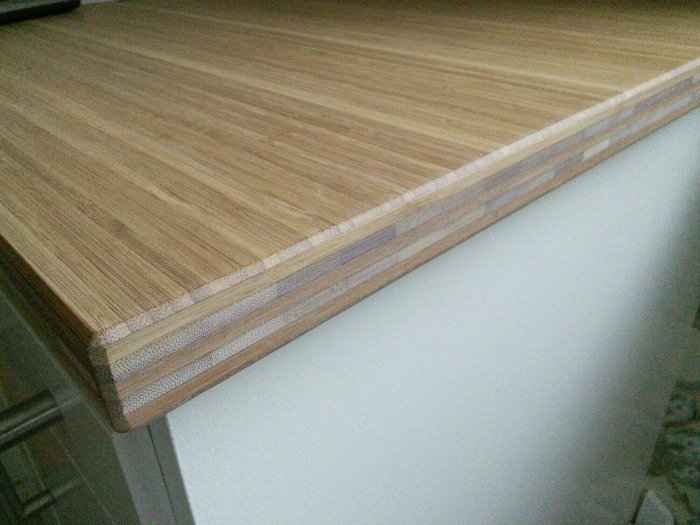
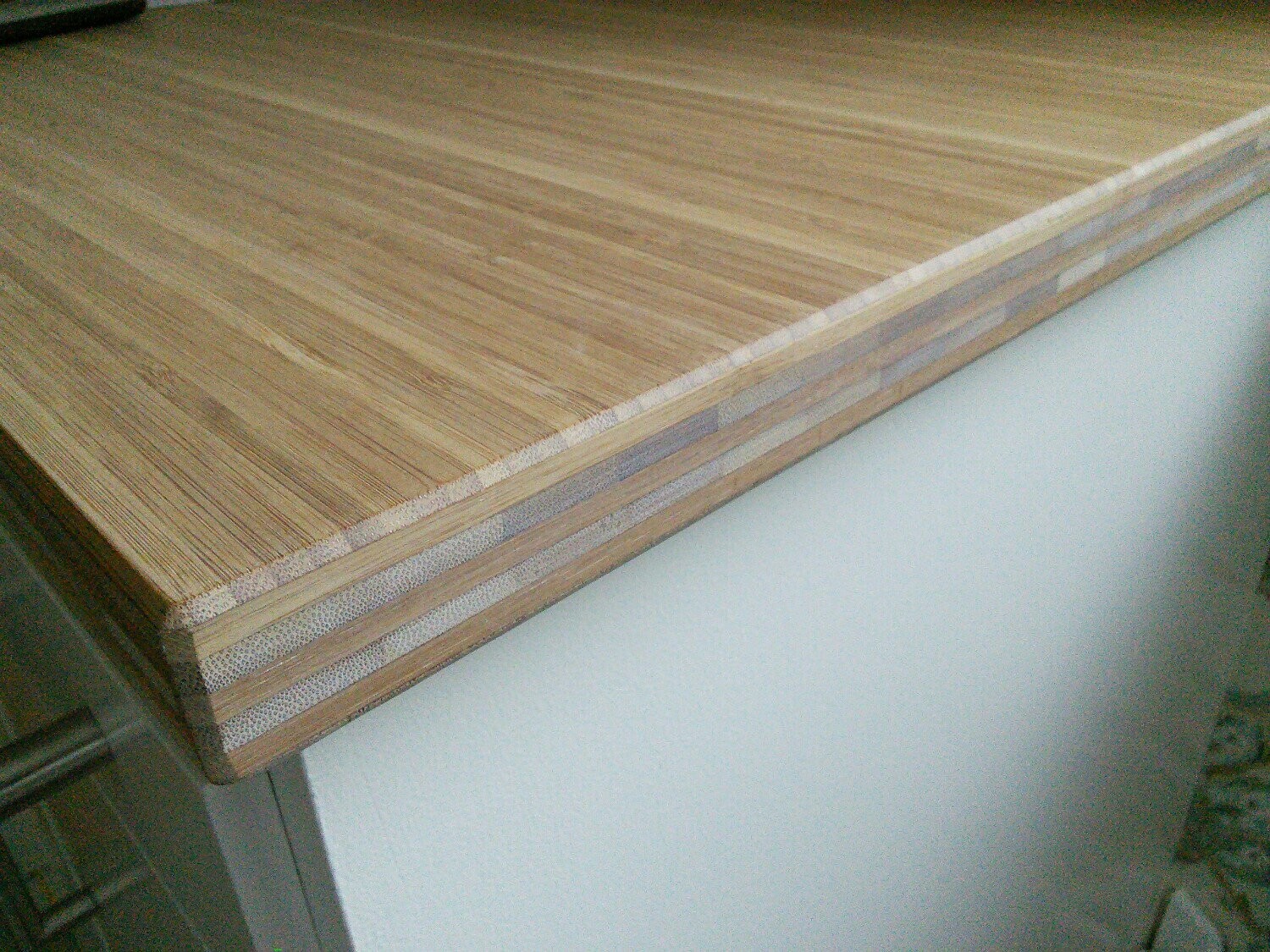
We're in the process of "pimping" our kitchen and have bought bamboo countertops. The manufacturer calls it solid and equates it in their instructions to a solid wood countertop. In reality, if we're being picky, the countertop is neither solid nor made of wood. The entire piece is a laminate consisting of seven layers of bamboo. Each layer is made up of thin bamboo sticks, rotated 90 degrees to the previous one. See the picture .
The measurements we specified when ordering were exactly those that could be measured with a margin of a few millimeters, for example, between the wall and the stove. The countertops arrived with the exact right measurements, but when I started reading the installation instructions, I saw that there SHOULD be a 5 mm gap between the countertop and the wall so that the countertop can move depending on humidity. I can promise that it won't be particularly pretty or practical to have one end of the countertop resting on the stove and the other end attached to the cabinet with a 30 mm height difference. ;-)
The countertop was bought at Kvik, who had no idea that there should be a gap between the countertop and the wall, and therefore did not inform us to consider this when the order was made. I sent an email to Dfi-Geisler in Denmark, who are the ones who manufactured the countertop. They couldn't answer whether the countertop moves at all and referred me back to the retailer. Feels reassuring.
Now, Kvik has indeed offered to trim the countertops so that they match the margin specified in the installation instructions, but installing the countertop a few millimeters away from the wall will result in gaps on the sides that won't be particularly attractive, and additionally difficult to fix so that they look good. One alternative could be to carve a groove in the plasterboard to allow some room for expansion.
My question is if anyone knows how much such a countertop moves? I have searched quite extensively for information but haven't found much beyond that bamboo moves more than wood, and primarily along the fibers, unlike most types of wood which move across the width. This applies to bamboo that is not glued.
So if you have experience or knowledge about this type of countertop, I'd be very thankful for your answers and feedback.
Now I have no experience with bamboo, but if you attach the board with a screw that is angled or through a larger hole in the frame, then there should be no problems.
I have no experience with bamboo, but if you attach the board with a screw that sits at an angle or through a larger hole in the frame, then there shouldn't be any problems
Thanks for your engagement!
It comes with angle brackets with generously sized holes and large flat washers for the screws, so that part isn't the problem. The concern is that when the board lies flush against the wall, the distance between the stove and the board is just over a millimeter. If the board can actually expand more than five millimeters, it won't be fun for the stove since it has nowhere to go because there's a sturdy sink bench on the other side.
And yes, we also thought it was nice. I have cutting boards in bamboo that hold their shape very well and hope that the countertops will hold up well too. However, they haven't received good ratings for stain durability and such, but we thought we'd ignore that and try it anyway.
We have solid bamboo flooring in our vacation home and it hasn't shifted in the slightest anywhere, despite the fact that we maintain a temperature of 10-12 degrees for a large part of the year...
We have solid bamboo flooring in our vacation home and it hasn't moved in the slightest even though we maintain a maintenance heat of 10-12 degrees for a large part of the year...
Thanks! That sounds really good. I assume that the bamboo in the floor is laminated like the worktop, meaning several layers where the fibers are twisted between the layers?
I have had much experience with bamboo kitchen countertops and have not experienced them moving. One of the advantages of bamboo countertops is their construction, which makes them more shape-stable than regular countertops because the fibers are crossed. For surface treatment, I recommend hardwax oil because regular oil has difficulty penetrating due to the much higher density in a bamboo countertop, ranging between 4.2 and 9.5 on the Brinell scale depending on which bamboo countertop you choose (oak is about 3.8 on the Brinell scale).
We are in the process of "pimping" our kitchen and have purchased countertops made of bamboo. The manufacturer calls it solid and equates it in their instructions with a solid wood board. In reality, if one wants to be picky, the board is neither solid nor wood. The entire board is a laminate consisting of seven layers of bamboo. Each layer consists of thin bamboo strips and is rotated 90 degrees to the previous layer. See the image [image].
/Micke
I don't understand what you mean by your pickiness? Bamboo is wood, isn't it? And it's solid, right? I wouldn't call it laminate.
If it hadn't been cross-glued and was truly just one big piece of solid wood, you would have had severe problems with shape changes and cracks, regardless of the type of wood!
I have a bamboo cutting board, the idea is to glue the bamboo standing up, this causes the fibers to contract again after the (obviously insanely sharp Japanese) knife has cut into it. Maybe that's what they're aiming for here as well? But the function is missed if it's not glued in the right way.
There is a significant difference between the factories that make bamboo countertops and those that make bamboo cutting boards in terms of quality and precision. Bamboo countertops are made like your cutting board, but only the top layer (wear layer) is vertical; otherwise, the countertop will not have the dimensional stability. The most popular bamboo countertops today are called vertical caramel and are 40mm thick and available in lengths of 4000mm.
I don't understand what you mean by your pickiness? Bamboo is wood, and it is solid, right? I wouldn't call it laminate.
Bamboo is grass, not wood. It has slightly different properties in terms of moisture impact than wood does. And it is indeed a laminate. By definition, a laminate is a material that consists of several bonded layers. So in that respect, a bamboo board like this is no more solid than a Plywood board. Personally, I wouldn't call a Plywood board solid wood, but maybe they do within the trade, and then I'm certainly wrong.
vectrex said:
If it hadn't been cross-laminated but really a single large piece of solid wood, you would have had serious problems with shape changes and cracks, regardless of the type of wood!
The solid countertops we looked at have, as far as I could judge, not been cross-laminated, but glued only lengthwise, and that is probably why the installation instructions say that there should be a gap between the board and the wall, precisely because it will move quite a bit, especially in terms of width. Now, this board is cross-laminated, and after the answer from anders07, I put up the boards assuming they will basically not move at all.
How has the record fared? Has it moved at all and how has it handled stains? I've also been considering bamboo, so I'm interested to hear what you think after a few years.
How has it gone with the board? Has it moved at all and how has it handled stains? I've also been considering bamboo, so I'm interested to hear what you think after a few years.
Hi!
Unfortunately, I can't answer that for you. I no longer live in that house. However, I can say that the bamboo cutting boards I have hold their shape very well.





halper said: