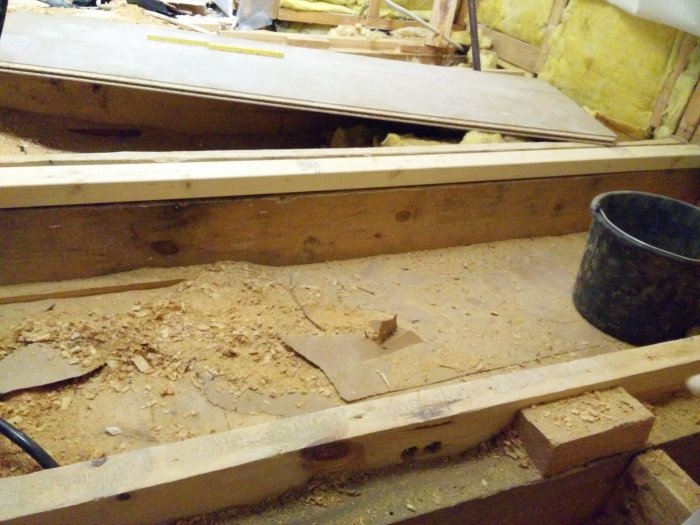
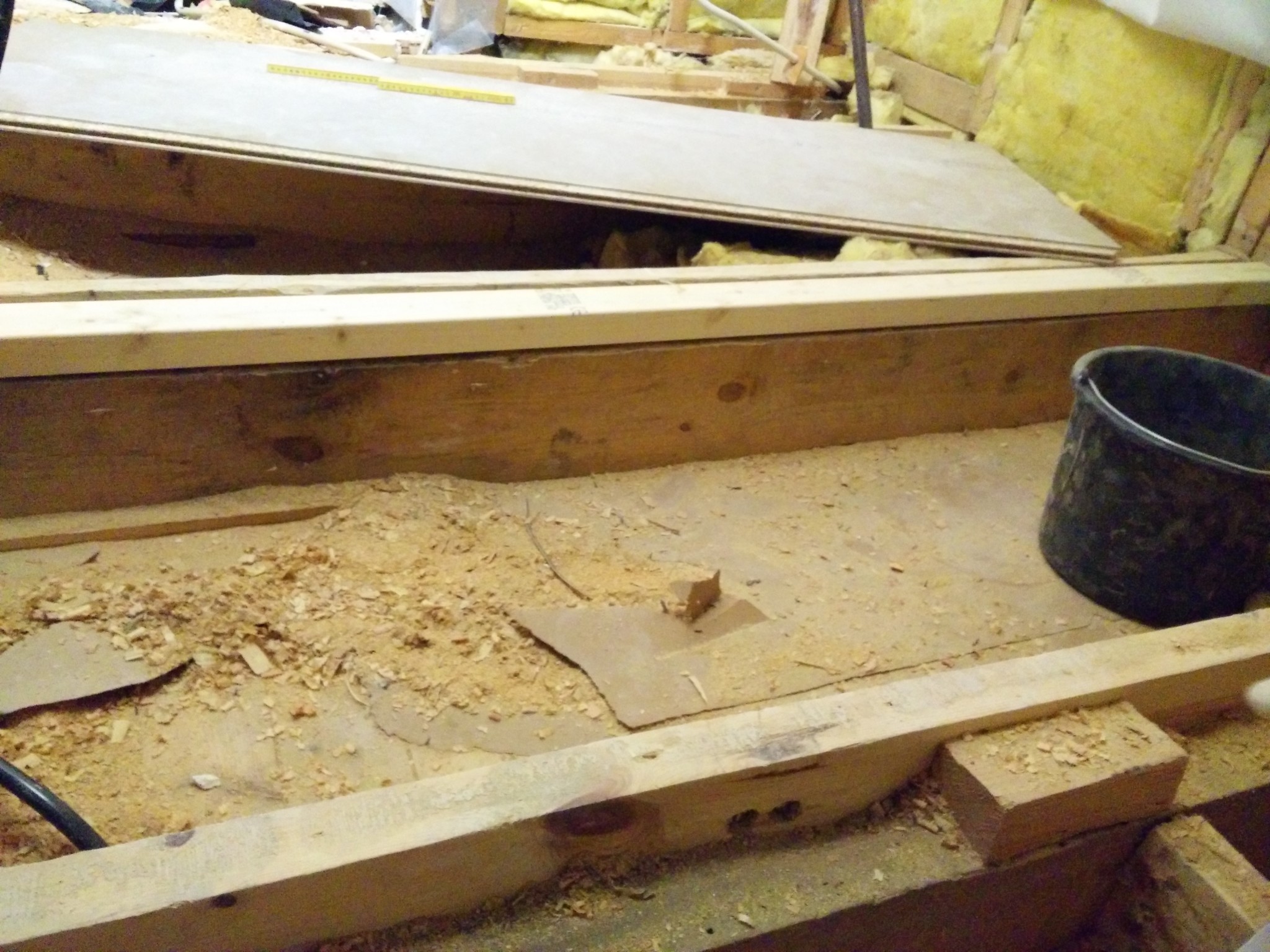
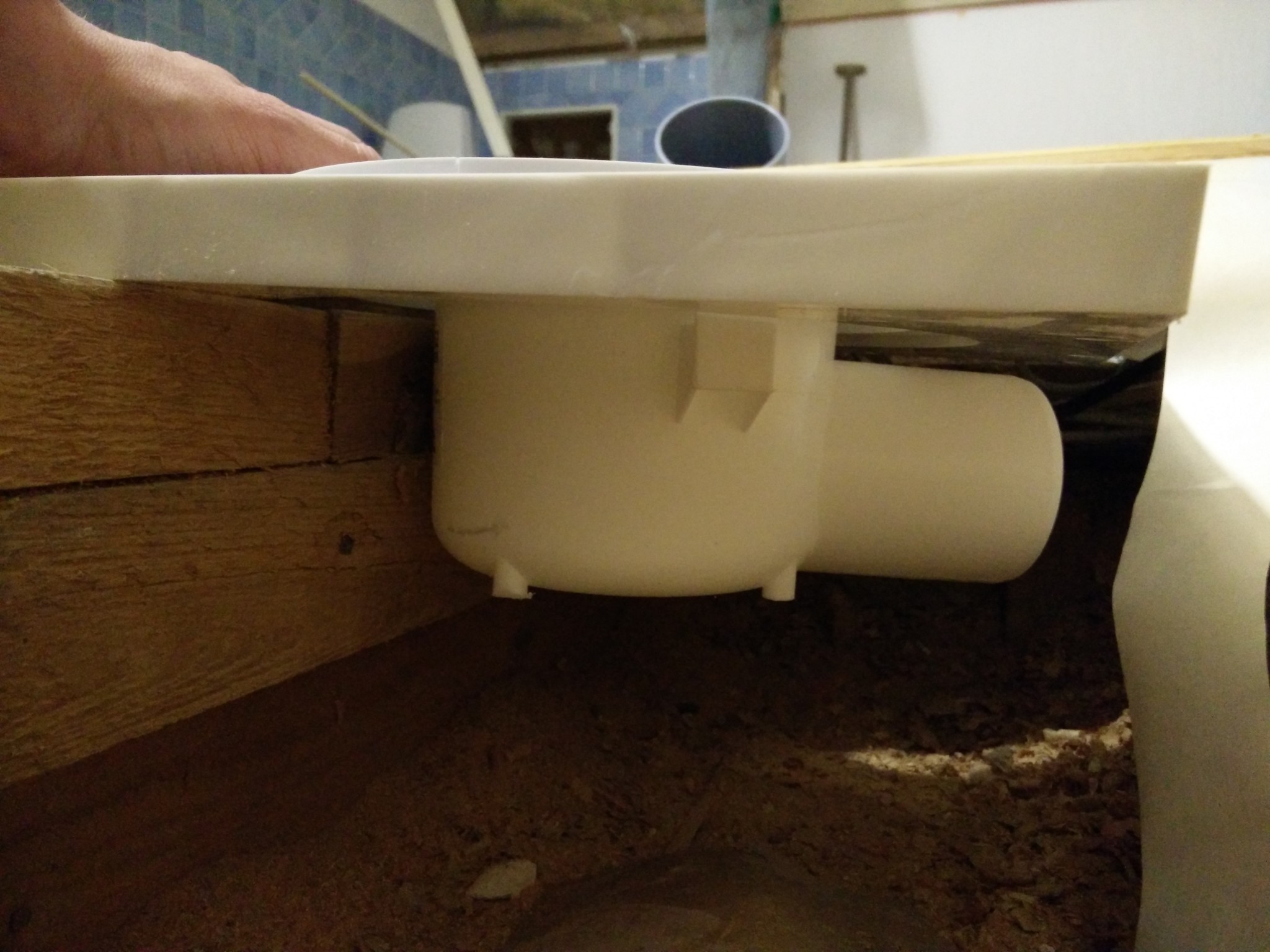
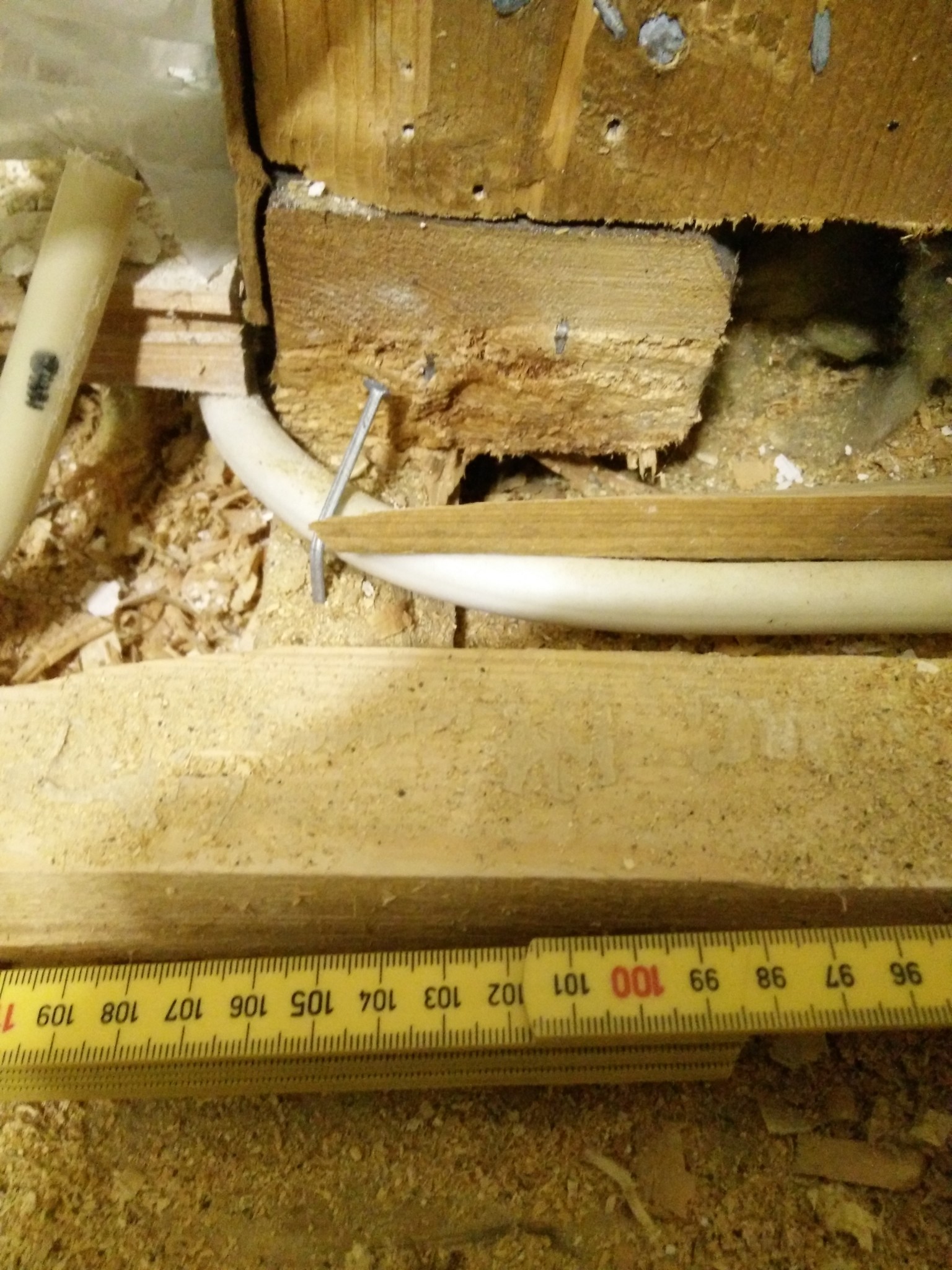
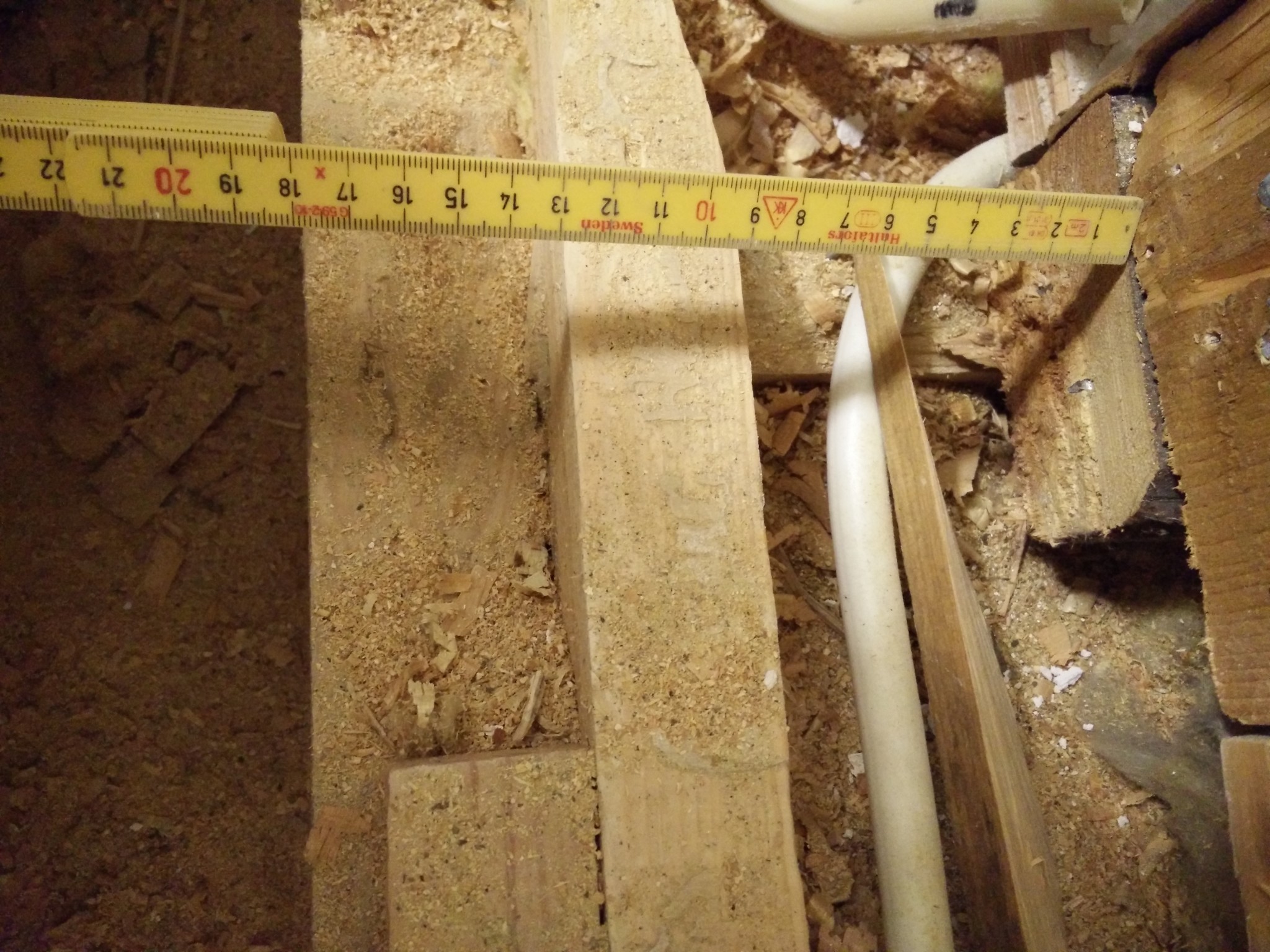
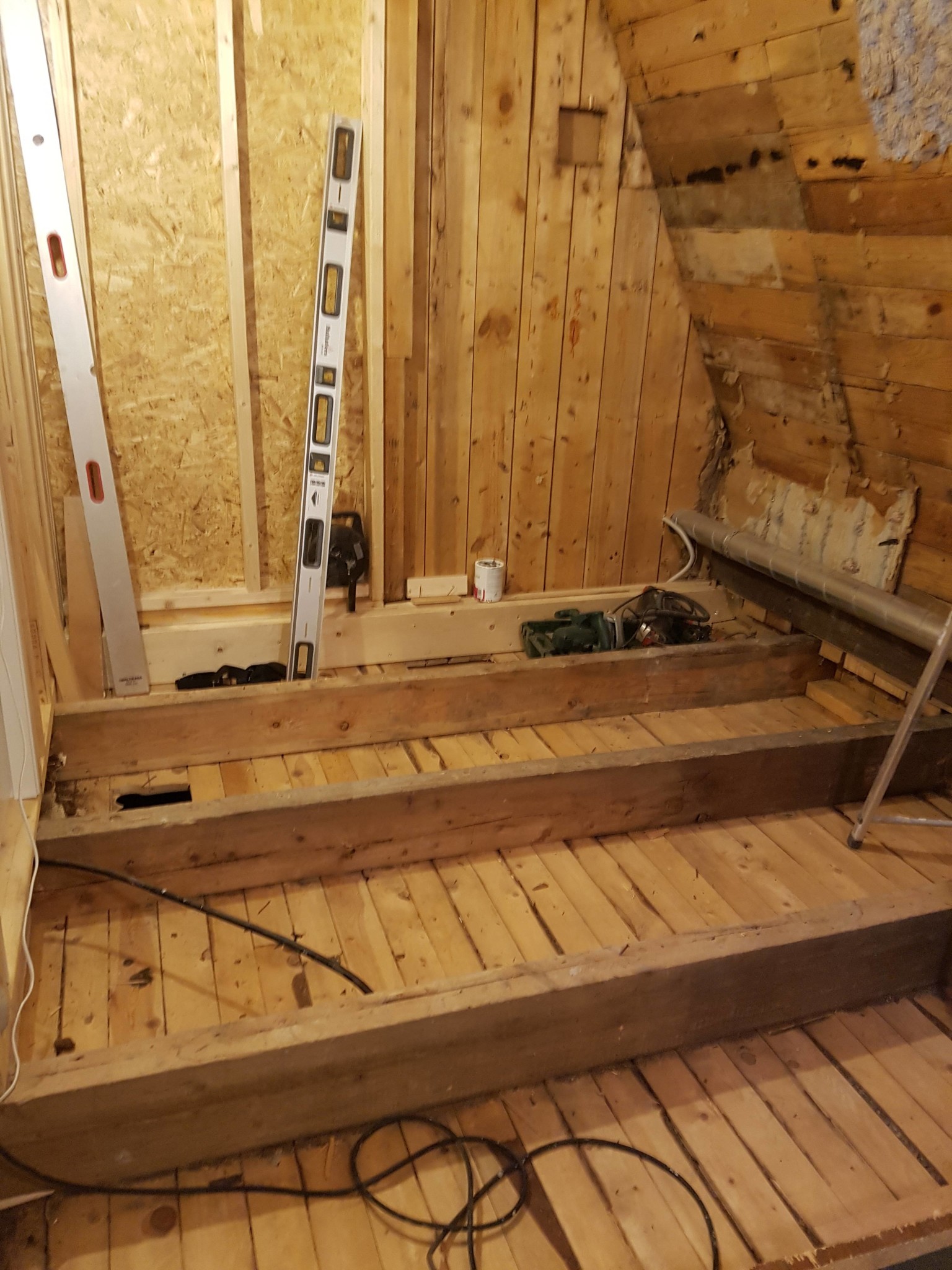
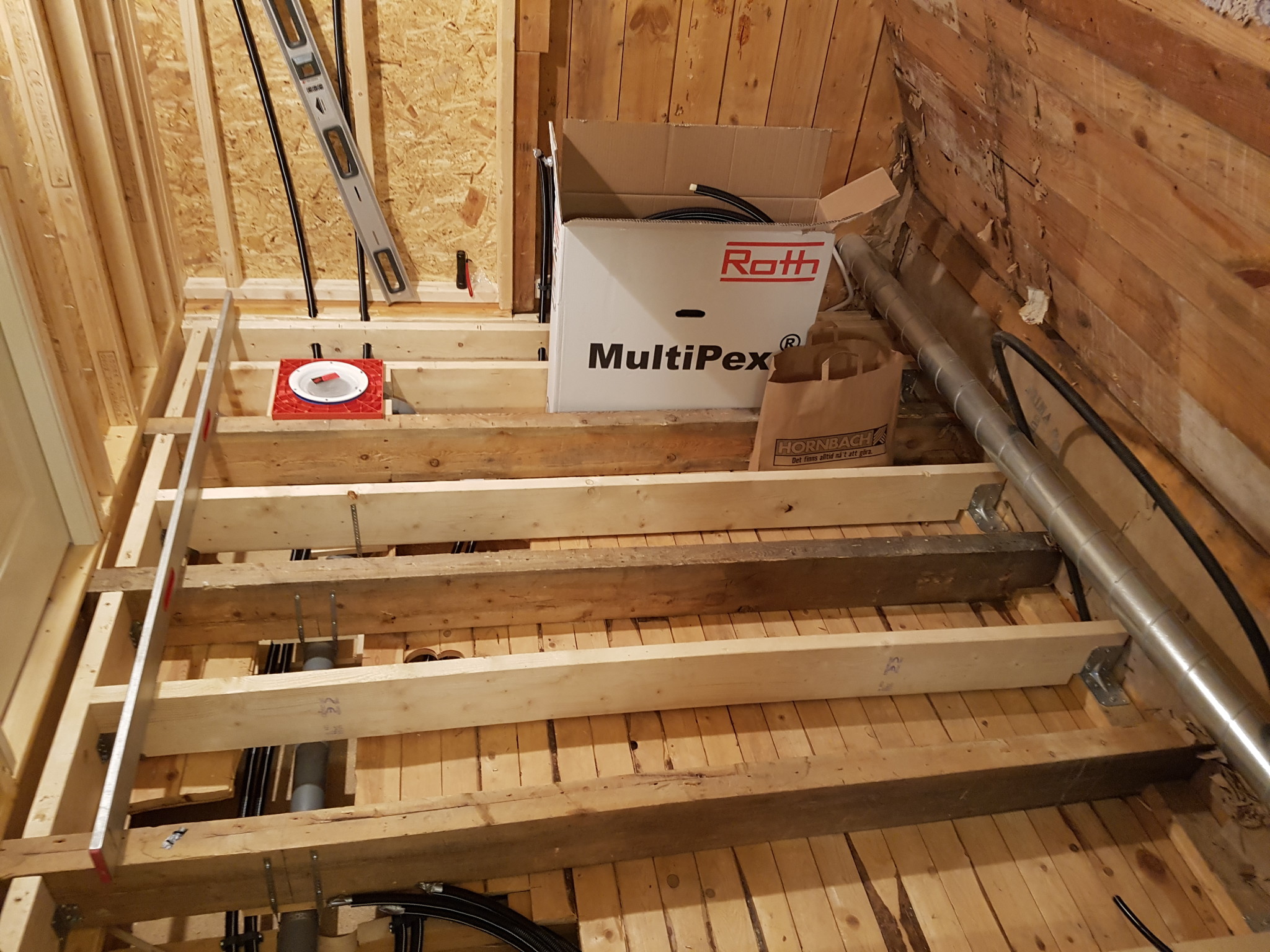
It's now leaning towards a combination of gluing on top of the existing and inserting some extra joists because the center distance is long.
I have also found the inner wall and can see standing planks. There's also a joist between some floor joists at the support as there's a wider door opening on the floor below.
[image]
[image]
Is it okay if the timber glued on top is not in one piece all the way? I was thinking of splitting a 45x70 short joist to 60mm width and screw-gluing it in place. Once the glue has cured, I will probably remove the screws or countersink them a bit more. Then, I will attach a straightedge and circular saw the joists level.
Does this sound like an okay solution?
I did exactly as you suggest to raise and straighten some three-inch floor joists in a bathroom project, and it worked perfectly. It's a bit tricky to run the saw sideways in the spaces while walking on the joists, but it works. It's hardly a problem to glue multiple pieces instead of one long piece. I removed the screws after the glue dried, sawed, and finally put the screws back.
Seems like this could turn out well, I split a piece for testing and put it in place:
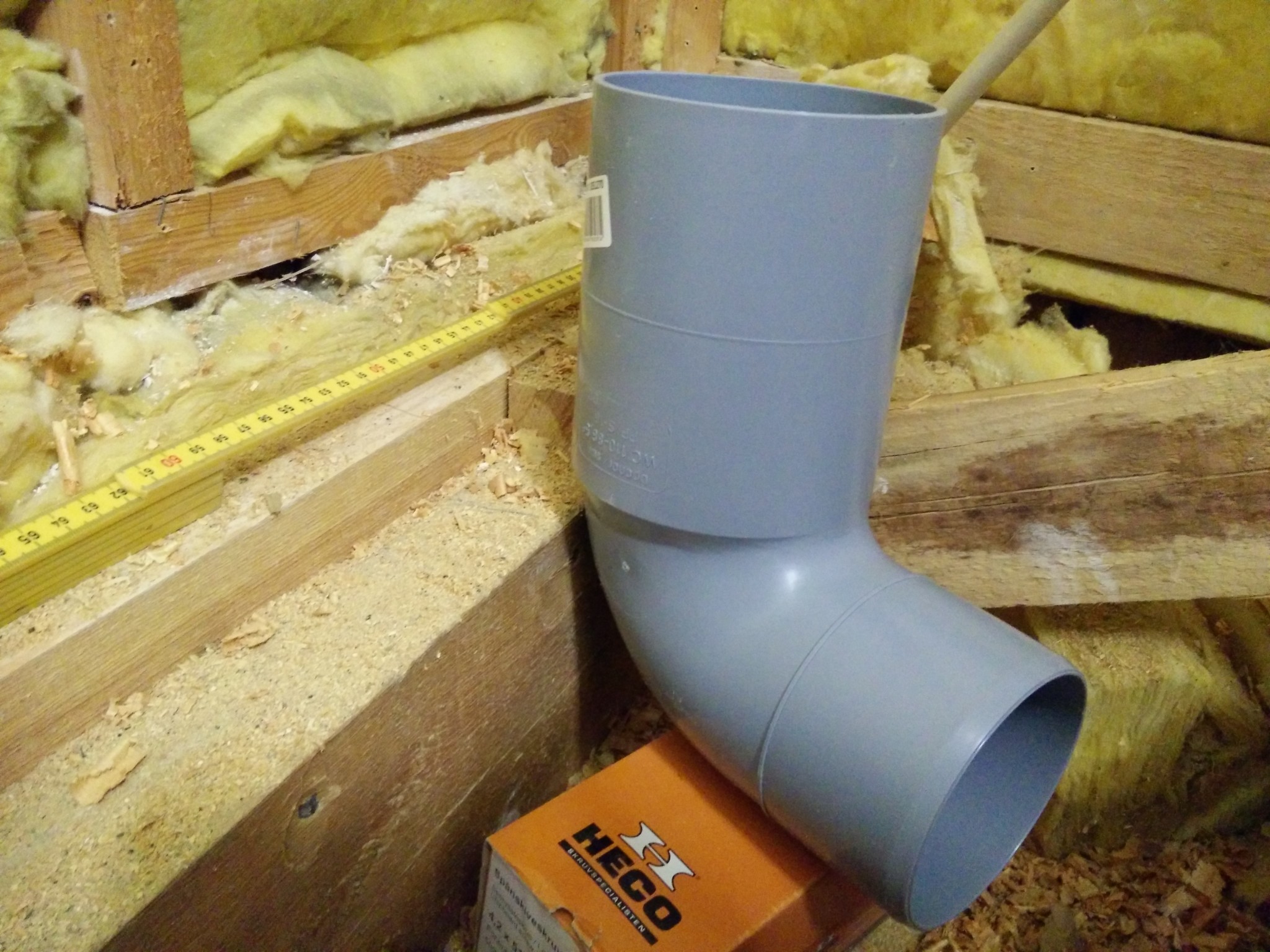
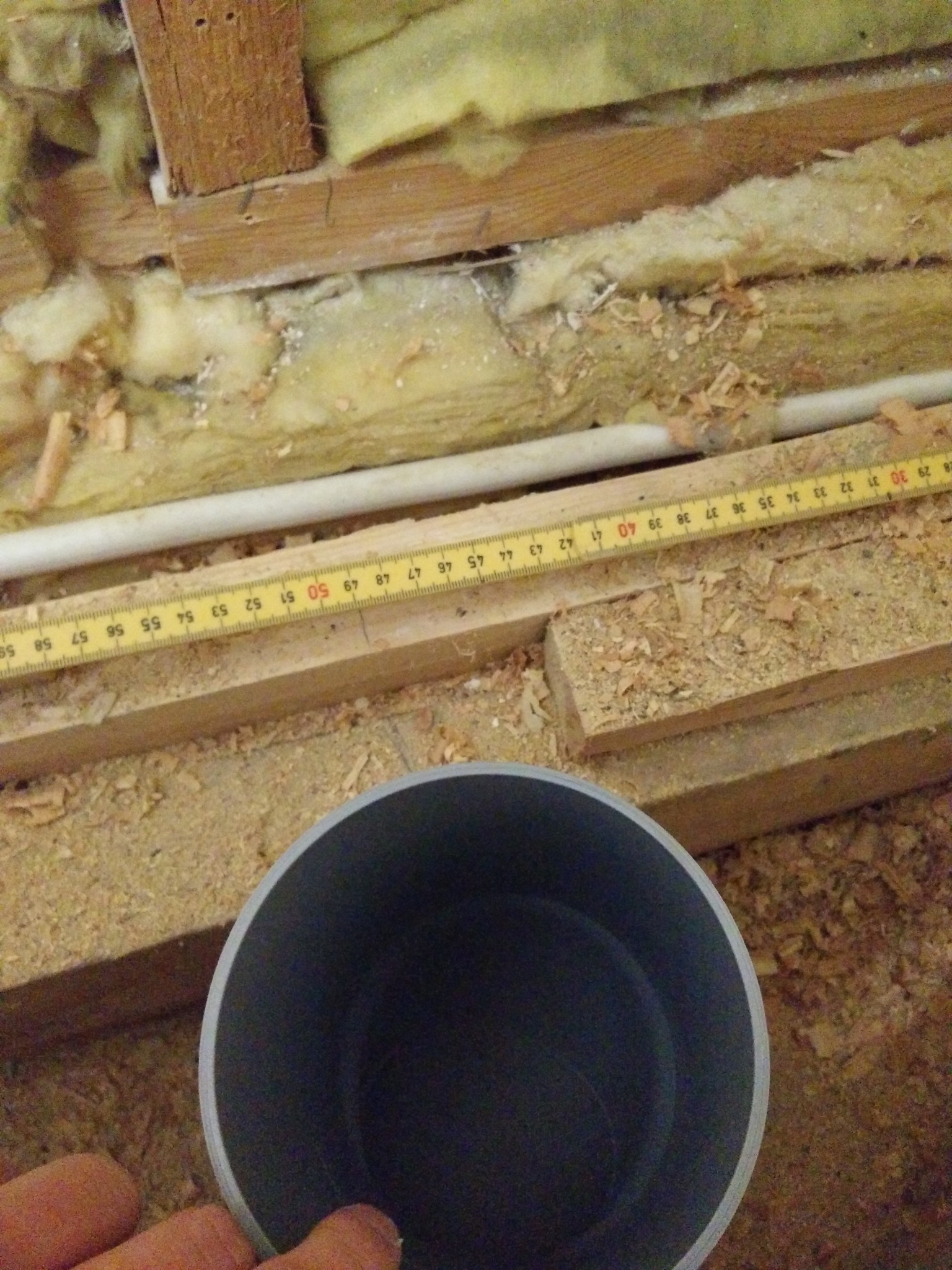
By the way, I've realized that one of the floor joists makes it difficult for me to get the toilet drain pipe close enough to the wall. Would it be structurally okay to screw glue one or two 50-60cm pieces of 45x220 to the existing one and then notch the joist from above? I suspect I have to go through the entire width to get to the right spot.
It’s a bit unclear to me what exactly needs to be reinforced compared to a regular pipe opening in the center of the beam.
It's also relatively close to the support, which should improve the situation.
When I measure, it seems like it needs to be a maximum of 13cm wide and 13 cm and 9cm deep (similar issue for a floor drain as well).
Both cases are quite close to a beam support (about 50cm).
For the drain, I would probably have needed to screw in an extra stud anyway to have something stable for the floor chipboard and the wall.
Other penetrations (only 75mm drain pipe that needs to cross the joist frame) I plan to glue-screw 15mm k-plywood on about 80-90cm. (Inspired by the template from 'säker vatten' described for 110-pipes).
I think it feels a bit questionable, but I have a hard time seeing the situation clearly. Can't you take a photo of the current situation? Some sort of abrovinsch is probably required, the question is which one?
I feel it's a bit questionable, but I have a hard time seeing the situation clearly. Can't you take a photo of the current setup? Some sort of abrovinsch is probably needed, the question is which one?
The first case is a toilet bend about 50 cm from the outer wall. It's quite possible I exaggerated the depth of 13cm (I meant from the top edge of a 220-regel) and it can possibly be reduced by a few cm further.
Otherwise, it's very difficult to place the toilet against the wall. The goal is essentially to get the drainage about 125mm cc from the finished wall.
The second case is a smaller notch for the floor drain which is 8-9cm deep. It's located about 1.4m from the outer wall and 1.1m from the other end of the floor beam (the beam ends at the old chimney wall).
It probably requires some form of support. The cutouts you want to make are quite large. Have you considered the possibility of moving the toilet or choosing one with a different concealed connection?
You can make cutouts right over the support, but preferably not where you want them.
It probably requires some form of reinforcement. Those are quite large cutouts you want to make. Have you considered the possibility of moving the toilet or choosing one with a different concealed connection?
You can make notches just above the support, but not preferably where you want them.
Moving the toilet would probably be difficult to achieve in this small layout, unfortunately (1.8x2.3m).
The floor joist closest to the wall (where I would like to notch for the toilet) is about 2.5 m between the supports. There is a nogging at about 105cm from the outer wall; it's surely possible to install a new joist between the nogging and the outer wall if that might help?
It is also possible with noggings towards the floor joist in the other direction.
From what I understand, there are eccentric couplings that can help about 30mm, but there is a risk that any sockets and similar may still build up and lead to wider/deeper notching.
What type of reinforcement is common in these situations?
Perhaps I should clarify, by the way, my suggestion with double screwed-and-glued 45x220 on one side of the beam; the idea was that the notching would only affect the "original beam" and the screwed-and-glued beams would remain intact. Not that the beam with all the reinforcements would be notched.
The dimension of the existing floor joists is probably 21/2x7 inches. A bit unusual, 3x7 inches was almost standard. The joists were laid as the plank frame was erected, it is the one that provides the support. The horizontal plank is not part of the support. The notch is probably to bring the plank level with the ceiling panel which is nailed from underneath into the joists. I would like to know how you reasoned when you came to your solution?
I think the construction resembles our house which was built in 1929, and where the joists rest on the plank, nothing went into the plank wall.
Yes, that was another thing. A possible solution is to cut off the beam and fasten its now free end to a short joist that is securely attached to the neighboring beams.
PPeter_K said:
the joists rest on the plank
But the plank is probably a wall plate resting on the wooden framework. Otherwise, it would never hold.
Yes, that was something else. An avväxling can be that you cut off the beam and attach its now free end to a kortling that is properly fastened to the neighboring beams.
But the plank is probably a hammarband that rests on the plankstomme. Otherwise, it would never hold.
Then my first thought about double glued 45x220 to make the beam 150mm wide and then notching about 6-7 cm into it is not as crazy? I'm thinking that the beam is at least as thick as before along its entire length.
I think the construction resembles our house, which was built in 1929, and the joists rest on the plank, with nothing going into the plank wall.
[image] [image]
I was a bit misled by the previous owner who had attached a joist only to the horizontal plank. But when I looked more closely at all the other floor joists, they were carefully inserted, and some didn't rest on the horizontal plank at all.
Vi vill skicka notiser för ämnen du bevakar och händelser som berör dig.