We moved into a 70s house 5-6 years ago and the previous owner had taken down the staircase, laid a floor, and put it back up again. We've now renovated the staircase by painting and adding steps to it. What we've noticed is that the staircase isn't attached to the wall on the long side; you can clearly see it move when you walk on it, which might be a reason for it creaking.
I've noticed that the inner stringer has a few cracks running between certain steps; does this matter? It looks like it's been that way for quite some time.
So the question is, should it be attached to the wall? And if so, how? Can you drill directly into the stringers?
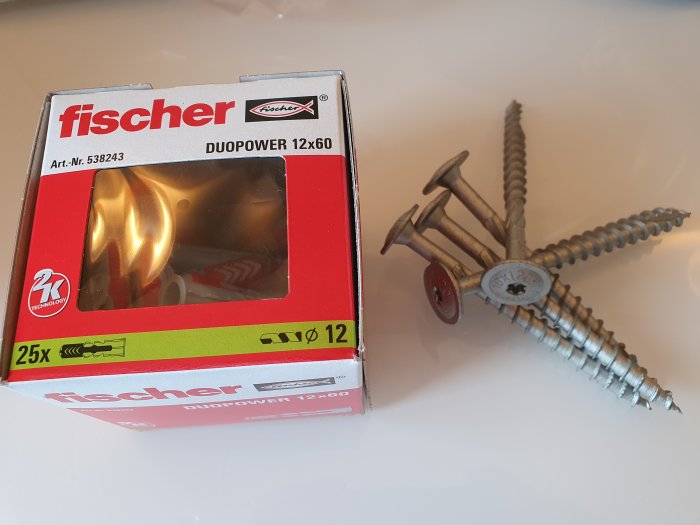
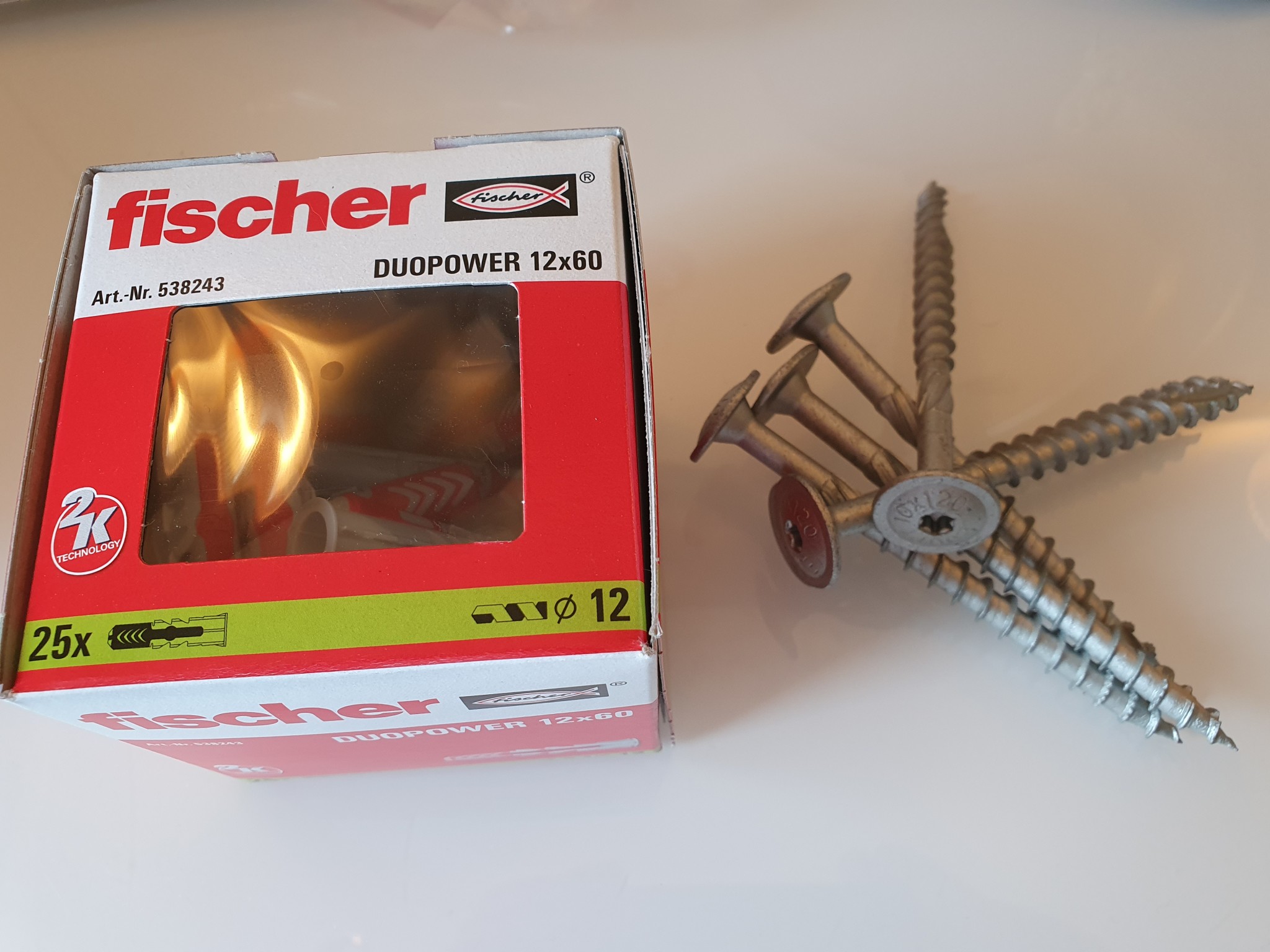
I made a trip to Hornbach and bought screws and plugs; could this be the solution, or is it unnecessarily heavy-duty?
Question 1: What are the steps you've put in there?
Question 2: What type of wall do you have? I think that French screws are not very visually appealing. An alternative is sanitätsskruv which have nickel-plated round heads.
Question 1: What kind of steps did you install there?
Question 2: What type of wall do you have? I find French screws not very visually appealing. An alternative is sanitätsskruv, which have nickel-plated round heads.
1. They are DURI oak treads glued onto existing steps.
2. The wall is mostly cinder block but also some lightweight concrete in places. From what I could see at Hornbach, these plugs should work for either.
If you paint the screws and washers white after they're in place, I can't imagine it's something you notice? But by all means, what is a sanitätsskruv? The advantage of a French screw is that you can drive them with a ratchet, i.e., apply a lot of force, but maybe that's not needed here.
or drill a 14 mm hole a bit into the carriage and place a wooden plug or plastic plug over the screw
for example TRÄLOCK FURU 12ST DIAM:14MM KARMPLUGG | Beijer Byggmaterial
That's an option, but I don't really want to hollow out the stringer since it already has some cracks in places. It probably would have been good to make as little impact as possible on the staircase when it comes to drilling holes?
But is the size reasonable otherwise? And how many should be installed?
The size is quite OK. If you get a good grip in the wall, three should be enough. I'm not familiar with the plugs, so I would choose Fischer or Essve nylon plugs. I would take such screws and make a small countersink.
The plug probably needs to be cut a bit so that the screw reaches 1 cm past the plug.
It would have been nice with branded plugs, but for some reason, they're not very easy to get through these building merchants.
Regarding screws, I find slotted screws a bit tricky, they feel unreliable if you need to tighten them hard. I'm also thinking about the countersinking, is it good when you need to tighten them really tight? Isn't it better with flat washers that distribute the force? I've used some French screws before, and in some cases, you need to tighten them quite hard, and sometimes the washer can even dig a little into the wood, well, maybe I've tightened them a bit too much then, but if the screw had been countersunk, you wouldn't have been able to tighten them nearly as hard, I suspect?
However, I'm obviously not a handyman, so I might be completely off track here.
When it comes to countersunk screws, what I could find at Hornbach were countersunk with TORX. But their heads weren't super large. Maybe screws need to be ordered online, the one you show in the picture looks very much like those already on the stairs, and I haven't seen those in stores at all.
Slot screws of the kind I showed are used to fasten toilets to the floor (nowadays they are often glued as it requires fewer tools). So they hold up pretty well. You should never use a power tool to tighten them. If you have a manual screwdriver with a blade that fits the slot well, you can tighten them quite firmly, and you don't need to tighten them more than that.
But sure, you can tighten French screws even more.
When it comes to countersinking, it's a good way to distribute the force without damaging the wood.
It's a matter of how you value aesthetics. French screws are more for rough carpentry like piers, hidden structures, sills, fence posts, etc. If you want it a bit nicer, you use countersunk slot screws. Most boat builders think this way.
But it's your choice.
Visited a slightly more "exclusive" hardware store (Optimera) in town. They're often quite a bit more expensive, but they usually have more suitable items. They didn't have any with straight grooves, but I found this:
These are still 10x120 screws even though they look a bit thinner. The big advantage is that the heads are large, so no washers are needed, and they don't protrude as much. The downside is that they're Torx, but they are at least more discreet than French screws.
When it comes to plugs, I buy suitable Fischer, and the screw will protrude about 20 mm, which was okay according to the seller.
I don't think they really need to hold the staircase with EXTREME force, but I still plan to set at least 4 at regular intervals. To make them more discreet, I'll paint over them; I'm considering whether I should also paint over the other screws in the staircase.
The price? Yes, it was significantly higher. Just the screws cost nearly 90 kr, i.e., more than everything from Hornbach. Unfortunately, you couldn't buy the plugs in bulk, so that was another 90 kr, but hopefully, it will be worth it. The alternative is to use the Hornbach sleeve, which reaches all the way in so that the screw only sticks out, say 5-10 mm, but the Fischer plug looks more advanced.
Click here to reply
Vi vill skicka notiser för ämnen du bevakar och händelser som berör dig.