
3,260 views ·
5 replies
3k views
5 replies
Attach renovation plasterboard to old wallpaper
Hello,
I am renovating at home and have a wardrobe wall in a house from the 60s, meaning the entire wall is just wardrobes and the wardrobe sides form the walls.
What I believe are chipboards (13 mm) serve as the actual wardrobes and form a whole wall between two rooms.
The wardrobes are then distributed to a hallway and 2 bedrooms.
There are several layers of wallpaper on the walls, and we tore down a substantial "mat" of wallpapers + fiberglass fabric. Some layers of wallpaper remain, the outermost layer is very crumbly, but the innermost layer seems to be well attached. We've tried to tear off as much as we can, but now it's very uneven, and to avoid wide-spreading putty on the old wallpaper, we thought of using renovation drywall, as the other walls will get OSB + drywall, making the outermost material the same.
I screwed up a sheet with 30 mm drywall screws, but when I realized it was only 13 mm thick, all the screws ended up in one wardrobe.
One thought is to place studs on the inside of each wardrobe, but the aesthetics hinder me a bit here.
I would like to just glue the drywall sheets onto the old wallpaper, but what is required for it to stick, considering the old wallpaper?
When I've searched here, people are talking about PL600, PL400, Tec7, boardfix, etc.
What do you choose, how do you do it, and what is the consumption rate?
It only concerns a few sheets on an entire floor, so simplicity weighs a bit more heavily than cost in this case, even though the cost is, of course, not insignificant.
I am renovating at home and have a wardrobe wall in a house from the 60s, meaning the entire wall is just wardrobes and the wardrobe sides form the walls.
What I believe are chipboards (13 mm) serve as the actual wardrobes and form a whole wall between two rooms.
The wardrobes are then distributed to a hallway and 2 bedrooms.
There are several layers of wallpaper on the walls, and we tore down a substantial "mat" of wallpapers + fiberglass fabric. Some layers of wallpaper remain, the outermost layer is very crumbly, but the innermost layer seems to be well attached. We've tried to tear off as much as we can, but now it's very uneven, and to avoid wide-spreading putty on the old wallpaper, we thought of using renovation drywall, as the other walls will get OSB + drywall, making the outermost material the same.
I screwed up a sheet with 30 mm drywall screws, but when I realized it was only 13 mm thick, all the screws ended up in one wardrobe.
One thought is to place studs on the inside of each wardrobe, but the aesthetics hinder me a bit here.
I would like to just glue the drywall sheets onto the old wallpaper, but what is required for it to stick, considering the old wallpaper?
When I've searched here, people are talking about PL600, PL400, Tec7, boardfix, etc.
What do you choose, how do you do it, and what is the consumption rate?
It only concerns a few sheets on an entire floor, so simplicity weighs a bit more heavily than cost in this case, even though the cost is, of course, not insignificant.

surris
Construction veteran
· Sverige
· 1 692 posts
surris
Construction veteran
- Sverige
- 1,692 posts
Okay, I can't visualize what it looks like. I'm imagining the picture as if it's an entire wall in a square room that needs plastering, so I don't understand why 15mm wouldn't work.
Feel free to update with a picture.
Feel free to update with a picture.
The response is a bit late, attaching the pictures I have.
It's a room with 4 walls.
3 "normal" walls where tretex has been removed and replaced with OSB + 13 mm gypsum.
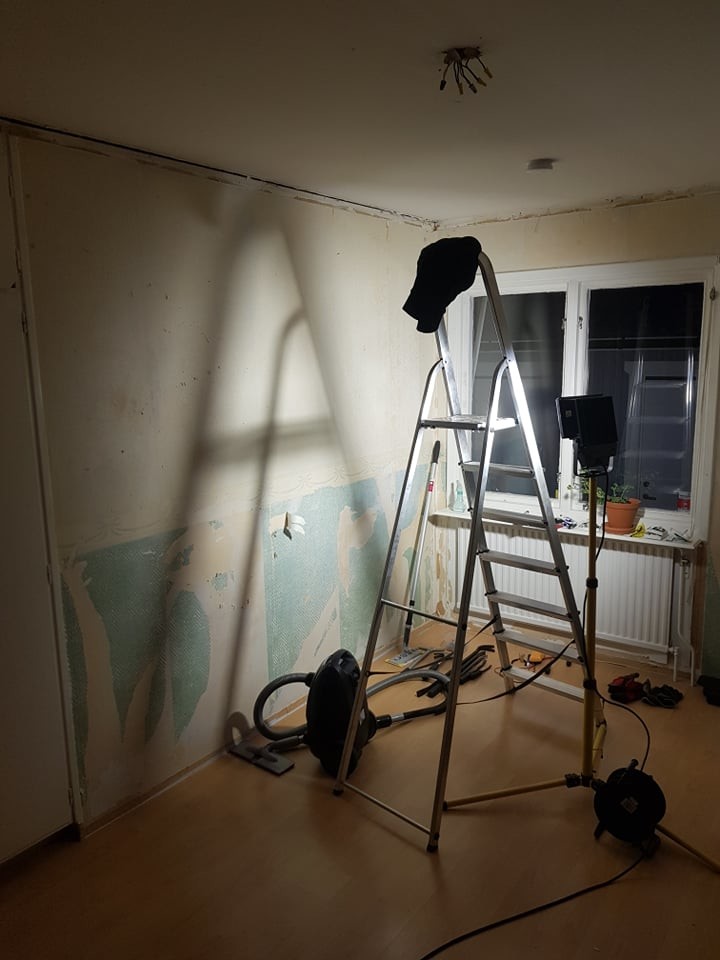
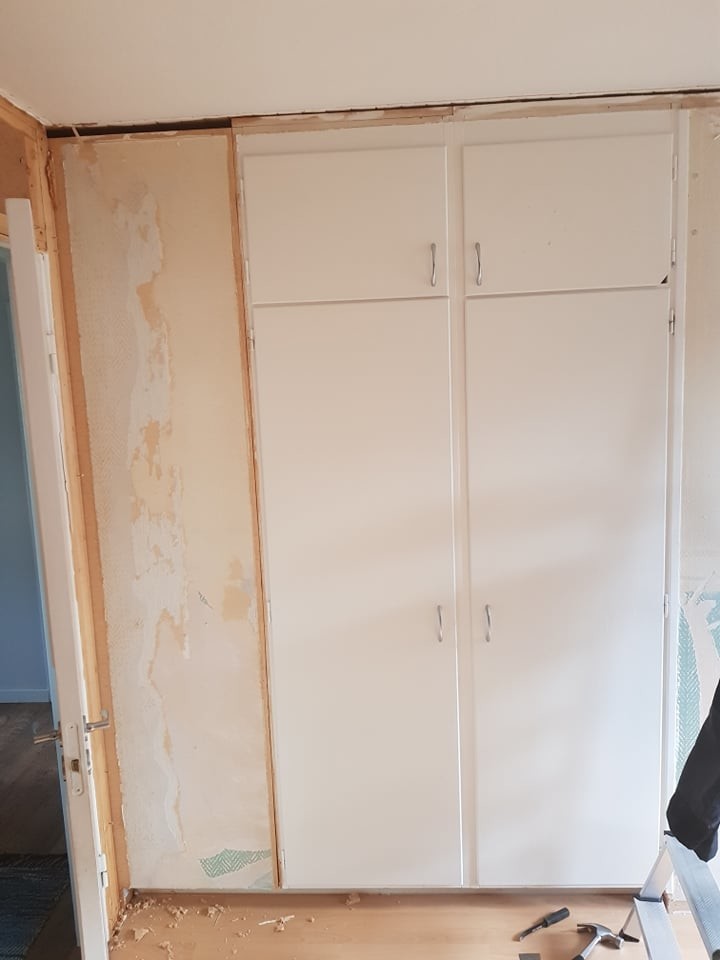
The other wall, however, which borders another bedroom, consists only of wardrobes. A total of 7 wardrobes, 2 with openings into the room we are renovating, 4 towards the other bedroom, and 1 with an opening towards the hallway. I hope the picture clarifies it a bit.
Image 1 shows the wall to the right of the wardrobes in the room (which is the backside of the 4 wardrobes facing into the other bedroom).
Image 2 shows the wardrobes, the area to the left of the wardrobe is the side of a wardrobe that opens into the hallway. (Note the space above).
The idea with 6 mm was that it might be an addition one can live with; if it's thicker, we thought spontaneously that it could start to look a bit odd.
Hope that made it clearer
It's a room with 4 walls.
3 "normal" walls where tretex has been removed and replaced with OSB + 13 mm gypsum.
The other wall, however, which borders another bedroom, consists only of wardrobes. A total of 7 wardrobes, 2 with openings into the room we are renovating, 4 towards the other bedroom, and 1 with an opening towards the hallway. I hope the picture clarifies it a bit.
Image 1 shows the wall to the right of the wardrobes in the room (which is the backside of the 4 wardrobes facing into the other bedroom).
Image 2 shows the wardrobes, the area to the left of the wardrobe is the side of a wardrobe that opens into the hallway. (Note the space above).
The idea with 6 mm was that it might be an addition one can live with; if it's thicker, we thought spontaneously that it could start to look a bit odd.
Hope that made it clearer
Click here to reply