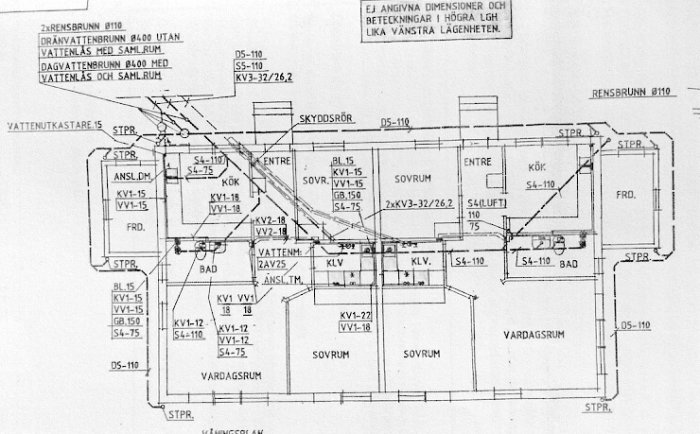
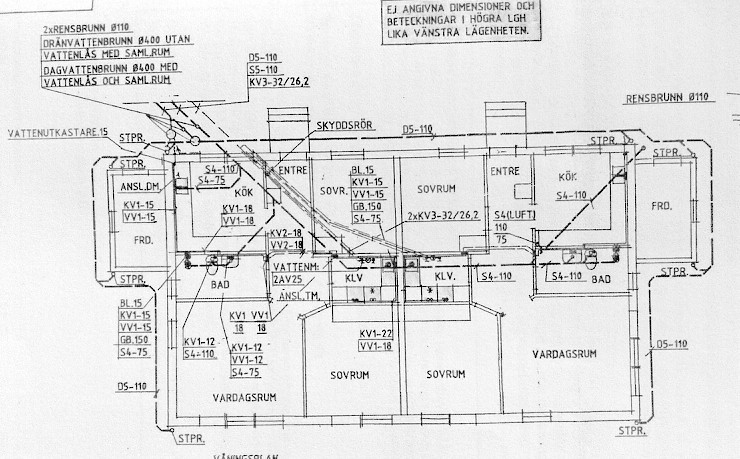
My house consists of two apartments and the floor plan is to be modified to create a large house. It is a single-story wooden house (stick-built), 160m2, on a crawl space foundation, built in '93.

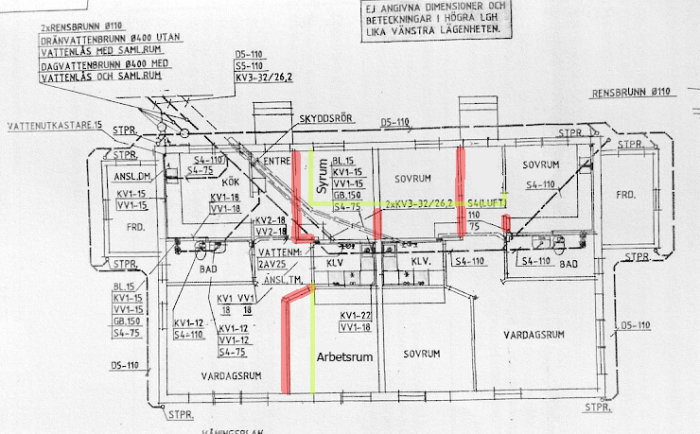
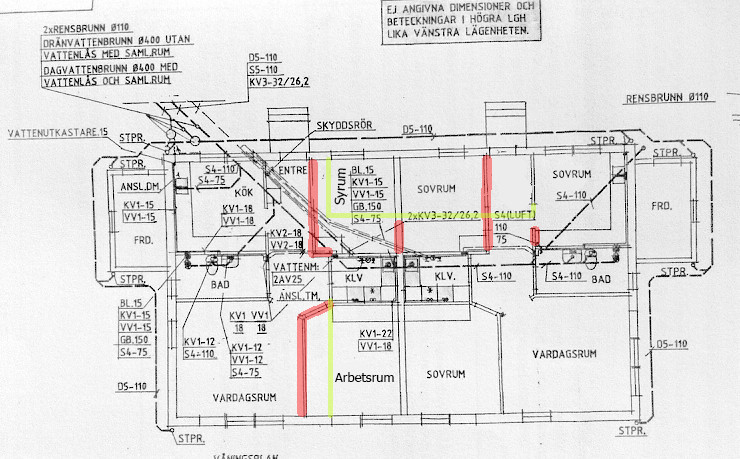
Before I start, I need help figuring out if any of the walls to be removed might be load-bearing.

I have attached two drawings, the original and one showing what to add and what to remove.
(Green = new walls, red = walls to be demolished)

Floor plan of a single-story wooden house showing modifications for merging two apartments, with new and removed walls marked in green and red. Floor plan showing wall modifications for a one-story wooden house, 160m2, with red indicating walls to be removed and green for new walls, built in 1993.
 
The middle wall/apartment separating wall is load-bearing; otherwise, the walls are probably not load-bearing.
 
Not certain that any interior walls are load-bearing at all. What does the roof structure look like? Can you show a section?
 
Villa vista said:
The middle wall/apartment dividing wall is load-bearing, otherwise, the walls are probably not load-bearing.
Why do you think the middle wall is load-bearing?
 
The middle wall is probably not load-bearing according to the trusses, but it should be structural stabilizing. It is impossible to determine load-bearing walls with an a-drawing or plumbing plan. However, it is the only wall that appears to have a structural function.
 
Ok, yeah, it's possible!

The fact that it's a bit more robust could also be because it's made with better soundproofing since it separates apartments.
 
If it is a gabled roof, I would guess that a wall running in the same direction as the ridge is probably load-bearing :)
 
We don't yet know what the roof looks like or in which direction the ridge goes. But otherwise, you could be right.
 
The most likely scenario is that the ridge runs along the longest side, and thus the center wall (hjärtväggen) is load-bearing.
 
If the roof rests on trusses, no heart wall is needed.
The longest span appears to be perpendicular to the apartment-separating wall.
 
The ridge runs the longest direction, from left to right in the floor plan.
It is correct that the thick wall contains extra insulation.

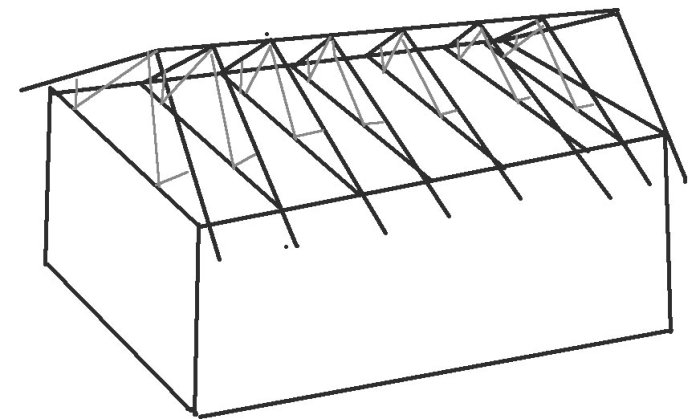
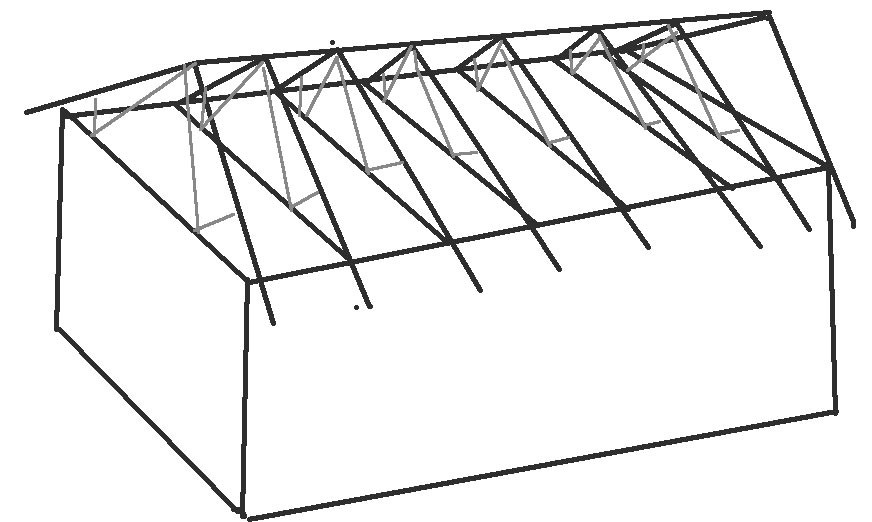
Drew a primitive sketch of the principle ;) Is it called a gable roof or truss construction, or what is it called?

A sketch of a building with a gabled roof structure, showing trusses running parallel to the building's length, from left to right.

* Can I assume that all walls running in the same direction as the roof trusses should not be load-bearing?
 
Last edited:
Turbo123 said:
The ridge runs in the longest direction, from left to right in the floor plan. It is correct that the thick wall contains extra insulation.

I drew a primitive sketch of the principle ;)

[image]

* Can I assume that all walls going in the same direction as the trusses should not be load-bearing?
You can safely assume that; however, I believe the Hjärtvägg is partially load-bearing.
 
You can assume that only the outer walls are load-bearing.
It is a gable roof that rests on truss rafters.
 
My previous house was an LB-house from 1980. 8 m wide and no load-bearing interior walls. Roof trusses similar to the ones you sketched, so it should be possible to remove and relocate the walls you want to change.
 
Last edited:
Click here to reply
Vi vill skicka notiser för ämnen du bevakar och händelser som berör dig.