I am an experienced reader of byggahus but a novice thread starter, so if this post is in the wrong forum, the admin can feel free to move it.
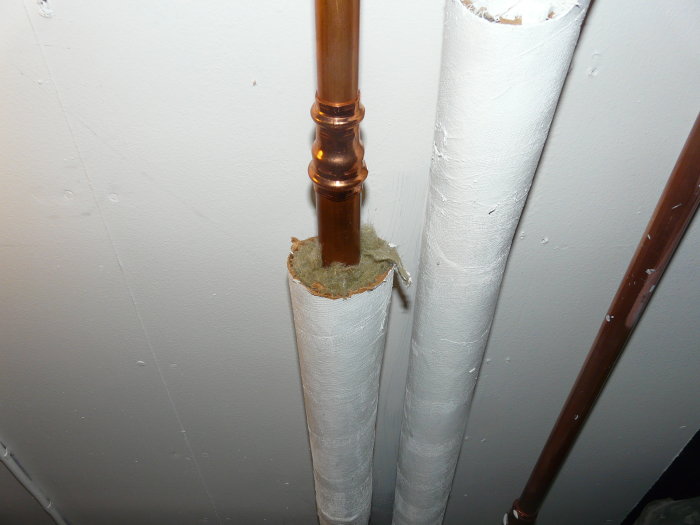
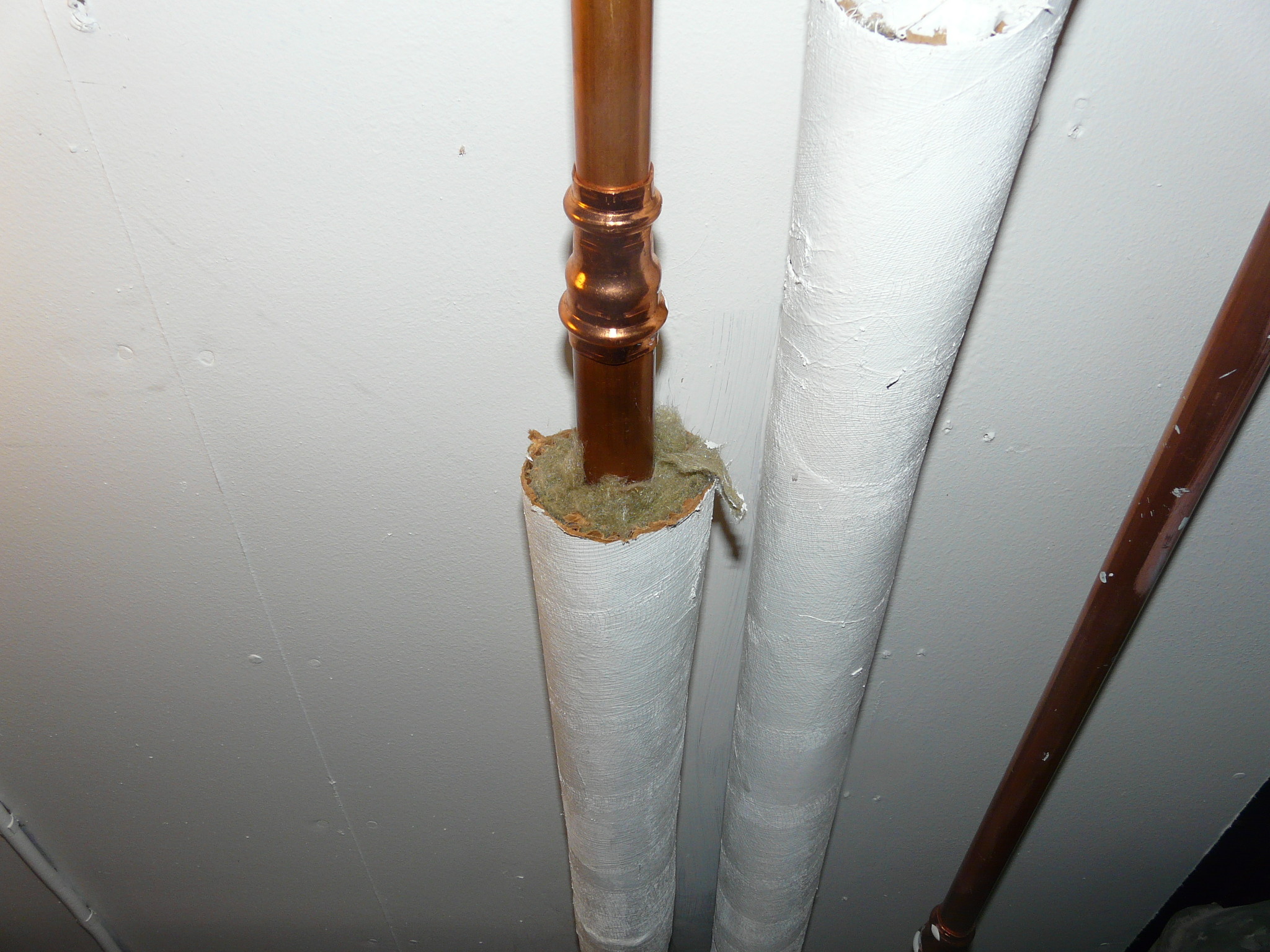
Can anyone say for sure whether the insulation in the attached image contains asbestos? These are hot and cold water pipes insulated in this way, and the previous owner exposed what is visible. I think the insulation looks like rock wool and the material around it like painted paper, but is it really that? If no one here knows, I will of course send a sample for analysis, but I am hoping for all you knowledgeable (home) experts in the forum first
It is stone wool, cardboard, gauze glued with water glass, and then painted white. Absolutely no asbestos there, and it is not as common in these contexts as one might think from the threads here.
Do you have any bends that are in the "same material"? if you look closely, you'll see that if so they are slightly differently made. There is a 90% certainty that there is work. on straight sections, there usually isn’t asbestos. However, I would prefer that it be sent for analysis before starting to tear it down. Asbestos is found in basically all materials.
Do you have any bends that are in the "same material"? If you look closely, you will see that if so, they are made a bit differently. There is a 90% certainty that there is asbestos. On straight sections, there usually isn't asbestos. However, I would prefer it to be analyzed before starting to tear into it. Asbestos is found in almost all materials.
Do you see any signs that would suggest asbestos is likely in the TS image? You should probably lower your percentage significantly, especially since it is almost certainly incorrect and could start unnecessarily worrying many readers here. The last thing you write seems really confusing.
Thank you for the quick and good responses! I'll add some information that might be useful for others reading. The analysis costs about 500 SEK per sample if you take the sample yourself and send it in, which I actually think is quite okay, but it looked like stone wool and paper so I tried here . We also have protection with particle filters (acquired for other demolition) and they were significantly more expensive than the analysis.
Do you see any signs that would make it likely there's asbestos in TS's picture? You probably ought to reduce your percentage quite a bit, especially since it's almost certainly not correct and could potentially worry so many who read here unnecessarily. What you wrote at the end seems really confusing.
If you read what I wrote, I said it's usually only in bends that there's asbestos. It looks like a plaster bandage, basically. You can see the difference. On straight sections like TS's picture, I wrote that it's unusual to encounter it.
Asbestos was used in almost everything before it was banned.
Insulation, various board materials, car brakes, etc., etc. What one should be wary of are materials that look incredibly fresh for their age. If it looks like new, there's probably asbestos in it.
If you read what I write, I said that it's mostly only in bends where asbestos is found. It looks like a plaster cast basically. You can see the difference. On straight sections like in the TS picture, I mentioned that it's uncommon to encounter it.
Asbestos was used in almost everything before it was banned.
Insulation, various sheet materials, brakes on cars, etc, etc. The thing to be wary of is rather materials that look incredibly fresh for their age. If it looks like new, there is probably asbestos there.
But what would age with the stone wool? If it's embedded as it is, it shouldn't change significantly and should therefore also look fresh.
A very insightful person I see, unfortunately, you are in the minority among craftsmen. As you say, asbestos was used in almost everything when it was allowed and popular.
It looks like stone wool, but I wouldn't have torn into it without an analysis.
If the house is built before the 80s, you should be extra vigilant.
When it comes to asbestos, it's better to assume it is asbestos even if in 90/100 cases it turns out not to be.
And if you're going to tear the stuff down and there is a single bend, as mentioned above, it is almost certainly that there is asbestos, and a remediation company should be hired.
The only thing one can say about forum threads discussing asbestos (notice the spelling, -=fullmoon=-, you're using at least three different ones ), censorship
Why would one use asbestos in the bends of water pipe insulation?
A very insightful person I see, unfortunately you are in the minority among craftsmen. As you say, asbestos was used in almost everything when it was allowed and popular.
It looks like rock wool but I wouldn't tear at it without an analysis.
If the house was built before the 80s you should be extra cautious.
When it comes to asbestos, it's better to assume that it is asbestos even if in 90/100 cases it turns out not to be.
And if you're going to tear it down and there's a single bend, as the above states, it's almost certain that there is asbestos, and then a remediation company should be hired.
In a previous thread, you were open about knowing your reaction to asbestos was partly based on your hypochondria. Then it might not be great to give advice based on your own reactions.
I advise TS and everyone else reading the thread to study the username "raddforasbest" as well as what has been written in previous threads by them. My opinion is that the individual is exaggerating. To the extreme.
A few too many people are responding to things they have no idea about and aren't helping the original poster at all.
Are you going to remove more insulation, or is it going to stay as it is now?
Asbestos is not dangerous as long as it remains in place without any disturbance that causes it to dust, which doesn't happen if you don't do anything with the elbow. So if the pipe is going to remain, you don't need to do anything with the pipe except maybe finish insulating what the previous owner removed.
If it’s going to be removed, as someone mentioned, the asbestos is in the pipe elbows. Removing it yourself is the cheapest and simplest way; here’s how plumbers do it when they remove old pipes.
Expose the pipe 20 cm from the elbow on both sides, place a garbage bag over the elbow and tape it tightly around the "clean" pipe, then use a reciprocating saw to cut on both sides of the bag.
The asbestos is gone without any exposure occurring.
That is my concrete tip, and I have a few years of experience in the construction industry.
Press fittings of this type did not exist when asbestos was used in the insulation.
But that is probably the reason why a piece of insulation has been removed. That is, a new joint has been made on an old pipe.
It is probably just as uncommon to have insulation with painted gauze on modern pipes with press fittings, so this is likely a case of splicing onto an old pipe.
Press fittings of this type did not exist when asbestos was used in the insulation.
OT, but the press fitting is an over 50-year-old Swedish invention. Theoretically, it could be an authentic installation with rock wool, gasbinda, and press fitting from the late 60s, but probably not.
Vi vill skicka notiser för ämnen du bevakar och händelser som berör dig.