Hello,
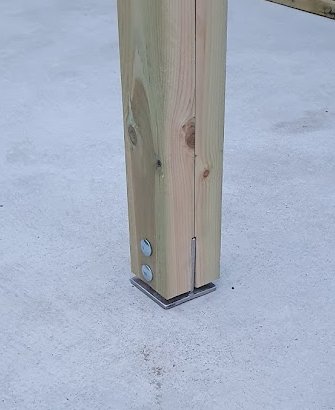
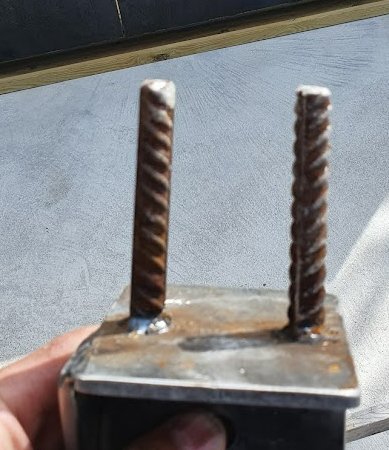
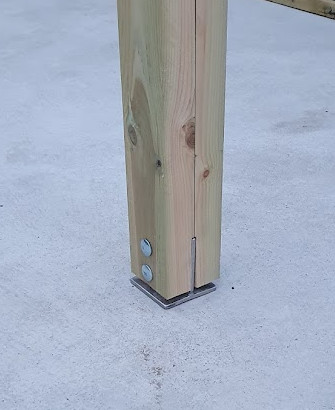
I will soon be fixing the post shoes for my pergola into a concrete slab with anchor compound. The holes are drilled according to the instructions and a test assembly without compound has been carried out. The tube states that you should fill the hole to two-thirds and rotate the rod down. However, this is not possible in my case (see image).
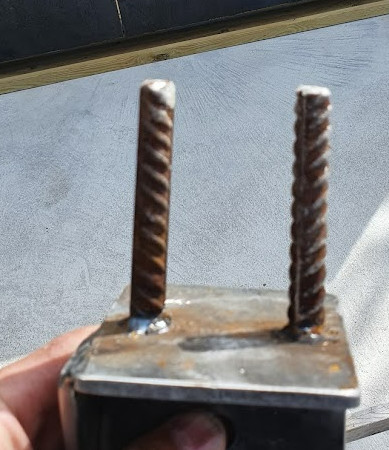
I'm considering how to do this so that it doesn't go wrong. I really want to avoid stopping once the compound is in the hole. I also don't want a lot of mess outside the post shoe. Rotating won't work, so it will have to be pushing and maybe tapping. The question is whether I really need to fill so much compound in the holes? The compound needs to go somewhere when the rods go down. Surely this isn't the application where the full capability of the anchor compound is required to hold.
I don't have a lot of experience with chemical anchors, but I'm usually good with ideas
I would probably spread the mass evenly over the bars beforehand and then have just a little bit in the hole. It should give roughly the same result as twisting. Just a bit messier. So, about that much around the bars so that they still fit into the hole. You can also push a smaller rod into the hole first to ensure it's properly spread, then pull it out, and then insert your pair with the right amount of mass on it.
I have done a similar assembly. But chose iron with holes. So I attached stainless 12mm threaded rod in the holes and then nuts to the iron. Has worked for 4 years now.
Actually, you should do a test assembly in another piece of concrete just to see if you can get the iron down into the holes when you can't twist.
Now I don't have a lot of experience with chemical anchors, but I'm usually good with ideas
I would probably spread the mass evenly over the rods first and then just put a little bit in the hole. That should yield roughly the same result as twisting. Just a bit messier. So, about as much around the rods that you can still get it into the hole. You can also push down a smaller rod into the hole first so that you've properly spread it in the hole, then pull it out, and then insert your pair with the right amount of mass on it.
Thanks for the response. That sounds like a reasonable approach. The actual anchor is quite tight to fit in (and remove) even without the mass, so feeling it out with the real anchor is not an option.
I have done a similar installation. But I chose steel with holes. So I secured a stainless 12mm threaded rod in the holes and then nuts to the steel. It has worked for 4 years now.
You should really do a test installation on another piece of concrete just to see if you can get the steel into the holes when you can't twist.
Hi,
Maybe not a bad idea. There are plenty of places on the slab that will be completely covered by the outdoor kitchen. However, I guess I need to get another nozzle for the tube if I want to use the compound multiple times.
Now I'm not the first to have this problem since I have shamelessly stolen the design from @Paerh.
It would be very interesting to hear how he did it, if he can get over the design theft...
Now, I'm not the first to have this problem since I've shamelessly stolen the design from @Paerh.
There are a few minor flaws in the design;
The issues with mounting and the anchor mass you mention here.
I would think that the holes are strictly speaking too close if you check the specification for the anchor mass.
It can't be disassembled in a non-destructive way.
The rebar will rust.
The rebar feels a bit too short in relation to the diameter.
No adjustment options once they are anchored.
So you have probably just discovered the reason why the "standard" is to use threaded rod or anchor sleeve and bolt connection.
But under the circumstances, it will probably be fine as you are suggesting. That is, don't be too generous with the anchor mass and wiggle them as best as you can to get the mass to adhere properly. And, as always, be careful to brush and blow out the holes thoroughly.
The problems with the mounting and anchor mass you mention here.
I would guess that the holes are strictly speaking too close if you check the specification for the anchor mass.
It can't be dismantled in any non-destructive way.
The reinforcement bars will rust.
The reinforcement bars feel a bit too short in relation to the diameter.
No adjustment possibilities once they are anchored.
So you have probably just discovered the reason why "standard" is to use threaded rods or anchor sleeves and screw connections.
But under the circumstances, it will probably be fine as you describe. That is, don't be too generous with the anchor mass and jiggle them to get the mass to adhere properly. And, as always, be sure to brush and blow out the holes thoroughly.
Thank you so much for the response.
One usually has to account for some minor flaws in the result when considering Of those you've listed, most seem manageable if I can just get the darn thing to fit. I (hopefully well) made the adjustment before I drilled. If a mount ever needs to be replaced, I'll simply have to cut the thing on-site and replace it with something slightly larger.
Hopefully, the rusting in the bars won't become a problem within my lifetime (I'm turning 40 soon and quite enjoy good food and drink). To be completely honest, I envisioned a stainless steel threaded rod instead of a reinforcement bar when I ordered the feet. I simply wasn't clear enough.
Then it was all done. Drilled a test hole under the upcoming kitchen and tried to insert a rebar. It turned out that the mass was quite loose in consistency, and it was no problem at all to push down the rebar.
Before I fastened the post shoes, I masked the plate with some tape around the shoes. I pushed the mass into the hole, and when I tapped the post shoe in place, a bit of mass squeezed out onto the masking. It looked neat, and there was no mess after I removed the tape. I think and hope that the mass will encapsulate the rebar enough that they rust slowly.
Click here to reply
Vi vill skicka notiser för ämnen du bevakar och händelser som berör dig.