
20,133 views ·
19 replies
20k views
19 replies
Air gap in low-sloped roof without flow at ridge and without ridge vents?
Based on the information in my previous post, I think it might not be wrong to build with an air gap but:
1. Either keep the eaves completely closed and sealed, so the air gap is not ventilated outward, but air can circulate inside and there is a small distance between the decking and cellulose insulation, i.e., from top to bottom: decking, air gap, masonite board, cellulose insulation. If needed, a few holes can be drilled per section to get some ventilation, or small ventilation flaps can be installed that can be opened/closed when necessary.
2. Or from the start, drill holes or install narrow ventilation flaps so the eaves are not completely open. This allows for some limited ventilation.
However, I think option 1 might be the wiser choice? Then you can do as you wish later. The question is just how to detect problems, but perhaps an inspection hatch inside at least one spot could show how the roof is doing (at least right there).
1. Either keep the eaves completely closed and sealed, so the air gap is not ventilated outward, but air can circulate inside and there is a small distance between the decking and cellulose insulation, i.e., from top to bottom: decking, air gap, masonite board, cellulose insulation. If needed, a few holes can be drilled per section to get some ventilation, or small ventilation flaps can be installed that can be opened/closed when necessary.
2. Or from the start, drill holes or install narrow ventilation flaps so the eaves are not completely open. This allows for some limited ventilation.
However, I think option 1 might be the wiser choice? Then you can do as you wish later. The question is just how to detect problems, but perhaps an inspection hatch inside at least one spot could show how the roof is doing (at least right there).
Hi. I've had the same dilemma. I have a low-pitched "envelope roof" much like in your picture. It's not flat as it looks in the picture, but about 8 degrees.Martin_B said:
Does it work to have an air gap in low-pitched roofs (yes, say 5 degrees or so) without airflow at the ridge and without ridge vents?
That is to say, the air gap is only open at the eaves at the bottom. Air can flow freely in each section from eave, up to the ridge, and back down to the same eave again, but not blow through from one eave to another due to the barrier at the ridge, and not out via gable vent either.
Does this work in the case where cellulose insulation is used, on a roof covered with surface felt or metal?
In some places, I've even read that an air gap can make it worse in cases where cellulose insulation is used, and in other places, it's stated that you should have an air gap regardless of whether or not cellulose insulation is used.
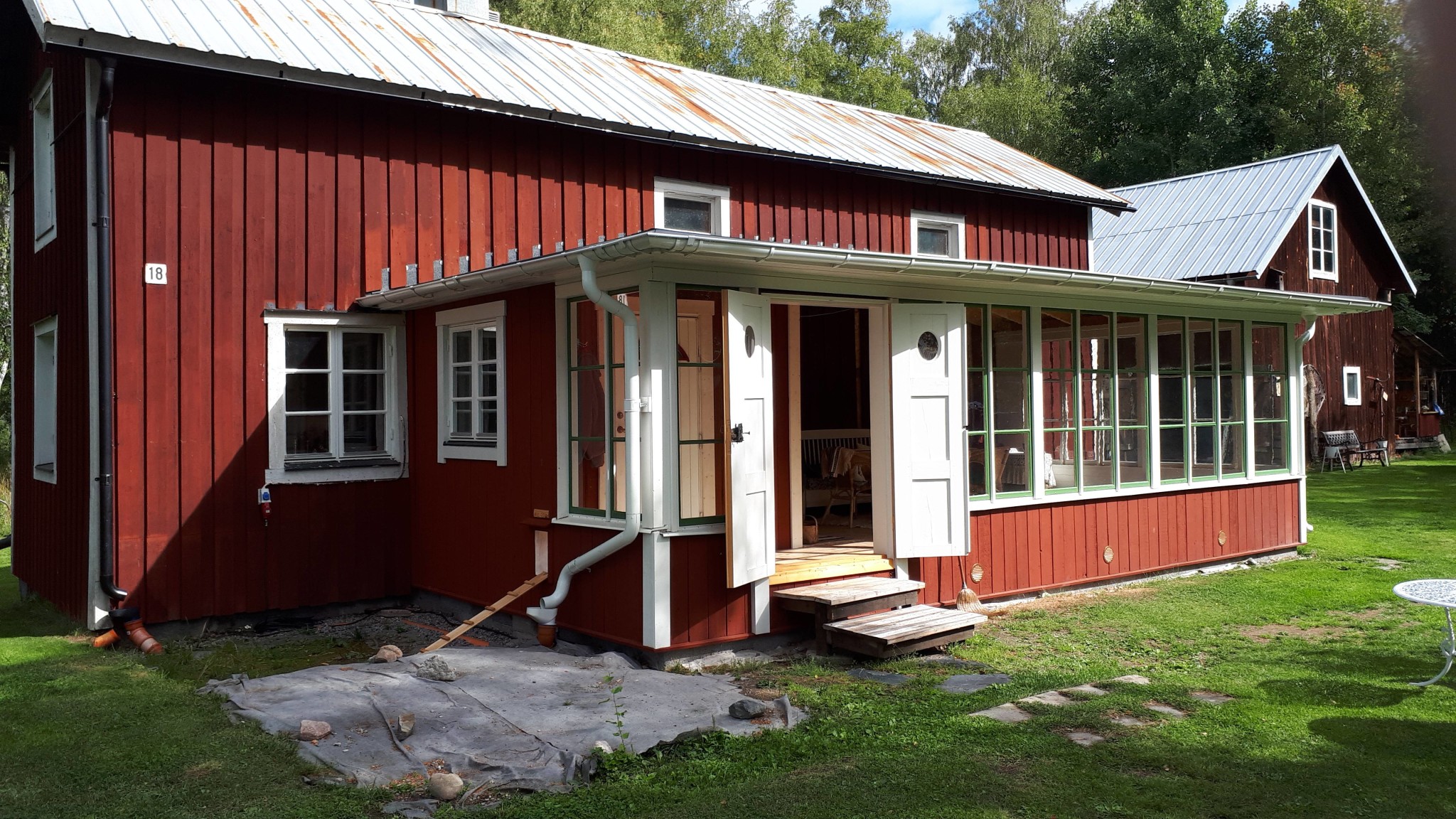
However, with a felt roof. Ended up with the solution of an open eave. Air gap below, but with mineral wool. Now, my construction is a bit special. It's a sunroom (uninsulated) with an integrated hall. It's only the roof in the hall that is insulated.
I wanted to have some form of airflow. But it became a nightmare figuring out how to do it with the short sides, where the upper side ends in the crossbar, that is, a complete stop. I drilled 20mm holes in a line in the crossbar for each section (not good from a construction perspective, but that particular beam is supported by the hall wall underneath). So now there's theoretical ventilation from the eave up to the crossbar through the holes and down again on the inside of the veranda. There was no other solution I saw back then. Cellulose insulation would probably have been better, but I didn't understand that at the time.
Raising this thread a bit as I am building an insulated porch with a 7-degree slope on a hipped roof. I am building with ventilation and thinking that the air should circulate out under the panel, is that completely crazy or?
I built with an air gap despite cellulose insulation, and also let it ventilate out towards the eaves, as well as through-pass ventilation at the ridge.Linjemontoren said:
In this way, there is at least the possibility to go in with a camera if needed.
The ventilation holes at the eaves are, however, significantly slowed with insect mesh in triple layers (a bit apart), to slightly slow down the airflow. In this way, I think the temperature becomes more even in the air gap with less risk of condensation as a result.
Honestly, I think it is basically the same no matter what you do when you have cellulose insulation. The result will always be determined by the location of the house, both in the country and in terms of cardinal direction, weather conditions (which you can never plan for), roof pitch, etc., etc. There are so many factors that determine it that you can't say with certainty that one option is better than the other.
If you have an air gap with ventilation, you can at least always close it very easily if needed. Becomes very difficult the other way around if you haven't even set an air gap from the start.
Martin! Hur gick det? Jag har en helt identisk frågeställning. Låglutande valmat plåttak utan möjlighet att förbinda facken via nocken som utförs av diagonal valmbalk.Fungerar det att ha en luftspalt i låglutande tak (ja, säg 5 grader eller något) utan genomströmning vid nock och utan nockventiler?
Det vill säga att luftspalten endast är öppen i takfoten längst ner. Luft kan strömma fritt i varje fack från takfot, upp till nock och tillbaka ner till samma takfot igen, men ej blåsa igenom från en takfot till en annan p.g.a hinder i nock, och inte ut via gavelventil heller.
Fungerar detta i det fall man använder cellulosaisolering, på ett ytpapp- eller plåttäckt tak?
På vissa ställen har jag t.o.m läst att luftspalt kan göra det värre i det fall man använder cellulosaisolering, och på andra ställen står det att man skall ha luftspalt oavsett cellulosaisolering eller inte.
Click here to reply