I am going to cover my walls first with battens about 25mm thick, then OSB, and finally drywall. I have recently redone the drainage for the entire house and installed insulation on the exterior. The walls and floors are completely dry; the finest sanding dust under work trays can easily be blown away with a small puff.
Despite the dry walls, I will use sill paper between the studs and the concrete wall.
What I'm wondering is how large of a gap I should use at the top toward the ceiling and at the bottom toward the floor? I want it to be as small as possible because it won't look very nice with the gap.
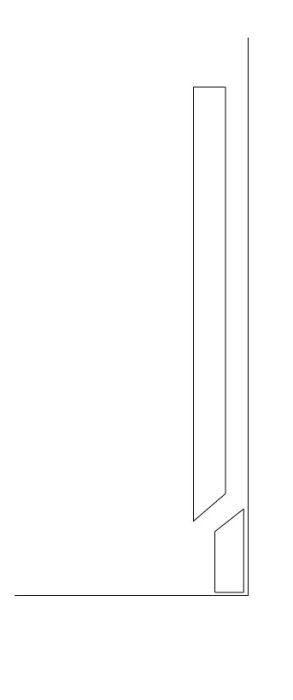
I looked in one of my old handbooks about installing wood paneling on masonry walls. It was recommended that the panel be miter sawed at 45 degrees at the top and bottom on the inside. This is to facilitate air movement. The opening dimensions at the top and bottom should be the same as the recommended air gap behind, i.e., 10-20 mm. I think you can stick with 25 mm battens as they provide better screw depth. If you can miter the OSB, I suggest at least 15 mm in opening dimensions.
Maybe you have a good tip on how to conceal the opening so it still looks natural? Some clever trim solution or something like that. At the bottom, I'm thinking of laying the same tiles as my floor is made of.
Roof profiles (hat profiles) are a suitable replacement for battens, made of steel and build 25mm. Then there are ready-made ventilated plinths you can use, or you can make your own. Roof moldings I'm not really sure about, but a shadow molding can probably be modified quite easily to achieve hidden ventilation.
Then there are ready-made ventilated baseboards you can use or you can make your own. Ceiling moldings I'm not quite sure about, but a shadow gap might be easily modified to provide hidden ventilation.
I've tried searching but without finding anything useful, is there any good image that describes how these baseboards work or something? Can't make sense of it
My thought was to leave a 1 cm gap from the floor to the wall and then put tiles a little bit up on the wall. In a garage, however, it gets a bit dirty, so it becomes a bit troublesome to reach and clean under the wall, creating a problem...
If, for example, you have tiles as flooring, you simply build up a suitable height of tiles directly on the wall. Then you can leave a gap there, so you avoid getting debris collected in it.
It changes the conditions a bit, so of course ventilated baseboards are out. It now depends a bit on what finish you want to achieve but as suggested above, it's probably smartest to move the ventilation up and build tightly against the floor.
Then it's probably not a bad idea to construct the wall so that any water that lands on the wall doesn't run down behind the tight area.
Or is it possible to tile directly onto the existing wall and leave the boards on the studs?
That changes things a bit, so, of course, ventilated bases are out. It somewhat depends now on the finish you want to achieve, but as suggested above, it is probably smartest to move up the ventilation and build closely against the floor.
Do you mean, for example, putting tiles down to the floor (10 cm on the wall) and then just above the tiles making a 10 mm air gap? If you cut the boards at a 45-degree angle, this shouldn't look completely wrong, and it also prevents water on the walls from running behind the wall...
Do all walls need to be ventilated, or does this only apply to exterior walls?
Do you mean, for example, that you put tiles down to the floor (10 cm on the wall) and then just above the tiles you make a 10 mm air gap? If you cut the boards at a 45-degree angle, it shouldn't look too bad and it also prevents water on the walls from running behind the wall...
Do all the walls need to be ventilated or does this only apply to exterior walls?
yes
Click here to reply
Vi vill skicka notiser för ämnen du bevakar och händelser som berör dig.





Rickard.ag said:

Kenny Lundbäck said:
Do you mean, for example, that you put tiles down to the floor (10 cm on the wall) and then just above the tiles you make a 10 mm air gap? If you cut the boards at a 45-degree angle, it shouldn't look too bad and it also prevents water on the walls from running behind the wall...