Yes, that's probably the case, but I still get a bit anxious
I don't feel like I have full control over all the parameters, and there are many suggestions on Google and here
I've tried to find a "local consultant" but no one seems willing to share their knowledge unless they get to do the work themselves, even if they get paid for the consultation..
The reinforcement issue seems to be the biggest concern, I hear I might need more than I'd hoped
Yes, that's probably the case, but I still get a bit anxious
I don't feel like I have a full grasp of all the parameters, and there are many bids on Google and here
Tried to find a "local consultant" but no one seems eager to share their knowledge unless they get to do the job themselves, even if they're paid for the consultation..
This thing about the reinforcement I think will be the biggest concern, seems to need more than I hoped I hear
the ground doesn't settle so well in that area. you know yourself that in the spring speed bumps arise
rather make it a bit sturdy and avoid having to redo it
So true. But to make "baskets" for a wall? Sounds like I need to rent a lot of stuff from Jiab :/ Never cast on a large scale before. Everything else in the house project seems simple in comparison But then we didn't cast the slab ourselves. I've probably repressed how much anxiety I had during the house build too
No need to be so serious.
formstag or gängstång that you najar three tior maybe 5cm from the ground. Then the same variant but 5cm from the upper edge.
No point in securing the house foundation. The house will move in a completely different way than the wall. Better to use an asfaboard against the house facade.
You have no idea how nice it is to have someone/some people to bounce ideas with! Even if the suggestions are different, at least they are concrete suggestions, and that's more than I have found/received before!
If the ground is difficult to pile things into, how do you anchor the supports then, I wonder?
You have no idea how nice it is to have someone/some people to brainstorm with! Even if the offers are different, they are still concrete offers and more than I've found/received before!
If the ground is difficult to pile things into, how does one anchor the supports then?
//L
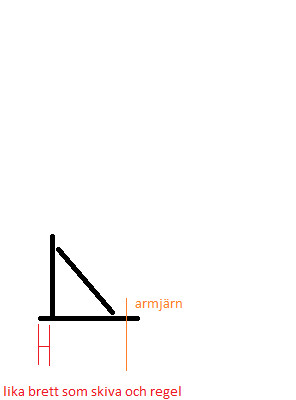
normally 50 cm ish rebar that is driven down
bad sketch but maybe gives an idea
L one in regular timber 45/70 bracing in 28/70
also works. just upgrade the timber. or double 45*45
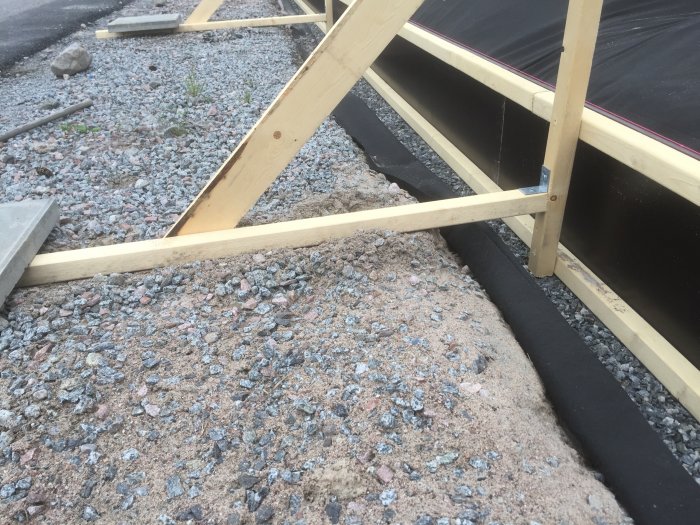
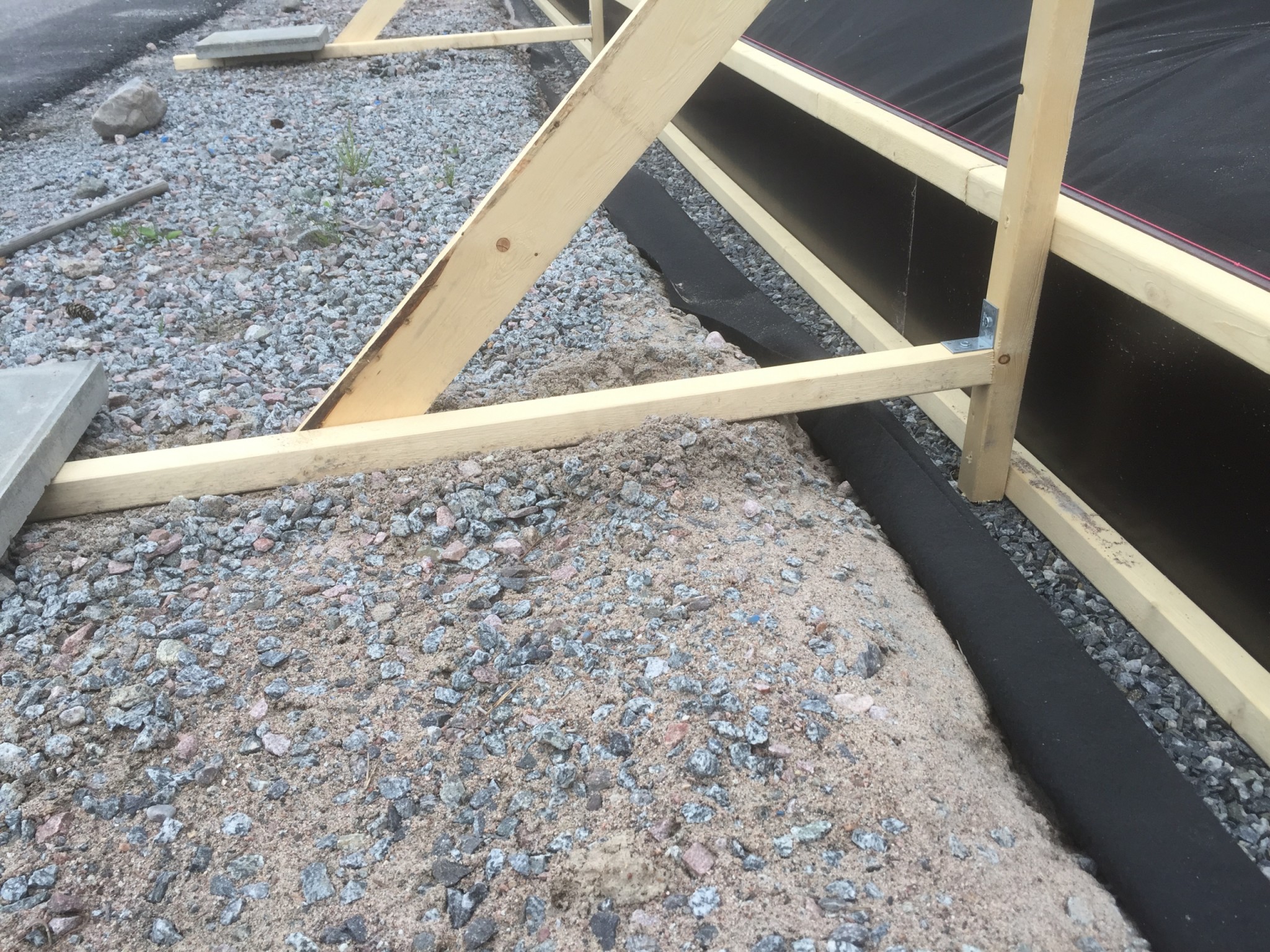
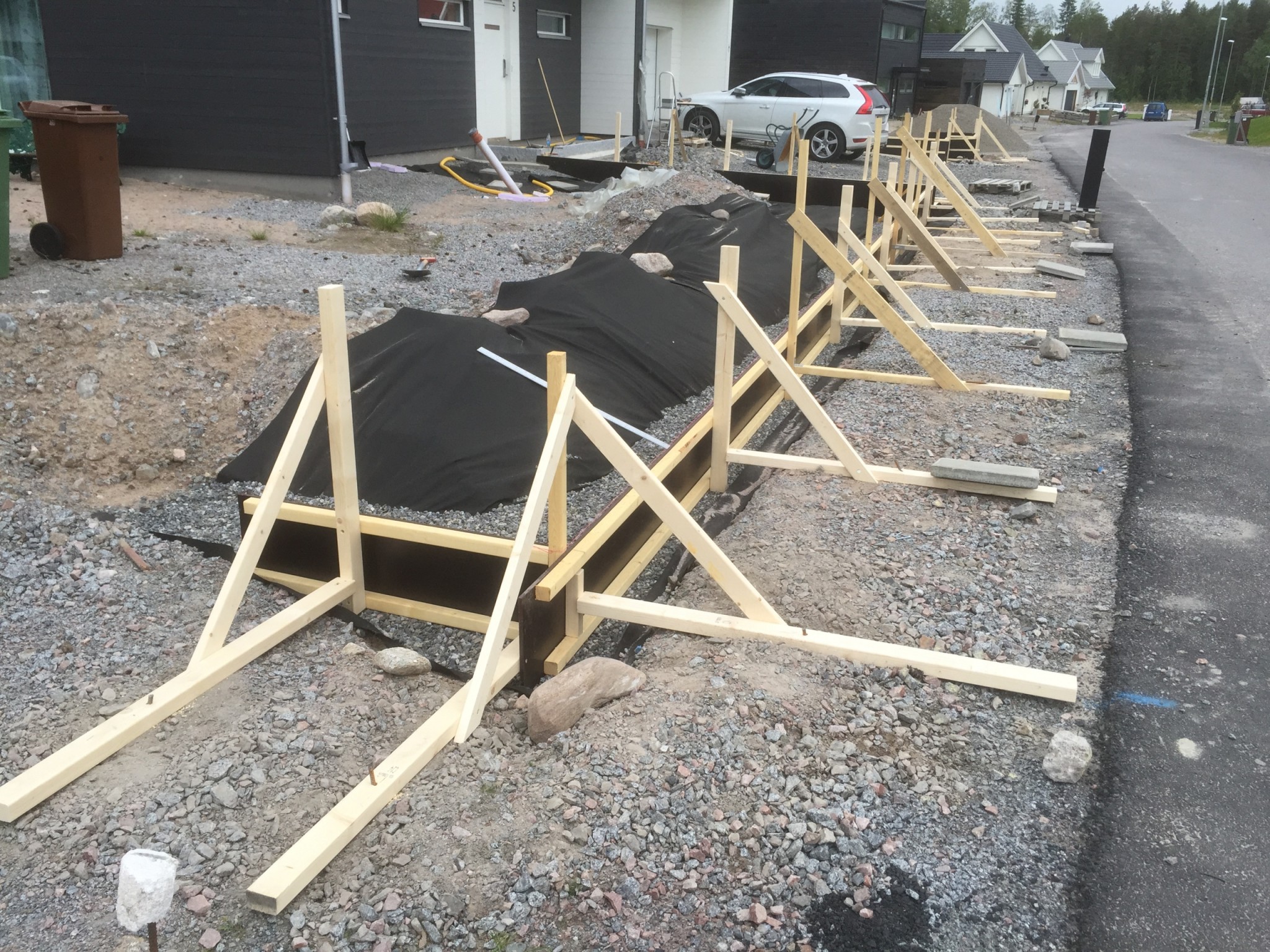
Worked hard tonight... more than doubled all supports with 45x70 + 28x70 according to your recommendation with extra care in the corners Also drove down 50 cm 10mm rebar! Feels significantly sturdier now. Also purchased 40 m M8 rod...
Morning! Considering it's a low form, it shouldn't fail when you build it as you have, provided you pour properly. Start by filling the bottom, proceed and then go back. That way the concrete will have settled a bit.
In your outer corners, you should have extended the studs, then nailed a locking board on each side.
When building the inside of the form, do the same by securing the inner corners with nails/locking boards and driving rebar into the ground as you did on the outside.
Braces shouldn't be necessary in the low form if you build it correctly, as the construction will lock itself. Your supports are somewhat high and might be in the way of the concrete truck's chute.
Keep in mind that the form should be easy to dismantle as well. Don't overdo it with screws; buy plain nails.
Hello! Considering that it is a low form, it shouldn't give way when you've built it as you have, assuming you pour correctly, that is. Start by filling in the bottom, then move on and then go back. By then, the concrete will have settled a bit.
In your outer corners, you should have extended the joists, then nailed a locking board on each side.
When you build the inside of the form, do the same by locking the inner corners with nails/locking board and driving in rebar into the ground as on the outside.
Braces shouldn't be needed in the low form if you build correctly, so the construction locks itself. Your braces are a bit high and will be in the way of the concrete truck's chute.
Remember it should be easy to dismantle the form as well. Don't overdo it with screws, buy plain nails.
Best regards, Carpenter.
Braces mainly so that TS doesn't have to widen their excavation as the width is enough. Mainly to facilitate.
Braces also to avoid having to do any complicated reinforcement.
Now I don't understand at all what you mean, the form ties have nothing to do with the reinforcement. It is a continuous pin that is broken off when the form is cast. Only to hold the form together.
And as I wrote earlier, the braces are way too high for the concrete truck to do a smooth job!
If it is to be done "for real," the vertical braces should not be higher than the casting height on the side that the concrete truck will fill from. Also, the height the concrete should be is marked inside the form.
It is a low form, it requires no more than 45-50 cm sticking out from the form to attach the diagonal braces to the ground. And not higher than the form itself.
Thanks for all the tips.
I have ordered a pump truck, not a chute. But I can shorten the supports anyway
As it looks now, there are 240mm wood screws through the form at the bottom edge (5cm up) that go 3cm into the board/stud, C-C 50cm. The bottom reinforcement rests on this. I'll put M8 through the supports on each side of the form as far down as I can (couldn't get down to 5cm though) and 5cm from the top, about C-C 100cm.
On the inside, it's very difficult to set supports, as the masses from the excavation are there :/
On the low part (max 45cm high), do I need to use more supports even on the inside if I'm using plenty of form ties?
Here is a picture showing how closely you need to brace, you might be able to set it a bit further apart since your wall isn't quite as wide;
The width doesn't matter, the pressure only depends on the height (or, if you prefer, the depth).
Try sticking your hand in a bucket of water or in the sea. Not much difference in the pressure you experience there, right?
A quick panic solution to brace it a bit extra if you're nervous is to put soil/gravel on the outside. That will hold up quite well. However, you'll need to dig it away again later...
Also, consider that if you connect the opposing sides of the form with some kind of brace, the pressure of the concrete will counteract itself. The pressure on one side will support the other, and vice versa. Just make sure the brace holds.
Last edited:
Vi vill skicka notiser för ämnen du bevakar och händelser som berör dig.