I've been Googling like crazy in search of sensible advice on how to make a mold and reinforcement for a retaining wall.
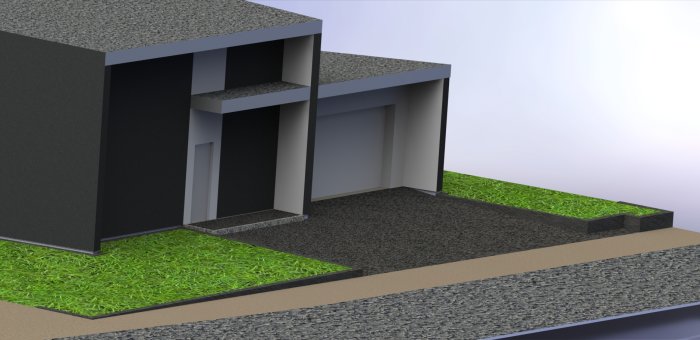
The wall will be from 40 - 70 cm high from top to bottom, 10-50 cm above ground with soil on one side.
For various reasons, I have to make it 200 mm wide.
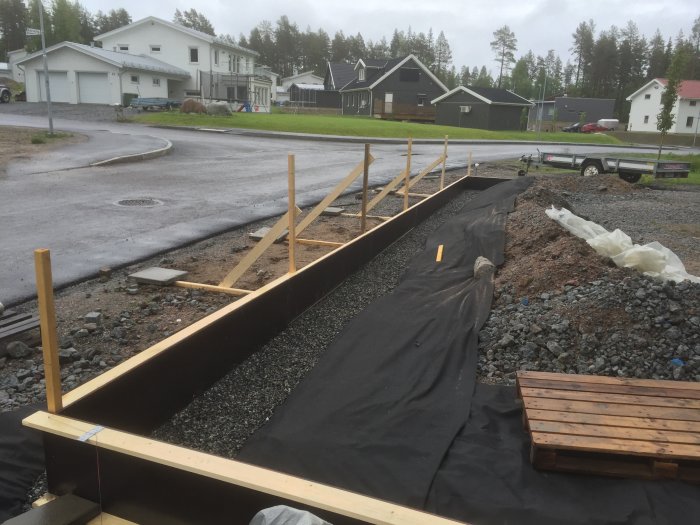
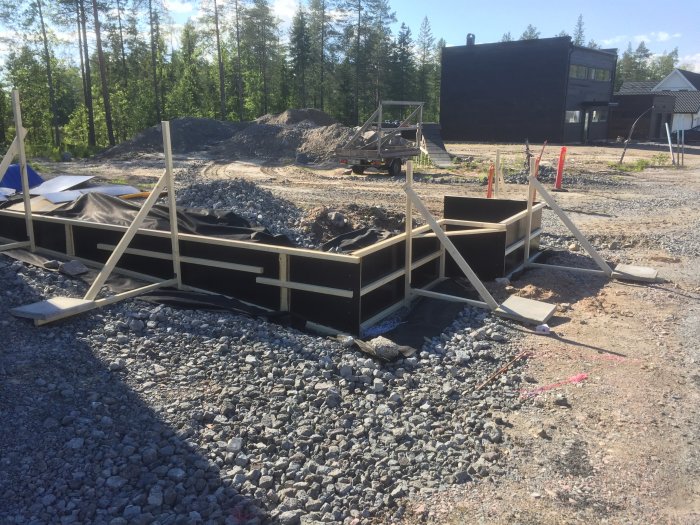
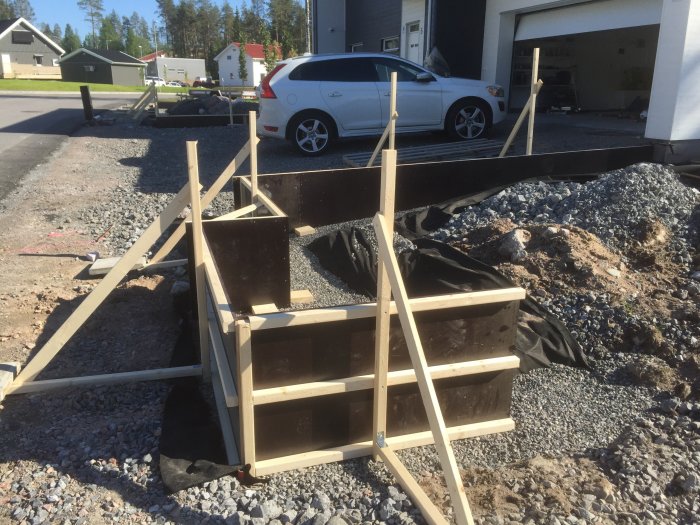
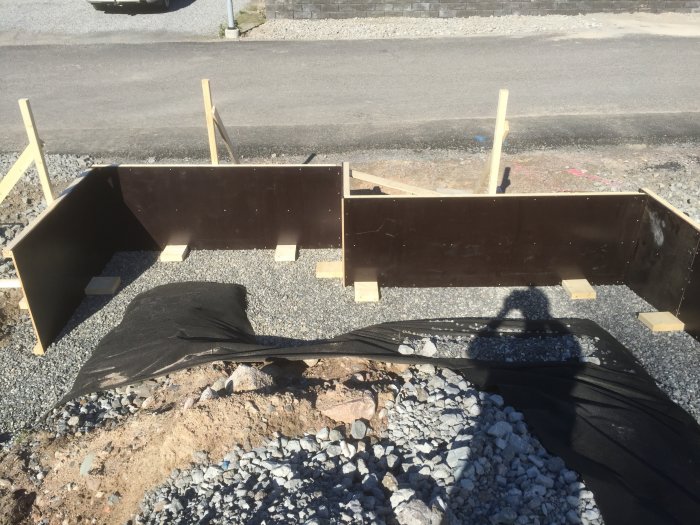
I've started to build a mold and am halfway through, the outer shell is ready, and I'm about to start on the inner shell. The outer shell is lined up as I want it with supports, etc.
I've placed blocks of 195 timbers here and there as spacers at the bottom. Then I thought I'd use 6x240mm wood screws along the bottom to hold the "walls" together at the bottom edge with c-c 500mm. Also at the top when the reinforcement is in place. The inner walls will also be form plywood with 2x2 timbers at the top and bottom and in the middle on the higher parts. The supports are only on one side with about c-c 2500mm or where I think it's needed.
The concrete wall will then be clad on the outside & on the top with slate slabs (10 mm thick).
Question: Will my mold break? And how do you think I should reinforce this? It's quite thick, you know. Front/back? Both? Dimensions of mesh/bar?
The concrete truck is coming next Friday, so I need to sort this out ASAP!
Really hope someone knowledgeable can give some tips here!
never cast in wood!!!
recommend form ties.
otherwise, preferably 45*70 and not 45*45 (but it can work if you're not working over with a vibrator.
it would have been nice if you had a foot on the wall. even if it doesn't get very high, there's a lot of pressure.
never cast in wood!!!
I recommend form ties.
Otherwise, preferably 45*70 and not 45*45 (though it can work if not overworking with vibrator.
It would have been good if you had a footing on the wall. Even if it doesn't get very high, there's a lot of pressure.
Thank you!
I received advice to skip the footing from those who sold the slate, and that was with a planned 95mm thick wall :/ Now it will be 200mm.
Since it will be clad, I didn't plan to vibrate too much, it doesn't matter how it looks, you know.
How close should I place the ties in that case? I thought the through wood screw would work as a form tie.
The higher part also has many angles. About 2m between the angles, so it should help hold back the earth too?
When forming, it's better to be really sure that it holds... I'm using 45x95. Here's a picture showing how close you need to brace, you might be able to set them a bit further apart since your wall isn't quite as wide;
You can use threaded rod as an alternative to form ties. The undersigned tightwad uses heavy steel wire (which I thread double through the form and lock with a nail on both sides, then twist the wire until it's tight and you have the right distance.
that was really advanced.
1000mm when you do it so low. and small.
and then one in each inner and outer corner.
will be a lot of life in your wall.
I would have placed three tens at the top and bottom
Nice to hear! I curled up in the fetal position when I saw how close the stays were above.
Probably need to double up on the stays, in other words.
So you don't think using long wood screws as stays is a good idea?
At what heights are you thinking for stays, if so?
No mat against possible cracking?
PS. Do you mean cc 1000 for the formwork or the supports? Maybe it's just as well to put threaded rod through the supports, top and bottom. Not just in the plywood?
You must also ensure that your form is securely anchored in the ground so it doesn't move away from the house when you start pouring in the concrete....
Reinforcement steel should be at least 50 mm from the finished surface. Use 12mm diameter.
You bend squares to suitable heights that you place out with c-c 150 mm
Use 10-12mm reinforcement steel, double rows and about 150 mm apart (in height)
You connect the rows with reinforcing bars that you bend into U shapes and place alternately up and down (placed c-c 150 mm). Each joint you tie together.
The reinforcement construction must be anchored in the form so it does not float up.
Drill the longitudinal reinforcing bars into the house foundation and cast them with expansive concrete.
Backfill with draining material behind the wall 15-20 cm, e.g., macadam. Ground cloth between macadam and soil. If there is a risk of standing water behind the wall, you must drain at the bottom. Otherwise, there is a risk of frost heaving.
Make sure you have compacted the ground where your wall will stand properly.
Damn, I'm starting to strongly regret getting into this... I've already invested quite a bit in shape material and will have a hard time getting everything done you suggested before the car arrives :/
I only have vacation starting next week and will be away this weekend, and next Friday it arrives... anxiety Aren't there any shortcuts here? It's not like it's a house foundation or anything
Know I considered that earlier. Not free either. And most of the wall is under 40 cm so I thought it would be easy to cast :/ Now we've spent all the money on nearly 100sqm driveable slate and slate for the wall cladding, so unfortunately there won't be any L-supports
Damn, I'm starting to seriously regret getting into this... already sunk quite a bit into form materials and it's going to be hard to get everything done that you all suggest before the car arrives :/
I have vacation starting next week and I'll be away this weekend, and it arrives next Friday... anxiety Are there no shortcuts here? It's not like it's a house foundation
//L
unfortunately. if the concrete sets, you'll have a wall that looks awful.
if you work from 7 to 4, you'll have a nice form done in 2 days at most. on the third day, you'll be placing the rebar.
Vi vill skicka notiser för ämnen du bevakar och händelser som berör dig.



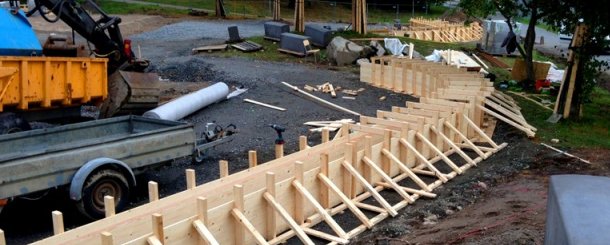

 Damn, that's a lot of timber that's going to be needed :/