The advice given varies a lot, and most seem to say that you should frame with steel studs and then drywall (and possibly OSB boards) on the steel studs, and it's done.
I have never given that advice without emphasizing the importance of ensuring ventilation gaps at the floor and ceiling so that air exchange can occur. In some threads, I've been criticized for this because then you let in humid "basement air" into the room, which creates an unpleasant atmosphere.
The problem without ventilation in the wall is that you trap moisture, and with a heated room outside the drywall and a colder wall behind, the moisture will cling to the drywall/OSB board like butter on bread.
I've had a problematic lightweight concrete wall in the basement that I've replastered twice. When we moved into the house, it was wallpapered with water damage and visible "bulges" where the plaster had come off.
I removed everything, knocked off the plaster, replastered and painted with diffusion-open paint, but after a few months, cracks started to appear again.
I then realized that the drainage wasn't working and dug up the entire exterior, and sure enough, a seam in the Platon mat had come loose, leaving the wall open to the ground.
I fixed it with isodrän on the outside, knocked off loose plaster, replastered, and painted again with diffusion-open paint.
Since it was dry and fine and there were no problems, we hung some cabinets with metal tracks as spacers on the wall.
After this lovely (but slightly rainy) summer, we noticed a musty smell in the room, and when I started examining, I saw that the paint had yellowed near the floor and there were small cracks in the plaster again.
I took off the cabinets from the metal track and found the source of the smell, the back of the board was covered with green mold, despite the cabinets being hung about 20 mm from the wall with an air gap between, open both upwards and downwards.
I've now removed everything, and I also had a small inquiry into the wall's condition when I unscrewed the tracks:
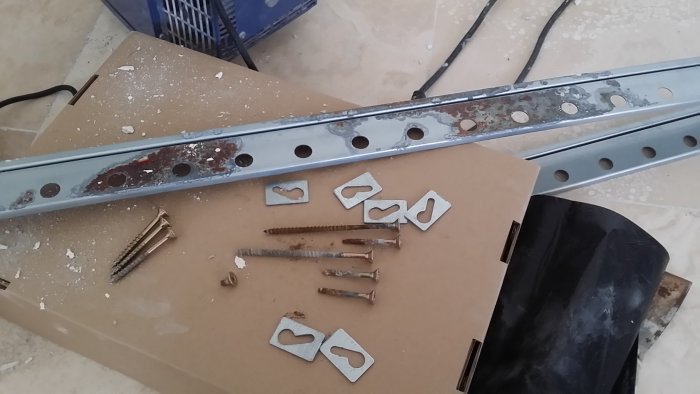
The screws have completely rusted away, and on the back of the metal track, there are clear signs of significant moisture. This despite the wall looking completely fine and showing no signs of moisture.
This naturally led me to suspect that the drainage wasn't working, so I dug up the exterior again. Already in the gravel, I saw it was rather dry, and behind the isodrän panels, there wasn't much moisture either, so the drainage evidently works.
After consulting a retired builder, we can only suspect that the wall is absorbing water through small cracks in the facade plaster/paint or other cracks/openings present in the exterior wall where water runs down when it rains. We didn't find any obvious deficiency in the facade or drainage, so precisely where the water comes in is not the easiest to determine, nor is knowing how long the wall has been "absorbing" water...
There are no drains or water pipes in or outside the wall that could leak, nor on the floor above.
To fix this now, I will knock off all the plaster and build a wall on steel studs with mechanical exhaust on the exterior of the facade, a´la Nivell.
That is the only way to "really" be sure that moisture won't come in!
I will never again recommend placing boards without mechanical ventilation on a basement or hillside wall!
You can put platon on the wall like this: [link]
and of course ventilate.
Yes, it works, but since the wall is already "sealed" on the outside, I don't want to risk trapping moisture, so I prefer a larger open area that can "breathe" properly and a larger amount of air that can be ventilated out. The same principle that Nivell uses. The amount of air behind a Platon sheet becomes very limited and harder to create movement, which risks areas that are not ventilated so well... The advantage is of course that there is less risk of moisture coming through to the wall, but since I strive to keep the wall dry by "blow-drying" it, I prefer the more open solution...
Click here to reply
Vi vill skicka notiser för ämnen du bevakar och händelser som berör dig.