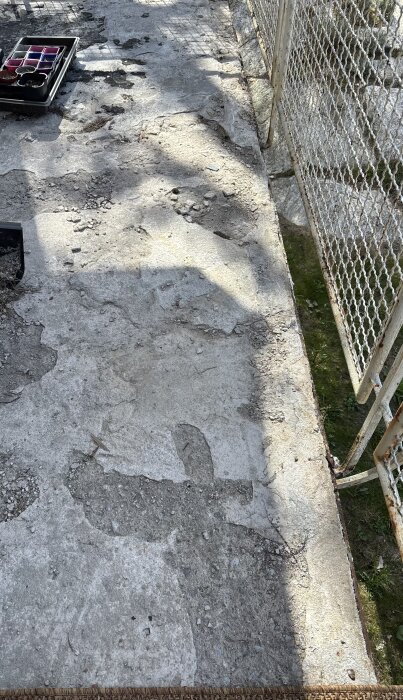
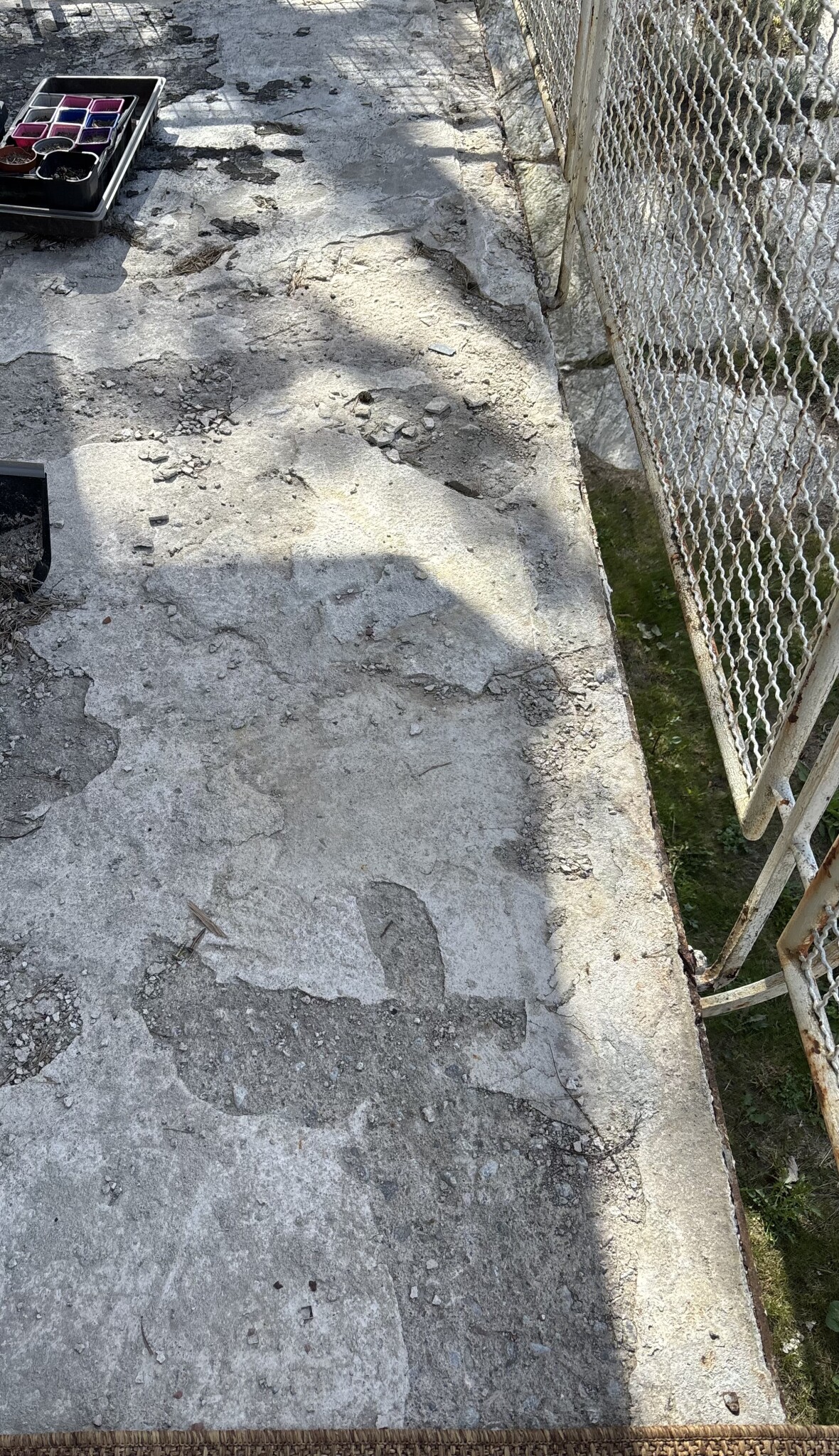
Hello! Need help with what to cast on an old balcony, about 7-8 sqm.
I need to cast a slab with a slope for drainage, between 1 and 5 cm thick. After casting, I will lay asphalt paper and on that, a deck that lies loosely. I am an "experienced amateur" when it comes to concrete and the like, but I need to know which specific product or type of material has the best chance of adhering well. For example, is primer needed, and if so, which one? Is it possible to cast regular concrete that thin? Or should one use some leveling compound?
Or is there a completely different method to achieve the same result?
Regarding frost spalling and cracking, it's okay if it doesn't turn out perfect, as long as the water drains off and doesn't press against the house.
Grateful for helpful answers
Then you must remove loose and cracked concrete, laitance, paint, and whatever else it might be. Carbonated concrete should be removed. Not a fun job. Consider a concrete grinder or small jackhammer and patience.
Then choose a ready-made repair system available on the market. Example, Weber REP 25 repair mortar.
The procedure is described in the product system's manual:
1. Reinforcement steel and other embedded items are
cleaned mechanically of concrete residues and rust
through wire brushing or sandblasting.
2. Adjacent concrete surfaces must not have cracks,
dirt, or poor concrete. The removal should be done
carefully to avoid creating new damages. The edges
between the repair area and the undamaged surface
should not be sloping. Joints should be made
perpendicular.
3. Grouting with the slurry product Weber Betoheft (see
product sheet) is done at a thickness of 2-3mm. The
substrate must be damp but still absorbent. Grouting is
performed with a brush so that both the reinforcement
steel and concrete surfaces are completely covered.
1. REP 25 is applied when the Betoheft grouting has
stiffened but not dried, almost wet-on-wet. REP 25 is
applied with suitable tools (trowel or similar) and built
up to the desired thickness. For thicker repairs, the
next layer is applied no earlier than when the first one has
stiffened. On horizontal surfaces, REP 25 can be used at
thickness up to about 50mm. Prevent rapid drying.
Cure by spraying with water for at least 7 days or cover
with plastic. Thereafter, the surfaces should be treated
with Weber Krympspärr to reduce the risk of cracks.
2. After the completion of the repair with REP 25, the
entire surface can be slurry coated with 2-3mm Betoheft
to achieve a uniform structure. It is applied with a
spray, spatula, brush, or soft brush. Pre-moisten REP 25
before slurry coating. Betoheft gives a "carbonation-inhibiting",
smooth and pore-free surface, which is suitable for
painting if desired.